Allergic Rhinitis as a Driver of Pediatric Mouth Breathing
Nasal obstruction from allergies forces mouth breathing that reshapes growing faces.

Allergic rhinitis in children is a chronic inflammatory condition of the upper airway mucosa, triggered when the immune system overreacts to inhaled allergens, and its most consequential symptom is nasal obstruction, not the sneezing or the itchy eyes. A 2025 Frontiers review describes this obstruction, along with the mouth breathing it forces, as a "core factor" behind a chain of downstream changes. That framing matters because it places obstruction at the start of the chain, not somewhere in the middle of it.
When the nasal passage narrows, the nose stops doing its job. Under normal conditions, the nose filters particles, warms and humidifies incoming air, and regulates airflow before it reaches the lungs. Once congestion forces a child to breathe through the mouth, all three functions are bypassed, partially or completely. The air arriving in the lungs is drier, less filtered, and less regulated than it should be.
The triggers behind this obstruction split into two categories, and which one applies changes the shape of the problem. Perennial allergens, dust mites, pet dander, indoor mold, produce year-round exposure and can keep the airway obstructed continuously. Seasonal allergens, tree pollen, grass pollen, weed pollen, produce obstruction in waves tied to the calendar. Dust mite and indoor allergen sensitization can begin before age two. The obstruction, and the mouth breathing that follows it, can take hold before a child's skeleton has done most of its growing. That timing detail is not incidental. It sets up everything that follows.
The mechanical cascade: how a blocked nose reshapes the face
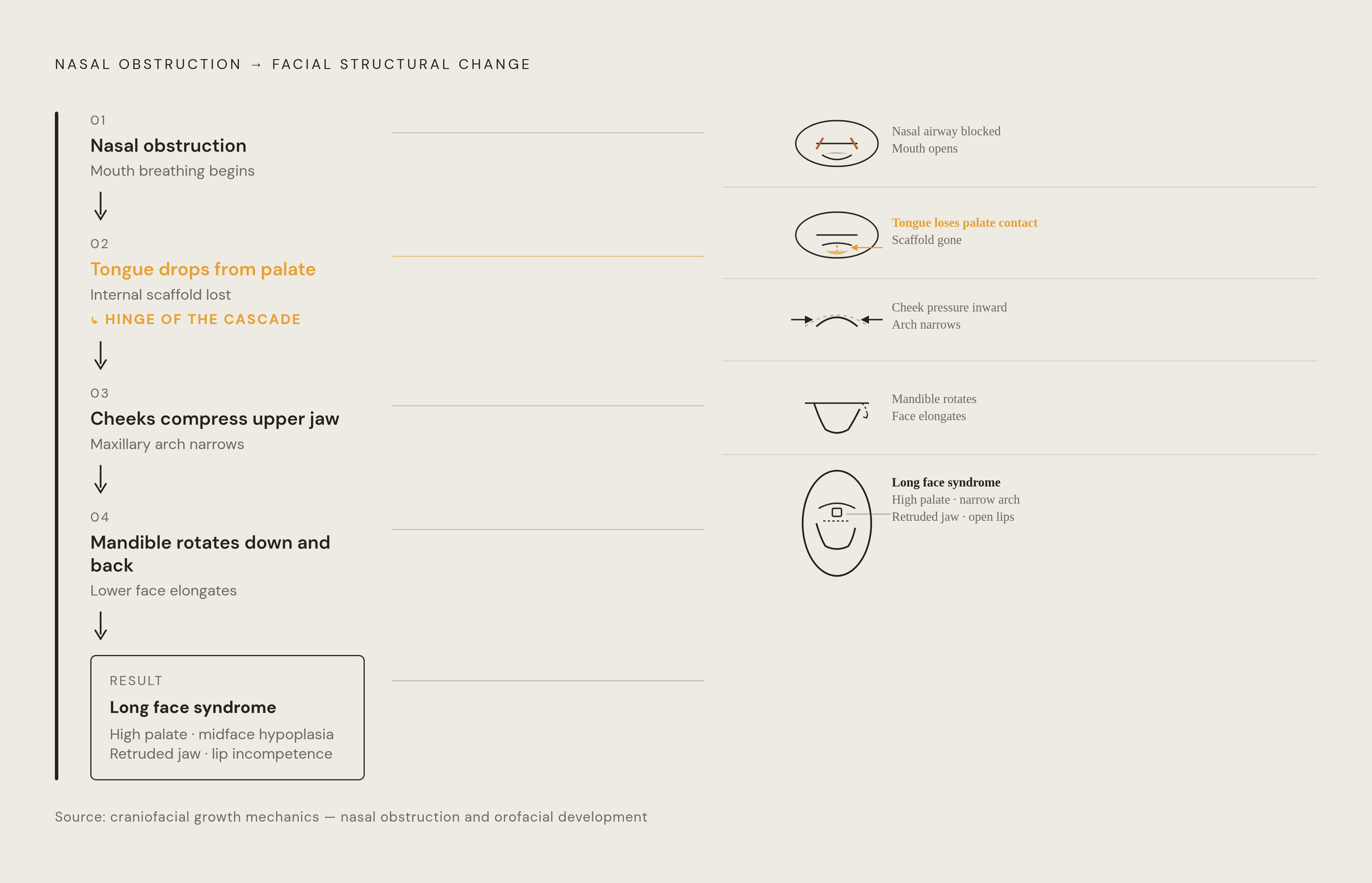
Once a child shifts to breathing through the mouth, the muscles and soft tissue that shape the face start working under a different set of forces, and the face responds accordingly. The chain starts with the tongue. In a nose-breathing child, the tongue rests against the roof of the mouth, pressing lightly on the palate and acting as a kind of internal scaffold during growth. Mouth breathing drops the tongue down and back, out of contact with the palate. That internal pressure disappears.
Without the tongue holding the palate out, the cheek muscles take over the job unopposed. They compress the upper jaw inward. The cheek muscles narrow the maxillary arch and pull the palate into a tall, vaulted shape instead of a wide, flat one, a shape clinicians call a high-arched palate. At the same time, the mandible rotates downward and back, stretching the lower third of the face. The combination produces what's sometimes called "long face syndrome", alongside midface hypoplasia, a retruded lower jaw, protruding upper front teeth, and dental arches too narrow to hold the teeth in proper alignment.
None of this stays confined to the jaw. Children going through this cascade often develop dark under-eye circles from venous pooling (sometimes called allergic shiners), a skin fold under the eye known as a Dennie-Morgan line, a crease across the bridge of the nose from repeated upward rubbing (the so-called allergic salute), and lips that no longer close fully at rest. They are different surface markers of the same underlying mechanical process. Clinically, the whole pattern gets a name: "rhinitis face," sometimes "adenoid facies." Children with allergic rhinitis show mouth breathing, upper jaw compression, and lip incompetence at rates substantially higher than children without the condition. The size of that gap is what turns this from an interesting biological detail into a pediatric health question worth taking seriously.
When in childhood the cascade does the most damage
Bone responds to force differently depending on whether it is still growing or not, and that single fact determines how much damage mouth breathing does at any given age. The 2025 Frontiers review notes that the skeleton's ability to adapt to these altered forces drops off once growth stops. Before that point, bone is still being laid down and remodeled, so it bends to whatever forces act on it most consistently. After that point, the structure is largely set.
That makes early-to-mid childhood a period where the stakes run higher than they do later on. Between roughly ages five and twelve, the maxillary arch and midface are growing at their fastest, and mouth breathing during this window carries a well-documented link to Class II malocclusion, a bite pattern where the upper jaw sits noticeably ahead of the lower one. The same forces that would cause mild, slow drift in an adult skeleton cause active, compounding redirection in a growing one.
Picture a child who develops perennial allergic rhinitis from dust mites around age two. If that allergy goes undiagnosed through elementary school, the mouth breathing it causes runs continuously through exactly the years when the face is doing the most structural work. By the time anyone identifies the allergy as the cause, years of remodeling may already be built into the child's adult facial architecture. Why does timing matter this much? The growth window is a biological deadline, and once it passes, the opportunity to redirect development passes with it. How many of the structural signs clinicians see in older children and teenagers trace back to an allergy that went unaddressed years earlier?
Allergy-driven fatigue and brain fog: the sleep pathway from nasal obstruction
The same obstruction reshaping a child's face is also disrupting sleep, and that disruption carries its own separate cost to attention, mood, and thinking clearly. Children with moderate to severe persistent allergic rhinitis show a higher rate of sleep disorders than children without it, even when they're receiving regular treatment. Nocturnal breathing problems and daytime sleepiness stand out as the most common features.
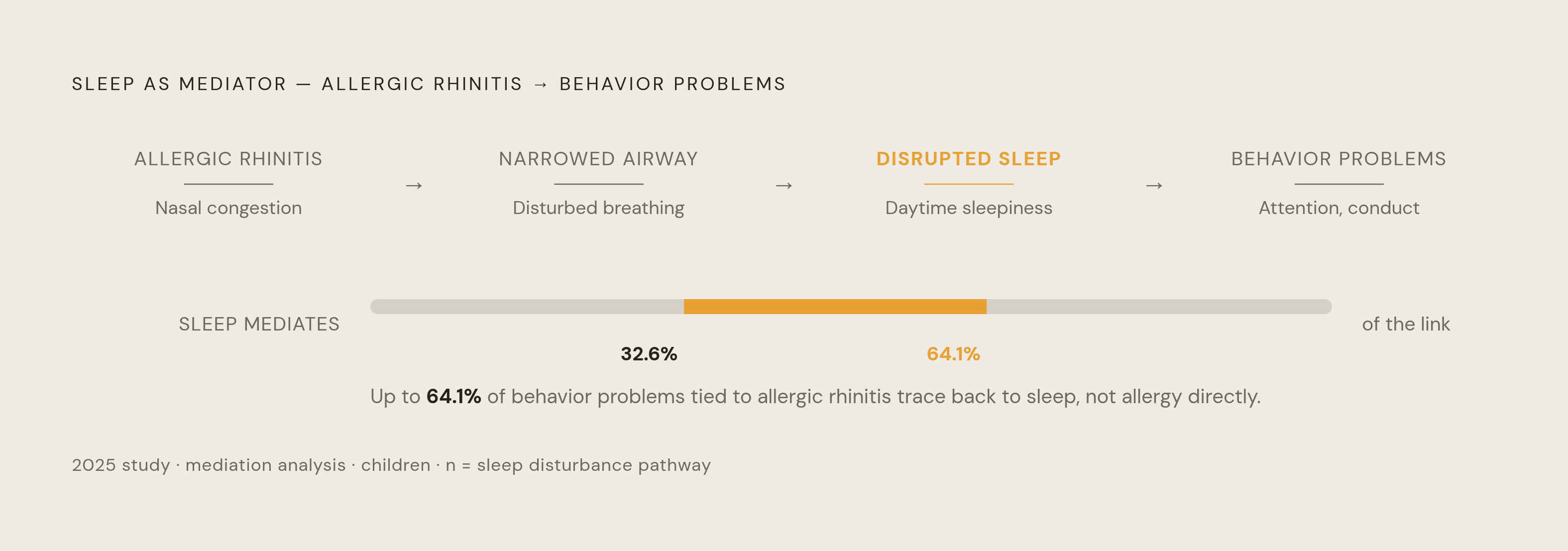
This is one of the main channels through which allergic rhinitis does its damage, not a side complaint running parallel to the structural story. A 2025 study found that sleep disturbance accounted for between 32.6% and 64.1% of the link between allergic rhinitis and behavior problems in children, with daytime sleepiness and sleep-disordered breathing doing most of that work. In practical terms: a large share of the attention and behavior issues tied to allergic rhinitis trace back not to the allergy symptoms themselves, but to the poor sleep those symptoms cause.
What causes brain fog and exhaustion in children (and adults) that often gets missed? A narrowed airway disrupts sleep night after night, producing fatigue and poor concentration during the day that can seem to come from nowhere. The same narrowed airway that drives the facial changes described above, maxillary constriction, a retruded lower jaw, is working against nighttime breathing at the same time. A tighter airway makes sleep-disordered breathing worse. Worse sleep-disordered breathing degrades sleep quality. Degraded sleep quality produces slowed thinking and shorter attention the next day. The 2025 Frontiers review also lists effects on respiratory function, exercise tolerance, speech clarity, and general well-being as part of the same spread, which tells you this cascade reaches well past the skeleton. A parent watching for crooked teeth might miss the signs that appear first: a child who can't focus in class, who seems tired no matter how many hours they sleep, or who struggles with schoolwork that used to come easily.
Why symptom-masking medications cannot stop the cascade
Antihistamines and nasal sprays have a real, legitimate role in managing allergic rhinitis day to day. What they cannot do is stop the structural chain reaction described above, and the reason comes down to where each type of treatment acts. Antihistamines block the histamine response, cutting down on sneezing, itching, and watery eyes for as long as the drug is active in the body. The immune system keeps responding to the allergen the same way as before. Once the medication wears off, the inflammatory response, and the obstruction it causes, comes right back.
Nasal corticosteroid sprays work differently: they reduce inflammation directly in the nasal tissue, which helps more than an antihistamine does for congestion specifically. But they come with their own limits, including nosebleeds and local irritation, and they don't touch the underlying sensitization either. Decongestant sprays are even more limited: used for more than three days, they risk rebound congestion that can leave a child more obstructed than before they started.
A child managed on antihistamines and a nasal spray alone can still cycle through obstruction and mouth breathing for years, right through the growth window where the damage compounds. The medications control the symptom, while the mechanical cascade driving facial change and sleep disruption keeps running beneath them. And this is not a fringe problem: an estimated 90% of allergic rhinitis patients are untreated, undertreated, or treated with the wrong approach for what's actually driving their symptoms. That means the cascade described in this piece is running unchecked in a large share of children who have allergic rhinitis right now.
How allergen immunotherapy interrupts the cascade at its source
Allergen immunotherapy is the one treatment category documented to produce lasting change in the immune response that drives allergic rhinitis, rather than just suppressing its symptoms for a few hours at a time. Because it acts on the sensitization itself, it works at the point where the cascade starts, not somewhere downstream of it.
The mechanism is straightforward: a child receives gradually increasing doses of the allergen they're sensitized to, either as drops under the tongue (sublingual immunotherapy, or SLIT) or as injections (subcutaneous immunotherapy, or SCIT). Over months, the immune system's sensitivity drops and tolerance builds, reducing the inflammatory response that was narrowing the airway. A systematic review of randomized trials found that both SLIT and SCIT reduced allergic rhinitis symptoms and medication use compared with controls in children, so the evidence holds for immunotherapy as a category, not for one delivery method over the other.
Each method has its own practical profile, and the honest comparison helps families weigh them. SCIT has shown advantages in some head-to-head studies for certain outcomes, including asthma symptom reduction, but it carries a higher risk of systemic reactions, requiring in-office injections and a monitored observation period afterward. SLIT's safety profile in children is favorable: the most common side effect is mild itching or tingling in the mouth, and it typically fades within one to two weeks. SLIT can also be given at home after the first dose is supervised, which removes the weekly in-office visit that SCIT requires. For a family juggling school schedules and work, that difference in logistics often decides whether treatment continues long enough to work.
That continuation matters more than it might seem. Data from a clinical study on SLIT show that treatment lasting more than twelve months is linked to meaningfully better long-term asthma outcomes. The benefit builds with time on treatment, not just with starting it. Immunotherapy also carries a preventive angle beyond symptom control: it may lower the risk of allergic rhinitis progressing to asthma and may help prevent new sensitizations from developing, a benefit that counts for more the earlier in childhood treatment begins.
A practical path to treatment for families today
Catching this cascade early starts with recognizing what the signs actually point to. Nasal obstruction, a child who breathes through an open mouth, complaints about poor sleep, trouble paying attention at school: taken together, these point toward an allergic driver upstream, not a dental problem or a behavior issue in isolation. Parents and clinicians who treat these signs as separate issues risk missing the thread connecting them.
Clinical evaluation of rhinitis-driven facial change typically involves a medical history, a physical exam, and further testing: checking how open the nasal airway actually is, imaging to assess facial structure, and identifying which specific allergens are involved. That last step, pinning down the allergen, is often the hardest part for families to access, since it traditionally meant an in-office skin prick test. At-home testing has changed that. Services like Wyndly now offer lab-certified finger-prick blood tests covering a broad panel of environmental allergens, coordinated through telehealth and interpreted by a physician. A parent who suspects dust mites or pet dander as the culprit can get an answer without scheduling an in-office visit first.
Identifying the specific trigger, whether it's a perennial source like dust mites or a seasonal one like grass pollen, is the step that makes everything after it possible. Once the allergen is known, the full SLIT pathway, from consultation through treatment plan to drops shipped to the house, can be coordinated by telehealth. That matters most for families whose location or schedule makes weekly allergy shots at a clinic unworkable. Wyndly runs this model end to end: virtual consultations, at-home testing, and doctor-guided sublingual immunotherapy plans with the drops delivered to the door. Therapy starts at $99 a month with a $49.99 initial consult, and the cost qualifies for FSA and HSA spending, so families can pay for physician-prescribed treatment with pre-tax dollars.
None of this replaces the full scope of care some children will need. The 2025 Frontiers review lays out a multidisciplinary approach: treat the nasal pathology first, then address any mouth-breathing habits that have taken hold, and bring in orthodontic or maxillofacial treatment where structural change has already set in. Immunotherapy is the foundation of that sequence, not a substitute for it. A child with years of untreated obstruction behind them may still need orthodontic work to correct an arch that's already narrowed. But that work succeeds a lot more reliably once the allergic obstruction driving it has actually stopped, rather than fighting an ongoing force the whole way through.
The growth window at the center of this entire cascade does not wait. Skeletal change slows once growth stops, sleep and attention problems compound the longer they run unaddressed, and symptom-masking medication leaves the underlying immune response untouched the entire time. Addressing the allergic trigger directly, during the years when a child's face, sleep, and attention are all still being shaped, is the one step documented to interrupt the chain instead of just quieting it for a few hours at a time.
Sources
- Frontiers
- Clinical features, pathophysiological mechanisms, and multidisciplinary management strategies for rhinitis-induced adenoid facies in children and adolescents: a review
- Masticatory Changes in Oral Breath Secondary to Allergic Rhinitis: Integrative Review - PMC
- Correlation between Malocclusion and Allergic Rhinitis in Pediatric Patients: A Systematic Review
- Efficacy and Safety of Sublingual and Subcutaneous Immunotherapy in Children with Allergic Rhinitis: A Systematic Review of Randomized Trials Including Direct and Indirect Comparisons - PubMed
- Oral Breathing Effects on Malocclusions and Mandibular Posture: Complex Consequences on Dentofacial Development in Pediatric Orthodontics - PMC
- Full article: Allergic rhinitis and behaviour problems in urban children aged 6 to 12 years and the mediating role of sleep disturbance