Where Dust Mites Actually Live in Your Bedroom
Mattresses and pillows harbor most bedroom dust mites, which thrive in body heat and moisture.
4 out of 5 American beds carry detectable dust mite allergen, and in nearly half of homes, the levels are high enough to raise the odds of developing an allergic reaction, the American Lung Association reports. That statistic is the whole reason this piece exists. Dust mites don't spread evenly through a house. They cluster in a predictable set of bedroom surfaces, ranked by warmth, moisture, and food supply, and understanding that order explains why washing the sheets once in a while never quite solves the problem.
Why the bedroom, specifically, and not the kitchen or the living room? Start with the math: people spend roughly a third of their lives in bed. Allergens don't stay airborne for long. They settle into fabric and dust, which means exposure concentrates wherever skin touches fabric the longest, night after night. Sleep is the primary window for dust mite allergen exposure, which makes sense once you think about what a bed actually is: eight hours of body heat, moisture, and shed skin, delivered to the same three or four surfaces on a loop.
There's a silver lining buried in that fact, though. Unlike a classroom or an office, a bedroom is one of the few environments a person fully controls. No landlord, no shared climate-control committee, no shared air handler. A bedroom is one of the few environments a person fully controls, which makes this worth mapping out room by room, not as a horror story, but as a solvable, mechanical problem. Once you know what dust mites need to survive, you can predict exactly where they'll show up, and that's where this starts.
What dust mites are, what they need, and why ordinary cleaning misses them
Dust mites are small. A quarter to a third of a millimeter, eight-legged, spider-like under a microscope and functionally invisible without one. The two species common in homes across one country. University of Kentucky Entomology identifies the two species common in homes as Dermatophagoides farinae and Dermatophagoides pteronyssinus. Neither bites. Neither stings. What they do is reproduce, steadily and quietly, in whatever fabric happens to be warm and damp enough.
A single mite can live up to 70 days, laying around 20 eggs every 21 days. Under good conditions, a population can double roughly every three weeks. Do that math forward a few months and a handful of founding mites becomes a colony numbering in the hundreds of thousands. That's not an exaggeration; it's just compounding.
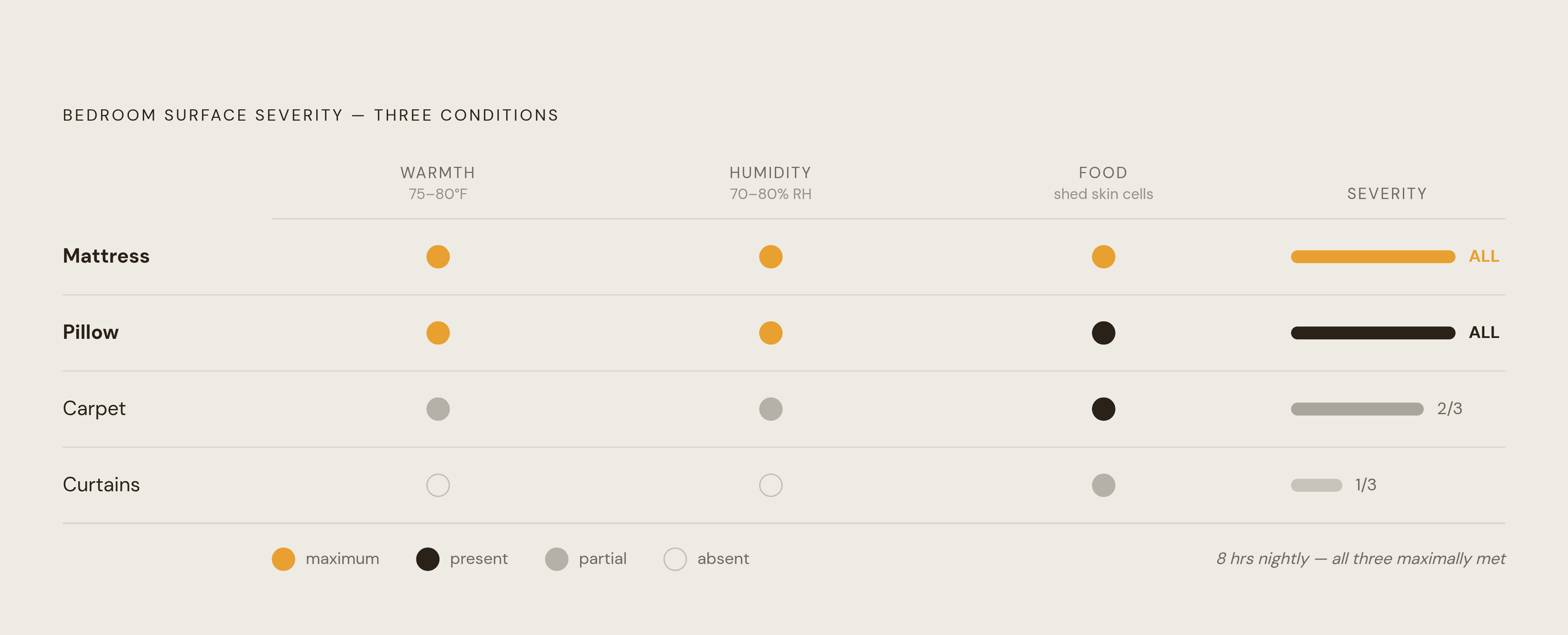
Three conditions make a surface hospitable, and these three become the lens for every hotspot that follows:
- Warmth. Mites do best between 75 and 80°F, which happens to be close to the surface temperature of a sleeping body.
- Humidity. Optimum relative humidity is 70 to 80%. University of Kentucky Entomology reports that mites require adequate humidity to survive and can't persist below 50% RH. True desert conditions are lethal to them.
- Food. Shed human skin cells. A person sheds around 1.5 grams of skin a day, which sounds trivial until you realize that's enough to feed a million dust mites for months.
Mites don't cause allergic reactions by biting. The trigger is protein, specifically the protein in their fecal pellets (each mite drops around 20 a day), their shed exoskeletons, and their decaying bodies after death. Proteins in the fecal matter are what the immune system reacts to. And because those droppings are small and light enough to become airborne, they get inhaled with a shifted pillow or a made bed.
So why doesn't regular cleaning fix this? Because mites don't sit on the surface where a vacuum or a wipe can reach them. They burrow into foam layers, mattress padding, spring structures, and dense carpet pile, well below where routine cleaning does any good, unless that vacuum happens to run a HEPA filter. Surface-level cleaning treats the top inch of a problem that lives three inches deep.
With the biology established, the question becomes where, exactly, in a bedroom these three conditions overlap most completely. That answer starts with the single largest reservoir in the room.
The mattress: why it supports the largest mite population in the bedroom
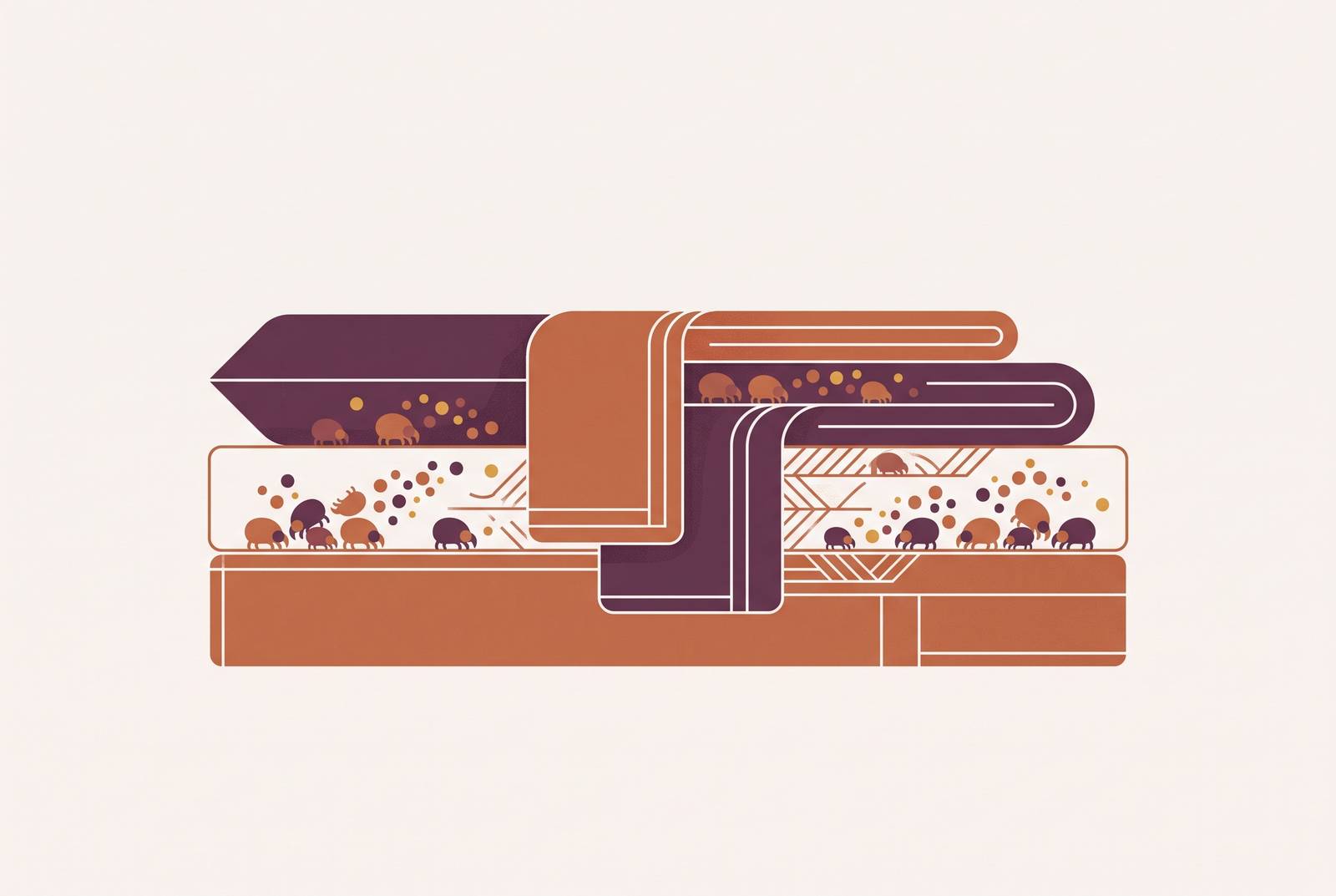
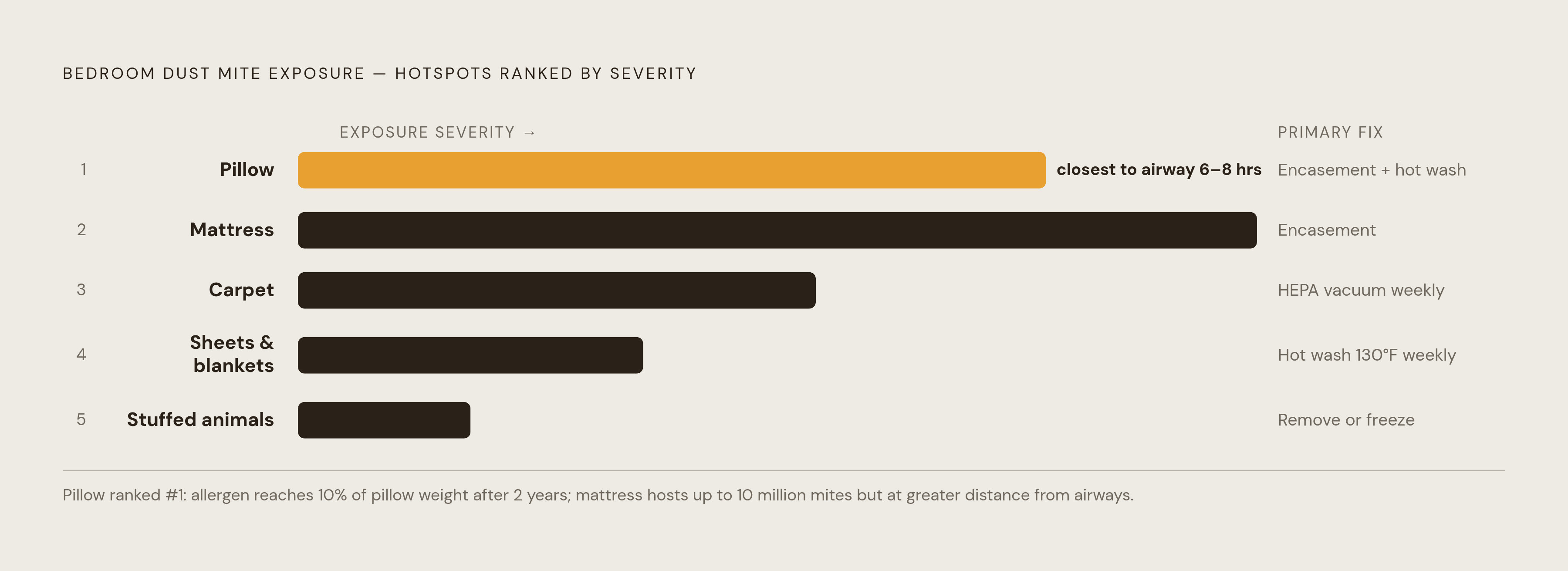
An average mattress holds somewhere between 100,000 and 10 million dust mites, depending on its age and the humidity of the room it sits in. Give it just two years without any kind of barrier and an unprotected mattress can carry more than 2 million.
Run the numbers on why: over eight hours of sleep, a body sheds something like 500 million skin cells, and much of that settles directly into the mattress surface. Body heat keeps the foam and padding layers at optimal mite temperature all night, every night. Perspiration adds the humidity. All three conditions, met simultaneously, for a third of every day.
Depth is what makes a mattress different from, say, a countertop. Mites don't stay on the quilted top layer, they work down into the foam, the padding, and the coil structure, which puts most of the colony out of reach of a vacuum cleaner entirely. Over the span of a decade, an unprotected mattress measurably gains weight, not from anything structural, but from the accumulated waste, shed skin, and dead mites layered into it year after year. The problem doesn't plateau. It compounds.
The most effective single intervention here is an allergen-impermeable mattress encasement, a cover engineered to physically block mite particles from crossing into the air a sleeper breathes. Dr. David Corry of Baylor College of Medicine said the cover "won't allow the very tiny mite particles to escape." That's a mechanical fix, not a cleaning routine, and it's worth treating that distinction seriously.
But the mattress isn't actually the closest hotspot to a sleeper's airway. That distinction belongs to something six inches away for six to eight hours a night.
Pillows: the hotspot closest to the airway
A research brief cited by one medical center found that after two years of normal use, pillows can carry dust mite allergen amounting to as much as 10% of their total weight, made up of dead mites and their droppings. Sit with that figure for a second. A tenth of a pillow's weight, not fabric or fill, but allergen residue.
The reason pillows earn top billing on this map isn't population size, it's proximity. Face and mouth contact runs six to eight uninterrupted hours a night, which puts the delivery distance for inhaled allergen at essentially zero. Breath and saliva add humidity directly into the fill. Head warmth keeps the whole thing at optimal mite temperature. And skin cells from the scalp and face concentrate here in a way they don't anywhere else in the room.
Switching to a "hypoallergenic" or foam pillow doesn't solve this. There's no strong evidence that foam pillows carry meaningfully less dust mite allergen than feather ones. The material of the fill matters less than what covers it.
What actually works is an allergen-proof zippered pillow cover, the kind designed to seal the fill away from skin contact entirely. Dr. Neeta Ogden, a spokesperson for the AAFA, suggests looking for products carrying AAFA certification where it's available, since that's a more reliable signal than marketing language like "hypoallergenic."
Sheets sit on top of both the mattress and the pillow, and they play a different role in this system entirely.
Sheets and blankets: the surface layer that accelerates colony growth
Sheets and blankets trap body warmth and moisture against the mattress and pillow beneath them, creating a small, contained microclimate where mite populations can double every three weeks under the right conditions. They're not where the colony lives permanently. They speed everything up.
That's the key distinction: sheets and blankets don't sustain a resident population the way a mattress does. They function more like a conveyor belt, ferrying allergen from the colony below to the nose and mouth above, every single night.
Temperature is what actually kills mites in the wash, and the threshold matters more than most people assume. Hot water wash is the effective kill approach, with sources pointing to temperatures of at least 130°F as the threshold. A cold cycle, or even a warm one, falls short of that mark and mostly just moves allergen around rather than eliminating it.
Frequency matters just as much as temperature. Weekly washing is the interval the evidence supports. Stretch that out to once a month and allergen levels climb back to problem territory well before the next wash. A bed made up tightly the moment someone gets up traps residual moisture and body heat inside the sheets, while leaving a bed unmade for even twenty minutes to air out gives that moisture somewhere to go. It's a small habit, but it works in the mite's favor or against it depending on which way it's done.
The bed, taken together, is the densest cluster of mite activity in a bedroom. But it isn't the only fabric in the room, and mites don't stay confined to it.
Carpets, curtains, and upholstered furniture: the room-wide reservoir that reseeds the bed
Carpet fiber holds up to 100,000 dust mites per square yard in deep pile, which turns ordinary movement through a bedroom into a low-grade exposure event. Walking across the floor, making the bed, even routine vacuuming, all of it kicks fecal particles into the air where they get inhaled. That's not a hypothetical, but how a settled allergen becomes an airborne one.
Hard flooring removes this reservoir outright. Where carpet stays, HEPA vacuuming is the primary defense, and it's a meaningfully effective one: one study published in the Journal of Environmental Monitoring found it can cut allergen levels by close to 81%.
Curtains carry a surprising amount of allergen too. Curtains accumulate allergen steadily over time, which is easy to overlook given how rarely they get washed compared to sheets. Even blinds aren't neutral: dust settles into their slats and becomes airborne every time they're adjusted, and cellular shades or Roman blinds, with their folded pleats, function almost like little nurseries for trapped dust. The simplest fix is removing drapery altogether, or swapping to something washable with a smooth surface.
Upholstered furniture rounds out the room-wide picture. Fabric headboards, bedroom chairs, ottomans, vanity benches, all of them offer the same deep-fiber habitat carpet does, just closer to the bed. Longer, denser fibers actually protect mites from vacuuming better than short pile does, which makes upholstered surfaces function as secondary colonies sitting right next to the sleep zone. Furniture with a smooth surface, leather, wood, metal, removes that habitat entirely.
What connects all three of these is disturbance. Every time one of these surfaces gets cleaned, sat on, or walked past, settled allergen gets knocked back into the air, right in the room where someone's about to spend the next eight hours. That's the room-wide reservoir working exactly as expected.
One group of bedroom occupants faces an additional hotspot that hasn't come up yet, and it's specific to how children sleep.
Stuffed animals and children's bedrooms: a compounding exposure problem
A stuffed animal that sits in a child's arms all night is, functionally, a miniature pillow. It absorbs skin cells, saliva, and moisture through direct, hours-long contact, and it does this quietly, toy after toy, without ever getting washed on the schedule a pillowcase does.
Scale that up. A child's collection of stuffed animals, spread across a bed and a shelf, can collectively harbor a substantial allergen load. That's not one hotspot, it's twenty small ones sitting in a pile.
The stakes here go beyond a stuffy nose. Sleep and Sinus Centers reports that dust mite allergens are a significant driver of asthma symptoms in children, with some estimates putting the figure as high as 85% among children already sensitized. And sensitization itself isn't fixed. Only around 30% of people currently react to dust mites, but Dr. Neeta Ogden of the AAFA notes that repeated exposure at high enough levels can eventually trigger sensitivity in someone who wasn't previously reactive. That reframes childhood bedroom exposure: it's not just a comfort issue in the moment, but a long-term risk factor being built one night at a time.
Management here follows the same logic as sheets. Washing stuffed animals weekly in hot water, at least 130°F, kills mites and rinses the allergen away. For toys that can't handle that kind of heat, freezing gets mentioned sometimes as an alternative, though it shouldn't be treated as an equivalent substitute for hot washing.
Children are especially vulnerable to the downstream effects of disrupted sleep. Children are especially vulnerable to the downstream effects of disrupted sleep, and restlessness, behavioral swings, and daytime fatigue that look like something else entirely can trace back to an allergic reaction nobody's diagnosed yet.
With the map of the room complete, the next issue is timing. Why does exposure that happens at night do more damage than the same exposure would during the day?
Why nighttime exposure hits harder than daytime exposure to the same allergens
Two things stack on top of each other at night, and neither one shows up during a normal waking day. First is duration: six to eight hours of continuous, uninterrupted contact with the highest-allergen surfaces in the house, far longer than any other single stretch of exposure a person experiences. Second is a drop in the body's own defenses. Cortisol, which helps keep allergic inflammation in check, falls during sleep, which means the body is more reactive to the exact same allergen load at 2 a.m. than it would be at 2 p.m.
That combination sets off a fairly predictable chain. Nasal tissue swells, congestion builds, and breathing shifts from the nose to the mouth. Mouth breathing fragments sleep, and swollen nasal passages restrict airflow further, which often shows up as snoring and a noticeable drop in deep sleep. Dr. Mariana Castells, of Harvard-affiliated Brigham and Women's Hospital, says: "Allergy symptoms can disrupt sleep and make people feel more tired and groggy."
That grogginess doesn't stay contained to the morning. Poor sleep driven by nighttime allergen exposure interferes with memory consolidation and concentration the next day, and most people chalk that up to work stress or getting older rather than tracing it back to what's happening in their own bed.
One more detail separates dust mite allergy from something like seasonal pollen: it doesn't take a season off. Because the bedroom environment doesn't shift with the calendar, symptoms can run 12 months a year. Chronic morning symptoms, sneezing, stuffiness, waking up groggy despite a full night's sleep, point straight at the bedroom, not bad luck or a coincidence.
None of this gets fixed by washing sheets once a month or running an air freshener through the room. So what actually moves the needle?
Humidity as the master variable: what reducing it accomplishes that cleaning alone cannot
Humidity is widely identified as a key factor in whether a home carries high dust mite levels, and the reason traces back to the biology covered earlier: mites pull moisture from the air, not from a water source. Control the air, and every hotspot in the house loses part of what it needs to sustain a colony.
There's a real-world example that makes this concrete. Researchers at Brigham Young University found just 25% of homes in one Utah county carried detectable dust mite allergen, compared with roughly 80% nationally, and almost every one of those Utah homes that did test positive came in well under the sensitization threshold. Dry air, in other words, did most of the work that scrubbing and washing couldn't.
What's the actual target? One research brief quotes an expert putting it this way: "The ideal is around 35%, but that's often unrealistic outside arid climates, if you can hit 45% to 50%, you're doing well." That's a useful, achievable number for most climates, and it lines up with the biology: University of Kentucky Entomology notes mites struggle to survive below 50% relative humidity.
That threshold is what makes humidity control different from every other fix in this piece. It's the only intervention that suppresses every hotspot at once, the mattress, the pillow, the carpet, the curtains, without requiring that each one be treated individually. Air conditioning and a dehumidifier are the two tools that do this work, and they act on the room itself rather than on any single object in it.
Lowering humidity is a floor, not a cure. It shrinks how large a colony can grow, but it doesn't erase the allergen that's already built up in a ten-year-old mattress or a carpet that's never seen a HEPA vacuum. Environmental control and physical barriers on individual hotspots aren't competing strategies, they're two halves of the same fix. One manages the air the mites need. The other blocks the particles already sitting in the fabric.
A hotspot-by-hotspot summary of what works
Put the whole map together and a pattern falls out. Every hotspot in a bedroom, ranked by severity, responds to one of two interventions: a physical barrier that blocks allergen from reaching the air, or an environmental change that denies mites the humidity they need to reproduce.
The mattress and pillow, the two hotspots with the highest concentration and the closest proximity to the airway, call for allergen-impermeable encasements, the kind of barrier Dr. David Corry describes as blocking even the smallest mite particles from escaping. Sheets, blankets, and stuffed animals respond to heat and frequency: a weekly wash at 120°F or above, not a monthly one at whatever temperature is convenient. Carpets, curtains, and upholstered furniture make up the room-wide reservoir, and here the fix leans on removal where practical (hard flooring, washable window coverings, smooth-surface furniture) and HEPA filtration where removal isn't an option.
Humidity is the one variable that touches every surface at once, underlying all of it. Getting a bedroom down to 45-50% relative humidity doesn't replace washing the sheets or encasing the mattress. It just means those other efforts stop fighting an uphill battle against air that's actively working against them.
None of this requires guesswork once the map is drawn. Dust mites don't hide, exactly. They just go wherever warmth, moisture, and skin cells overlap, and in a bedroom, that turns out to be a remarkably predictable set of places.