Indoor Mold Growth After Water Intrusion Events
Mold colonizes wet materials within 24 to 48 hours, before visible signs appear.
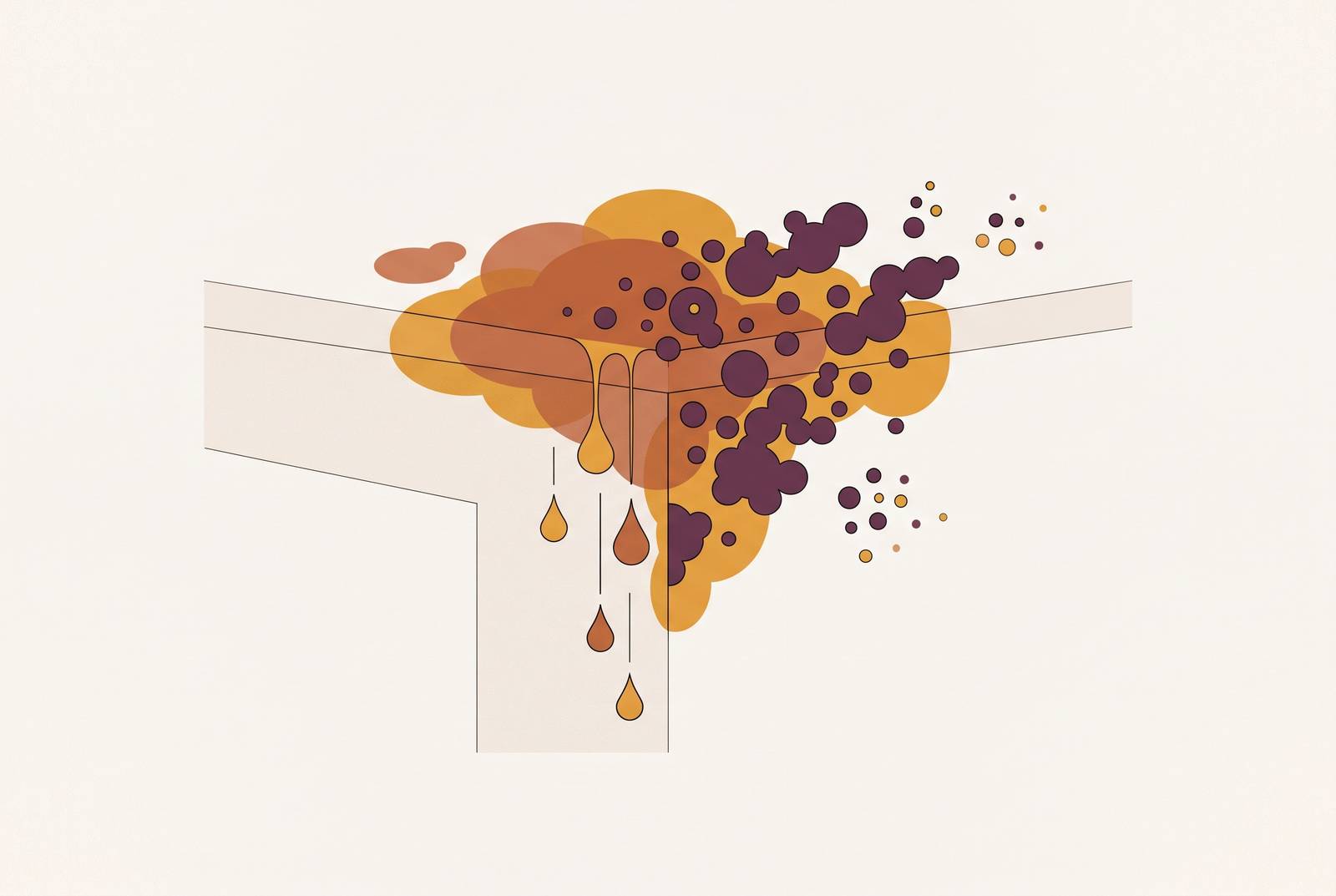
Water intrusion is the setup. Mold colonization is the consequence, and the gap between the two is measured in hours, not weeks. Most homeowners think the emergency ends when the water stops. Most homeowners think the emergency ends when the water stops, but it doesn't. If the water is dried within 24 to 48 hours after a pipe bursts or a roof leaks, the job stays a drying job; if not, it becomes a demolition project.
The biology that turns a wet wall into a mold colony
Mold is a fungus. A fungus doesn't grow the way a bacterium does, and it doesn't need what a plant needs. It reproduces through spores, and those spores are already in the air, inside the house, right now, at low background levels. A water intrusion event doesn't introduce mold to a building. It activates what's already there.
Four things drive fungal growth: food, moisture, warmth, and spores. Spores are a given. Warmth is a given, since most homes sit within the temperature range that happens to be the sweet spot for common indoor mold species. Food is a given too, if the building has drywall, wood framing, or cellulose insulation, because all three are organic material that mold happily consumes. So the moment a pipe bursts or a roof starts leaking, three of the four conditions are already satisfied. Moisture is the only variable left, and the water event supplies it.
The moisture threshold isn't about how wet something gets. It's about how long it stays wet. A stud that gets briefly damp and dries within a day poses far less risk than one that stays saturated for a week, even if the initial water volume was small. Even after standing water is gone, relative humidity inside a wall cavity or a closed room can stay high enough to keep feeding growth. The material doesn't need to be visibly wet anymore. It just needs the air around it to stay damp.
Different mold genera dominate depending on the conditions present. Cladosporium and Penicillium tend to move fast and show up early. Aspergillus follows a similar pattern. Stachybotrys chartarum, the species most people have heard of by reputation, actually moves slower. It needs cellulose material, like paper-backed drywall or cardboard, to stay saturated over an extended stretch of time. It's not the first colonizer. But when it does establish, it produces allergens and mycotoxins that pose serious health concerns.
Once a colony matures, it doesn't stay put. Opening a wall, running the HVAC system, or wiping a surface without containment can send spores airborne, seeding areas that were never touched by water in the first place.
The 24-to-48-hour window that determines whether mold takes hold
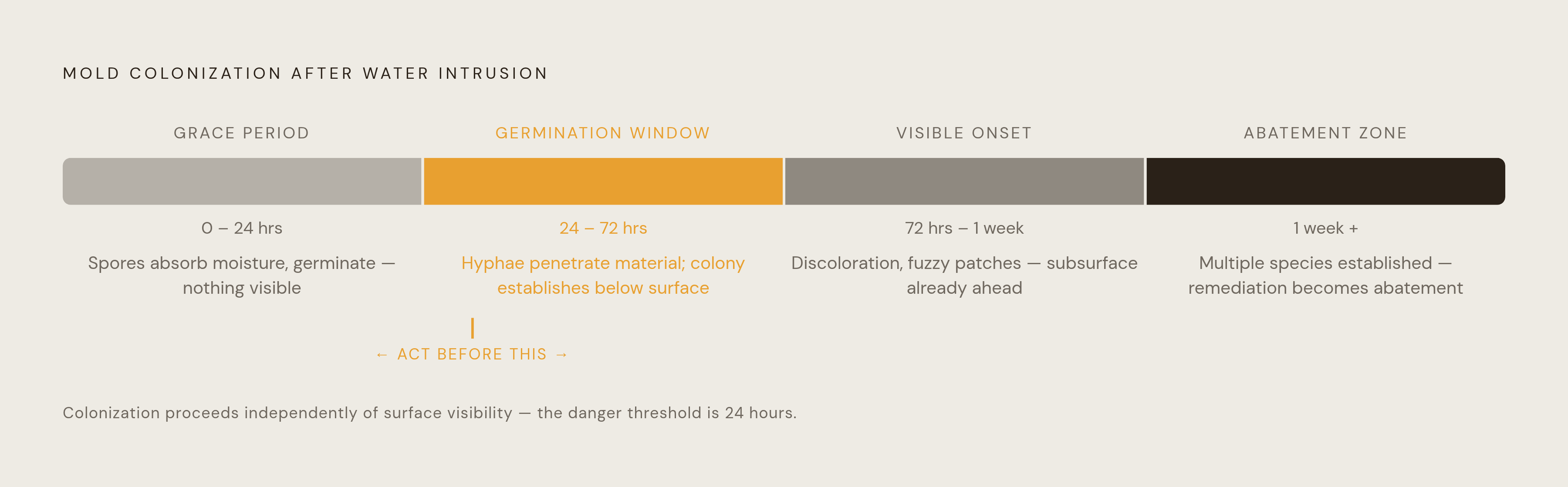
24 to 48 hours is the number that matters most in this entire subject. That's the window in which mold spores, sitting on a wet organic surface at typical indoor temperature, begin to germinate. Not visible growth. Germination. The biological clock starts ticking almost immediately.
Break the timeline down and the urgency gets clearer:
- 0 to 24 hours: spores on wet surfaces absorb moisture and begin germinating. Nothing is visible yet, but the process has already started.
- 24 to 72 hours: hyphal threads, the root-like structures fungi use to anchor and feed, start pushing into the material. The colony establishes itself beneath the surface before any staining or discoloration appears.
- 72 hours to one week: visible signs, discoloration, fuzzy patches, may appear on the wettest surfaces. But subsurface colonization inside wall cavities or beneath flooring is already ahead of what's visible.
- Beyond one week with moisture still present: multiple species take hold, colonies expand, and the job shifts from straightforward remediation to a more complicated abatement project.
Why does this catch so many people off guard? Because the visible cue, that first patch of discoloration, lags the actual biology by days. Someone mops up the water, runs a box fan for an afternoon, and feels like the crisis passed. Meanwhile, inside the wall cavity, colonization may already be a day or two ahead of anything the eye could catch.
Temperature plays a role too, but maybe not the role people expect. Cold slows fungal growth. It doesn't stop it. And a heated home in the middle of winter, with a slow leak behind a wall, actually offers close to ideal growing conditions. There's no seasonal off-switch here.
Where mold hides after a water event and why it keeps growing
Wall cavities are the classic hiding spot, and the mechanism is straightforward once you picture it. Water gets in from the top, whether that's a roof leak, a window frame, or a pipe running through the wall. Gravity pulls it down, and it pools at the bottom plate of the stud bay. That's a warm, dark, poorly ventilated pocket, usually packed with insulation. Close to ideal conditions for a colony to establish, and it's sitting behind a painted surface that looks completely fine.
Subfloors behave the same way. A flooded room or a leaking dishwasher soaks the plywood or OSB underneath the finished floor, and that layer stays wet long after the surface feels dry, because evaporation from below is blocked by the flooring on top. Basements and crawl spaces are worse still: constant humidity, poor airflow, and direct contact with soil make them the most mold-prone zones in most structures even without a fresh intrusion event.
HVAC systems deserve particular attention, because they don't just get damaged, they become a delivery mechanism. If ductwork or an air handler sits in a flooded space, or if a condensate line overflows and soaks the surrounding insulation, mold can take hold inside the system itself. Once that happens, every time the system runs, it's distributing spores through the building rather than just conditioning the air.
And under tile or vinyl flooring, the surface materials, grout, adhesive, are water-resistant, but what's underneath usually isn't. A slow leak behind a shower or beneath a dishwasher can feed mold invisibly for months before anyone notices a smell or a stain.
The compounding problem is the one people miss entirely: even after the visible water event is "resolved," the saturated materials keep releasing moisture into the air as they dry. That raises ambient humidity in the room, and elevated humidity alone, without any direct water contact, can sustain mold growth on surfaces nowhere near the original leak. In humid climates or buildings with weak ventilation, the structure itself becomes a moisture reservoir that can take weeks to dry down to a safe level. Colonization doesn't pause during that stretch. Colonization doesn't pause during that stretch; it continues.
Why visual inspection after water intrusion gives a false sense of security
Discoloration appears days after colonization actually begins. By the time a homeowner spots a stain on the ceiling or a dark patch near the baseboard, the fungus has already worked its way into the material's surface. The visible sign isn't an early warning. It's a lagging indicator.
The riskiest locations, wall interiors, subfloor cavities, crawl spaces, aren't visible at all without opening the material up. Surface dryness tells you almost nothing about moisture content deeper in the wall. A moisture meter might show elevated readings behind drywall that looks and feels bone dry to the touch.
Smell often arrives before sight. A musty, earthy odor is frequently the first sign a person can actually detect, and it can show up before any colony becomes visible, though not every species produces a strong smell. In a room that recently had a water event and now just smells "off" for no obvious reason, that pattern deserves attention.
Confusion muddies the picture further. Mineral deposits, or efflorescence, can look a lot like early mold. So can algae staining. And the reverse happens too: early-stage mold growth gets waved off as "just a water stain" because it hasn't developed the fuzzy texture people associate with mold.
Then there's the cleaning trap. Wiping a surface down with bleach or an antimicrobial spray kills spores sitting on top of the material. It does nothing for what's grown into the material itself. If moisture is still present at depth, that same spot can regrow within days to a few weeks, and the homeowner is left wondering why the "mold problem" keeps coming back after they already cleaned it.
Running fans and a dehumidifier in the visibly wet area feels like progress, and it is progress, but only for that area. If the wall cavity was never opened and dried, or if nobody actually measured moisture content in the framing, the job may look finished while the underlying material is still wet enough to feed a colony.
How professionals assess the extent of mold and moisture after intrusion
Moisture meters and thermal imaging cameras do the work eyes can't. A moisture meter reads the actual water content inside a wall or floor assembly without tearing anything open. Thermal cameras pick up temperature differences that often correspond to wet areas, since damp material behaves differently thermally than dry material. Neither requires demolition to get a real answer.
Air sampling measures spore concentration and species in the air, and it's compared against an outdoor baseline sample taken the same day. If the indoor-to-outdoor ratio is significantly elevated, that's one of the clearest signals that active growth is happening somewhere in the building, even if nobody can see it yet.
Surface sampling identifies which species are present on a suspicious surface. It's useful for figuring out what you're dealing with, but on its own it can't tell you how far the contamination has spread through the structure.
Bulk sampling goes a step further, involving physical material removed and sent to a lab. That's typically reserved for cases where subsurface colonization is suspected and the species profile actually changes how remediation gets planned.
The industry standard, broadly speaking, is that materials need to be dried down to an appropriate moisture content, based on the specific material and species involved, before anything gets closed back up. Sealing a wall over material that's still holding excess moisture can contribute to remediation failures down the line, as can an unresolved moisture source, a leak that was never actually fixed.
Clearance testing is the final check, and it matters because it's performed by a third party, not the company that did the remediation work. Without it, there is no independent confirmation that the work actually held. It compares post-remediation airborne spore levels against an outdoor or unaffected reference sample, and reconstruction should not proceed until that comparison confirms the remediation held. What none of this testing can tell anyone, though, is how a specific person will react to whatever exposure already happened. That depends on individual sensitization, and sensitization varies from one person to the next.
What mold exposure does to the respiratory system and immune response
Mold spores and fungal fragments are well-recognized airborne allergens found indoors. In a sensitized person, the immune system reads inhaled spores as a threat and mounts an IgE-mediated response, the same general mechanism behind seasonal pollen allergies or a reaction to pet dander.
Sensitization itself is a process that unfolds over repeated or prolonged exposure. The first exposure might produce no symptoms at all. Repeated or prolonged exposure inside a contaminated space, though, can shift the immune system into a state where later exposures trigger a full allergic response. That shift can happen gradually, over time, with continued exposure inside a water-damaged building.
The symptom list reads like any other allergy: sneezing, a runny or congested nose, postnasal drip, itchy or watery eyes, coughing, wheezing. None of it is unique to mold on its own, which is part of why it gets missed so often. Pollen allergies follow the seasons, but indoor mold, once it's established in a building, doesn't. Pollen allergies follow the seasons. Indoor mold, once it's established in a building, doesn't. Exposure can run year-round, so the symptoms never really get a break, because the allergen load never really drops.
For anyone with asthma, mold sensitization is a recognized trigger for flare-ups, and living in a building with both an active mold problem and an asthma diagnosis compounds the risk in a way that's hard to manage with medication alone. And it's not only about allergy. Even people who aren't formally sensitized can experience irritant effects, coughing and eye irritation, when spore or mycotoxin concentrations rise. Children and immunocompromised occupants face heightened risk, particularly in how severely they may react once exposed.
Why indoor mold symptoms are routinely mistaken for something else
Mold allergy symptoms look almost identical to dust mite allergy, pet dander allergy, or general perennial rhinitis. Without allergen-specific testing, there's genuinely no way to tell them apart just by symptom description. That overlap is the whole reason mold gets missed as often as it does.
Add the seasonal confusion on top of that. Someone dealing with congestion and fatigue year-round might just chalk it up to "always having allergies," or assume they're catching one cold after another, rather than connecting it to a persistent allergen source sitting inside their own home or office.
Mold-driven congestion pushes people into mouth breathing at night, and that leads to a chain of effects. Mold-driven congestion pushes people into mouth breathing at night. Mouth breathing fragments sleep. Fragmented sleep produces next-day fatigue and slower thinking. And that fatigue almost never gets traced back to a building problem. It gets blamed on stress, on aging, on "just not sleeping well lately."
Daily antihistamines complicate the picture further, not because they don't work, but because they work just well enough. Daily antihistamines produce enough symptom relief to make a contaminated building feel tolerable, while the underlying allergen exposure, and the sensitization it drives, keeps building.
One diagnostic clue stands out above the rest: symptoms that improve noticeably during a few days away from the building, on vacation or a work trip, and return within a day or two of coming back. That pattern points fairly directly at something specific to that indoor environment. It's also worth knowing that many people sensitized to mold are also sensitized to dust mites or pollen, and that combined load makes isolating mold as the specific culprit even harder without targeted allergen testing.
What remediation requires to stop the allergen load
Nothing in remediation matters if the water source itself isn't fixed first. Dry the materials, clean the surfaces, replace the drywall, and mold will simply come back if the roof still leaks or the pipe still drips. Source control comes before anything else on this list, not after.
Porous materials that are colonized all the way through can't be cleaned back to safe. Drywall, insulation, soft wood framing, once mold has worked into the material itself, need to be physically removed. Encapsulation products have a role in some situations, but they're not a substitute for removing material that's deeply colonized.
Containment matters during the removal process itself. Physical barriers and negative air pressure keep spore concentrations from spreading to adjacent rooms while a moldy wall is open. Skipping containment lets opening that wall distribute spores through the rest of the structure, undoing progress made elsewhere.
If the HVAC system was in the flooded area, or ran during the contamination period, duct cleaning and a coil inspection belong in the scope of work. Otherwise the system just redistributes spores after the surface-level work is finished, and the whole project circles back to where it started.
Drying standards apply before any reconstruction begins. Framing and substrate need to hit an acceptable moisture content, based on species and material, before new drywall goes up. Close the cavity too early, and the conditions for a new colony are already back in place behind the fresh paint.
Clearance testing, done by an independent party rather than the remediation company itself, confirms the work actually held. Skipping it and rebuilding anyway is a documented cause of remediation projects that fail, and of occupants whose symptoms never actually resolve after the "fix." For a serious intrusion event, multi-room flooding, an extended roof leak, proper drying and remediation before reconstruction usually takes weeks, not days. Anyone feeling rushed by a contractor to close the walls back up quickly should ask whether clearance testing happened yet.
When remediation alone is not enough: treating the immune system, not just the building
Fixing the building solves the exposure going forward. It doesn't automatically undo the sensitization that already happened inside a person's immune system. This changes what "recovery" actually looks like after a mold event.
Once someone is sensitized to mold, their immune system may keep reacting to mold spores encountered anywhere, not just in the building that caused the original sensitization. A clean clearance test on the house doesn't reset that biological response. The building issue and the immune system's response are related, but they're not the same thing, and fixing one doesn't finish the other.
That raises a fair question: what actually helps at that point? Allergen-specific testing can identify what a person's immune system reacts to, mold species included, and give a clearer picture of the sensitization itself rather than just guessing from symptoms. From there, management typically runs through medical channels, allergists and immunologists, rather than remediation contractors, because the target has shifted from the structure to the person living or working inside it.
None of this is a reason to skip proper remediation. It's a reason to treat remediation as the first phase of the problem, not the whole solution. The building can be clean, dry, and tested clear, and a sensitized occupant can still carry a reactive immune system that responds to mold exposure anywhere, indoors or out, for a long stretch of time afterward. Recognizing that distinction, building fixed versus immune system sensitized, is what separates a complete response to a water event from one that only ever addressed half the problem.
Sources
- Mold Growth Timeline: What Happens At 24, 48, And 72 Hours After Water Damage | Paul Davis Restoration Of Northwest Arkansas
- Understanding Indoor Mold Growth: Estimating Time of Mold Growth
- Mold After Water Damage: Timeline, Risks & What to Do
- Mold Growth After Water Damage: Restoration general timeframe
- Mold Growth After Water Damage - Resto Pros
- epa.gov
- uvm.edu
- ors.od.nih.gov