HEPA Vacuum Filtration for Dust Mite Allergen Removal
Sealed HEPA vacuums capture allergens standard models stir back into the air.
This article is about why dust mite allergens survive ordinary cleaning and what actually works to control them. A standard vacuum can make exposure worse by stirring allergens into the air, while a sealed HEPA system captures them instead. Understanding the physics behind that difference changes how, and why, someone should vacuum.
Why dust mite allergens behave differently from household dust
Dust mite allergen is a protein, carried on fecal matter and body fragments left behind by mites, and those fragments are heavier than typical airborne dust. Mites themselves aren't the allergen source directly. Their droppings and dead carcasses are the source, and the allergen load in a home can stay high long after the mite population itself has died off.
Because these particles are relatively heavy, they settle fast once something disturbs them. In a room nobody has touched in hours, very little mite allergen actually floats in the air. It's sitting in carpet fibers, mattresses, box springs, pillows, and upholstered furniture, the exact surfaces a vacuum is built to clean.
That settling pattern creates a trap. A room can look spotless and the air can feel clean, right up until something disturbs the dust sitting in the carpet or the couch cushions. Walking across a rug, plumping a pillow, or running a vacuum stirs it all back into the air a person is breathing. The dust sitting in the carpet or couch cushions produced no visible sign until something disturbed it. It was just waiting for movement.
How standard vacuuming disturbs settled allergens without capturing them
Ordinary vacuuming often fails to lower dust mite allergen levels in carpet. In practice, it tends to push more allergen particles into the air during and right after cleaning than were there before the vacuum started.
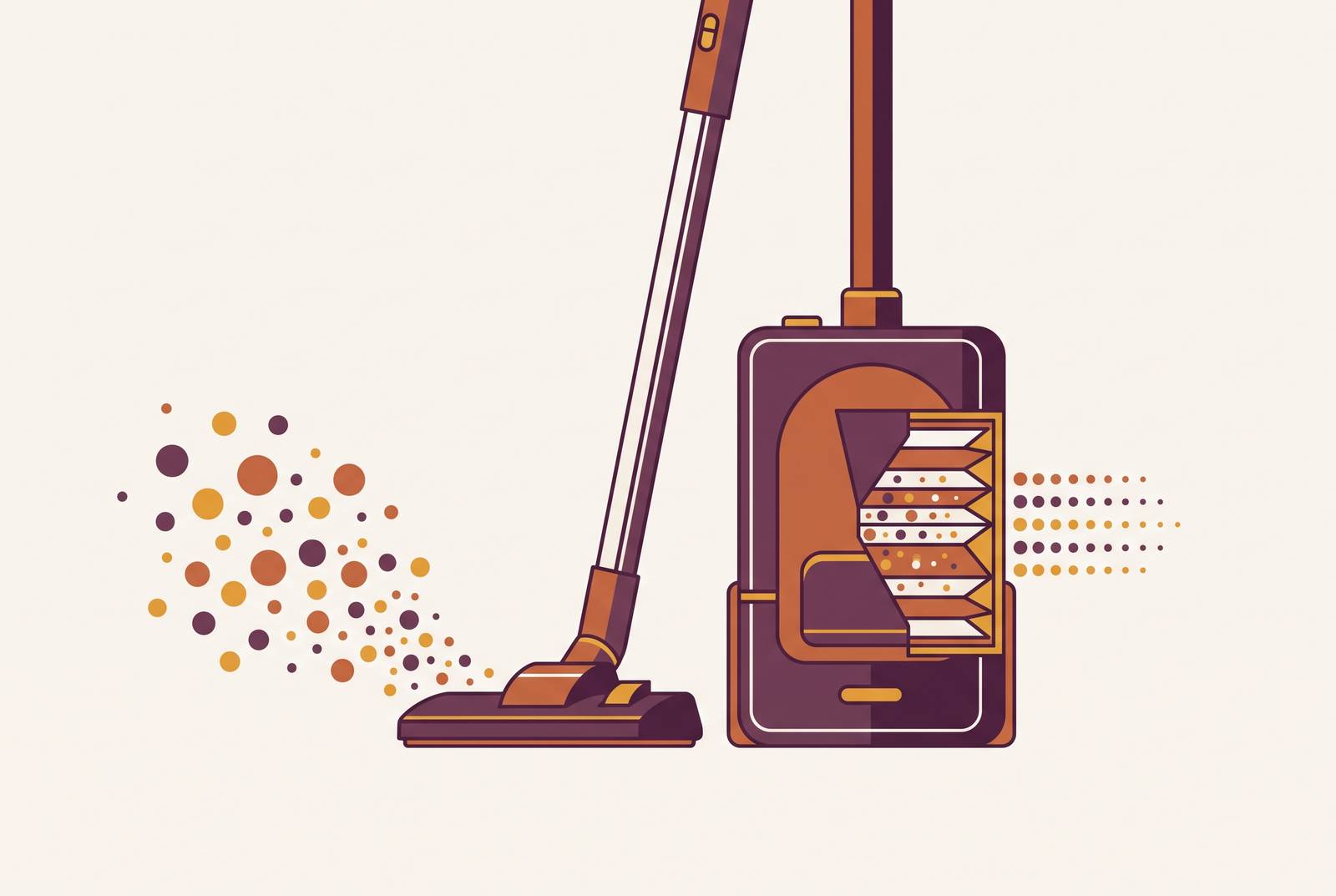
The mechanism is mechanical. The spinning brush head agitates the carpet fibers, and it lifts settled particles off the surface. Then the vacuum's exhaust, if it isn't sealed, blows the finest of those particles straight back into the room. Conventional filter bags and foam filters were never built to catch particles in the size range of mite fecal fragments, so a large share of what gets stirred up simply rides the exhaust stream back out.
There's a second failure built into the biology itself. Live mites grip textile fibers using adhesive pads on their legs. Suction alone rarely pulls the mites off the carpet or the couch. Vacuuming moves the settled debris around far more effectively than it removes the animals producing it.
None of this is a failure on the part of the person vacuuming. It's a structural limitation of how conventional vacuums are built: unsealed housings, filters sized for visible dirt rather than microscopic allergen, and a cleaning motion that agitates before it captures. Cleaning day becomes, for someone with a dust mite allergy, one of the highest-exposure stretches of the week.
What a HEPA filter does inside a vacuum
A HEPA filter is genuinely good at its job. The U.S. Department of Energy standard says an efficient HEPA filter has to capture more than 99.97% of submicrometer particles at 0.3 μm, so it covers the allergen-carrying fragments that slip through ordinary filters. Air is forced through a dense mat of randomly arranged fibers, and particles get caught through a mix of interception, impaction, and diffusion depending on their size.
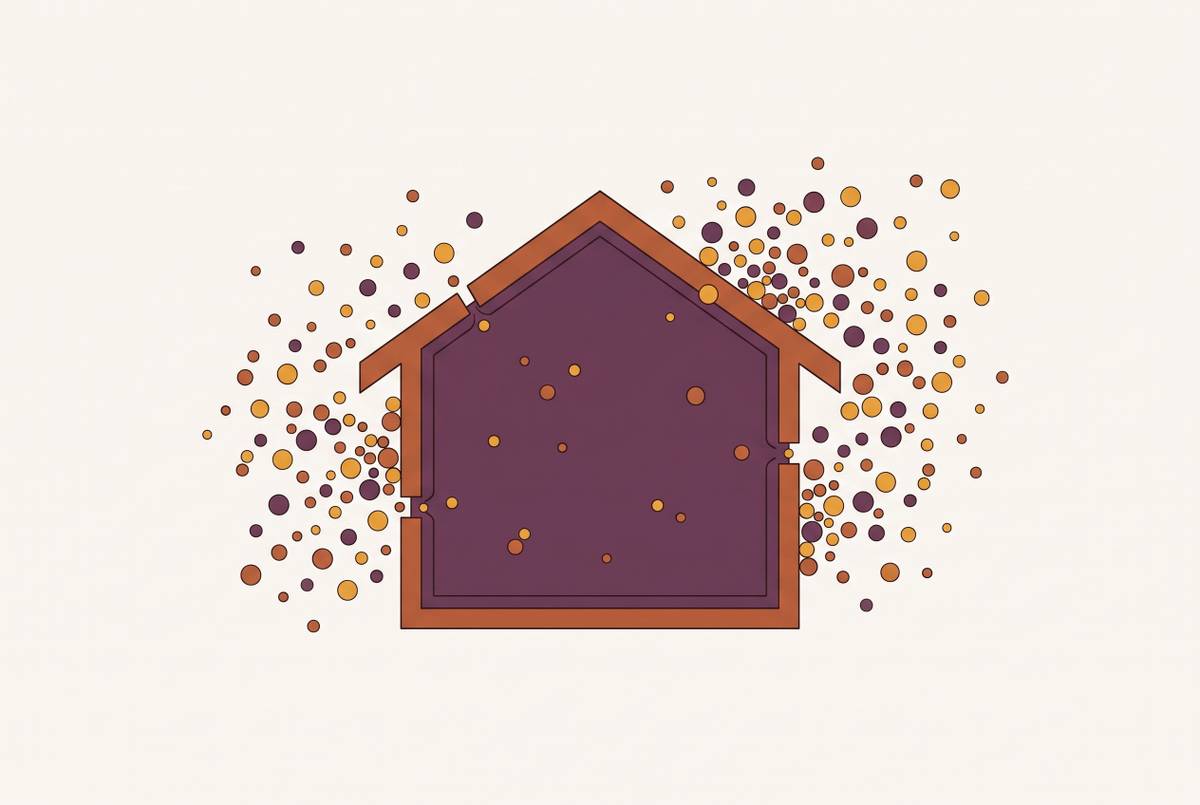
A filter rating alone doesn't tell you whether a vacuum is doing its job. The filter can perform exactly as advertised and the vacuum can still leak allergen into the room, because the rest of the machine has to be sealed for that performance to matter. If the housing, the seams, or the bag compartment allow air to bypass the filter, allergen-laden air escapes around it, and the 99.97% figure becomes irrelevant at every point where that bypass happens. A HEPA filter in a leaky housing is a strong engine bolted to a car with a hole in the floor.
Bagged and bagless designs carry different risks here. A sealed, bagged system limits re-exposure when it's time to empty it. Bagless bins, by contrast, can release a concentrated cloud of trapped allergen the moment the bin is opened, undoing some of what the filter just accomplished.
Even a flawless sealed HEPA vacuum has a physical limit. Particles larger than roughly 10 μm stay airborne only briefly, so they settle back down before the machine's airflow can ever pull them toward the filter. HEPA filtration handles what comes out the exhaust. It has no influence on what gravity has already deposited before suction reaches it.
What HEPA vacuuming achieves in real homes
Field research backs up the basic case for HEPA vacuuming, with an important caveat attached. A study from the National Institute of Environmental Health Sciences enrolled homes with high house dust mite allergen levels and tested two approaches: intensive vacuuming combined with dry steam cleaning, and intensive vacuuming on its own. Upholstered furniture received either dry steam cleaning or intensive vacuuming, and beds were fitted with complete encasements.
Both approaches produced significant drops in dust mite allergen concentration and load. The gap showed up over time, not immediately. In homes that received intensive vacuuming alone, allergen levels crept back toward pre-treatment values within four weeks. When steam cleaning got added to the vacuuming, that window stretched out to roughly eight weeks before the same rebound occurred.
Separate research on mite populations lines up with that timeline: despite regular vacuuming, mite populations and their eggs can surge again after about seven weeks, landing right inside that four-to-eight week recovery window.
None of this undercuts the case for HEPA vacuuming. The American Academy of Allergy, Asthma and Immunology's practice parameters give a strong recommendation, backed by B-level evidence, for regular vacuuming with HEPA filtration or a central vacuum with adequate filtration or outside venting. If allergen exposure drops consistently over time, it can produce real health benefits. The vacuuming works. It just doesn't work alone, and it doesn't work forever on its own.
Why the sleep environment matters most for allergen control
Dust mite allergen concentrates most heavily in the places people sleep. Mattresses, box springs, and pillows are prime reservoirs, and a person spends roughly a third of their life in direct contact with them. Unlike pollen or outdoor allergens, dust mite exposure is perennial. It doesn't ease up in a different season, and the exposure in bed is continuous and nocturnal in a way few other allergen sources are.
That combination makes dust mite allergy especially disruptive to sleep. A large majority of allergy sufferers report sleep problems, and the downstream effects pile up fast: chronic fatigue, daytime drowsiness, trouble concentrating, weaker performance at work or school, missed days, and mood disorders. Many people carrying these symptoms never trace them back to what's happening in their mattress each night.
There's a mechanical piece to this too. Ongoing allergen exposure drives nasal congestion, and that pushes people toward mouth breathing during sleep. That compounds sleep quality problems on its own, independent of whatever the immune system is doing in response to the allergen itself.
Mattresses and pillows are also the hardest reservoirs to clean using a vacuum alone. Mites cling to the fibers inside, and unlike bedsheets, a mattress can't be thrown in the wash. So you have to address it through cleaning technique, encasement, or both, since you can't launder a mattress.
Vacuuming to reduce exposure rather than redistribute it
Good technique follows directly from the physics already laid out: heavy particles settle fast, mites grip with adhesive pads, and unsealed exhaust undoes whatever the filter catches. If the goal is lowering allergen exposure, not just picking up visible dirt, a few equipment choices matter.
Look for true HEPA filtration, rated H13 or higher under ASTM F1977 standards, not filters marketed as "HEPA-style" or "HEPA-like," which carry no enforceable standard behind the label. Confirm the system is fully sealed, so the housing seams, filter compartment, and bag or bin don't let air slip past the filter. A bagged design limits re-exposure at disposal better than most bagless bins do. An upholstery tool and a mattress nozzle reach the soft surfaces carrying the highest allergen loads, places a standard floor head can't clean properly.
Sequence changes the outcome as much as equipment does. Work top to bottom, so dust knocked loose from shelves, curtains, or furniture falls to the floor, which gets vacuumed last. Vacuuming before dusting runs that logic backward and redeposits settled particles onto a floor that's already been cleaned.
Speed matters during the pass itself. Slow, overlapping strokes give the suction and the brush head time to lift embedded debris out of carpet fibers and upholstery. Fast passes mostly just stir things up without pulling much of it into the machine.
Frequency depends on how much contact a surface gets. Mattresses and heavily used upholstery call for weekly vacuuming. Furniture that sees less traffic can go biweekly. All fabric surfaces benefit from a deeper seasonal pass.
Because allergens become airborne during the process itself, anyone with a severe dust mite allergy should wear a mask while vacuuming, or have someone else do it, and wait before walking back into the room. Maintenance closes the loop: a clogged or saturated filter loses suction and filtration efficiency, so following the manufacturer's replacement schedule isn't a minor housekeeping detail. A dirty HEPA filter inside a leaky housing defeats the entire purpose of owning one.
Encasements and humidity control for holding HEPA vacuuming's gains
The four-to-eight week rebound documented in the NIEHS study points to something vacuuming can't fix by itself: the mite population living in bedding never actually goes away just because the carpet got cleaned. Vacuuming removes allergen that's already there. It does nothing to stop the reservoir from refilling.
Allergen-impermeable encasements for the mattress, box spring, and pillows physically block that reservoir from shedding allergen into the air around the bed. This is the same intervention the NIEHS researchers paired with vacuuming to stretch out the effect, and it targets the exact surfaces that are hardest to clean with suction alone.
Humidity plays an equally direct role, because dust mites need moist conditions to survive and reproduce. A patented humidity control system was built specifically to address this problem, and it keeps indoor relative humidity within a range that suppresses mite survival. The underlying principle is straightforward: without enough moisture in the air, the mite population can't sustain itself, no matter how often the carpets get vacuumed.
Each of these three measures handles a different part of the same problem. Vacuuming clears out allergen that's already accumulated. Encasements block the largest reservoir from shedding more. Humidity control suppresses the mites' ability to reproduce. Layered together, they stretch the window between rebounds far longer than any one approach manages alone. Repeated cleaning, air filtration, and wet dusting can bring allergen levels down over time, but only once the source itself has been removed or contained. Skipping that step lets the reservoir simply fill back up.
Why environmental control cannot retrain a sensitized immune system
Even a disciplined routine of HEPA vacuuming, encasements, and humidity control reduces exposure without eliminating it, and none of it changes how an already-sensitized immune system reacts once exposure happens. That reaction is driven by immune memory, formed when the immune system first becomes sensitized to the allergen.
Once someone is sensitized, their immune system produces IgE antibodies against dust mite proteins. Exposure above that person's individual threshold triggers symptoms, and lowering the allergen load in the home raises how much exposure it takes to cross that threshold. It doesn't undo the sensitization itself. The immune system still remembers the allergen as a threat.
Allergen immunotherapy works on that memory directly, and it's the only treatment currently considered potentially disease-modifying for IgE-mediated respiratory allergy. Sublingual immunotherapy introduces controlled amounts of allergen to specialized immune cells under the tongue, and it gradually shifts how the immune system responds over time. For dust mite allergy specifically, randomized controlled trial evidence backs clinically meaningful reductions in symptoms and medication use with HDM SLIT tablets, and benefits last one to two years after you complete a three-year treatment course. A five-year surveillance study following that same three-year course found notable improvement in allergic symptoms among children with allergic rhinitis and atopic cough, and results were better both during treatment and after it ended.
Safety profiles differ by route of administration. Sublingual immunotherapy mostly produces local reactions, while the injected form, subcutaneous immunotherapy, carries a higher risk of systemic reactions. That distinction matters for someone starting treatment while still living in a home where dust mite allergen hasn't been fully brought under control.
The two strategies aren't competing with each other. HEPA vacuuming and encasements cut down the allergen load the immune system runs into every day. Sublingual immunotherapy changes how forcefully that immune system reacts to whatever allergen still gets through. One lowers the dose. The other changes the response to it.
Sources
- System for allergen reduction through indoor humidity control
- Effectiveness of HEPA Filters at Removing Infectious SARS-CoV-2 from the Air
- Efficacy of Subcutaneous, Sublingual and Oral Immunotherapy for Allergens: A Comparative Study - Lisiecka - 2025 - Immunology - Wiley Online Library
- Clinical efficacy of sublingual immunotherapy for allergic rhinitis and atopic cough: 5-year real-world surveillance - ScienceDirect