Air Purifier HEPA Standards and Allergen Capture Efficiency
True HEPA filters capture 99.97% of particles at the size that matters most for allergies.
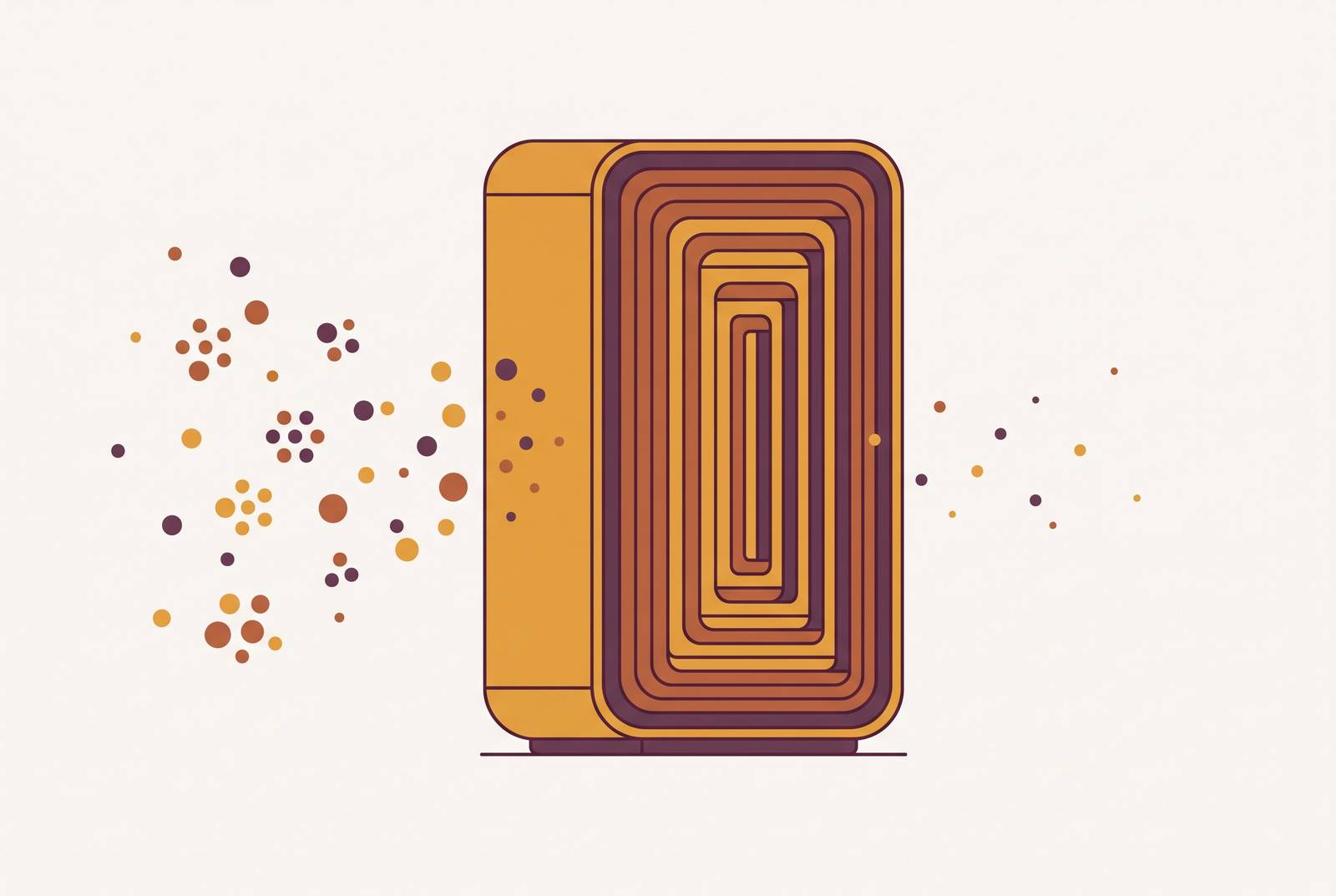
A buyer picks a purifier with "HEPA" printed across the box, runs it all night in the bedroom, and still wakes up congested. The gap between expectation and result usually traces back to one thing: the word "HEPA" by itself promises nothing. HEPA is a performance standard, and a filter only earns the designation by capturing 99.97% of all particles at 0.3 microns as air passes through it, a figure that is specific on purpose. The market is full of filters labeled "HEPA-like," "HEPA-style," or "HEPA-type," and none of those phrases carry the certification behind the real standard, so a buyer who assumes "HEPA-type" means HEPA is often sitting in a room with far more allergen left in the air than expected. The standard traces back to World War II and was advanced considerably during the Manhattan Project, when engineers needed a filter precise enough to stop airborne radioactive particles. That origin says something about how seriously the 99.97% threshold was built, and it explains why HEPA became the benchmark the rest of the air filtration industry still measures against. A filter marketed as "HEPA-like" typically captures substantially fewer particles than one that actually meets the standard, and for someone with a dust mite allergy running a purifier overnight, that difference adds up to real, ongoing exposure. The only way to know what a filter actually does is to find the specific performance claim stated in the product specifications, not the word on the front of the box.
How a HEPA filter physically captures particles through three separate mechanisms
Why does 0.3 microns matter so much? The answer sits in how a HEPA filter physically stops particles, because it isn't one mechanism doing all the work. Three distinct physical processes operate side by side, each one most effective on a different particle size, and together they cover the full range a HEPA filter needs to handle. The first is impaction: larger particles carry enough mass that they cannot follow the air as it curves around a filter fiber, so they travel in a straight line, hit the fiber, and stick. Think of a heavy truck that cannot take a sharp turn at speed. It plows forward and meets whatever is in its path. The second mechanism is interception, which handles particles that are lighter and smaller. These particles follow the airstream fairly closely, but their path carries them near enough to a fiber that they brush against it and stay there. This is the dominant mechanism for allergens like pet dander fragments and bits of dust mite waste that fall in the middle size range. The third mechanism, diffusion, takes over for the smallest particles, those below roughly 0.1 microns. These particles are so small that they get knocked around by collisions with individual air molecules, a phenomenon called Brownian motion, and that erratic path makes them far more likely to bump into a fiber than their tiny size would suggest. So where does 0.3 microns fit into all this? It sits in the gap between these mechanisms, the "valley" where impaction and interception have started to lose their grip on particle size and diffusion hasn't fully kicked in yet. That makes 0.3 microns the hardest particle size to capture, and that is why it became the test standard. A filter that hits 99.97% efficiency at that size is, by definition, performing even better above and below it. Some filters add a fourth mechanism, electrostatic attraction, which gives smaller particles an extra pull toward the fibers and strengthens the case for hybrid filtration technologies built around that effect.
How allergen particle sizes map onto what a true HEPA filter captures
The physics explains why 0.3 microns is the hard case. The allergens people actually breathe make the easier case, and it helps to see where they fall. Dust mite allergen particles measure between 10 and 40 microns, dozens of times larger than the MPPS threshold a HEPA filter is tested against. Cockroach allergen fragments fall within a comparably large range. A true HEPA filter catches particles at that size with ease, since both impaction and interception work more effectively as particle size increases. That's physics, not marketing copy. Pet dander deserves its own mention, because it includes protein fragments that can measure as small as 1 micron, smaller than most other common indoor allergens and closer to the territory where capture gets harder. But a true HEPA filter doesn't lose its grip at that size. Diffusion, the mechanism covered in the previous section, becomes more effective as particles get smaller, so a filter that hits 99.97% at 0.3 microns captures 1-micron dander with even greater efficiency. HEPA filtration has nothing to do with gases, chemical odors, or volatile organic compounds, which pass straight through regardless of filter grade. Those pass straight through a HEPA filter regardless of its grade, because the filter works by physically intercepting particles, not by neutralizing airborne chemicals. Activated carbon is the component that handles that side of indoor air, and a purifier combining both a HEPA filter and an activated carbon layer addresses a broader set of triggers for anyone whose allergies overlap with chemical sensitivities.
HEPA Grade Tiers From H10 to H14
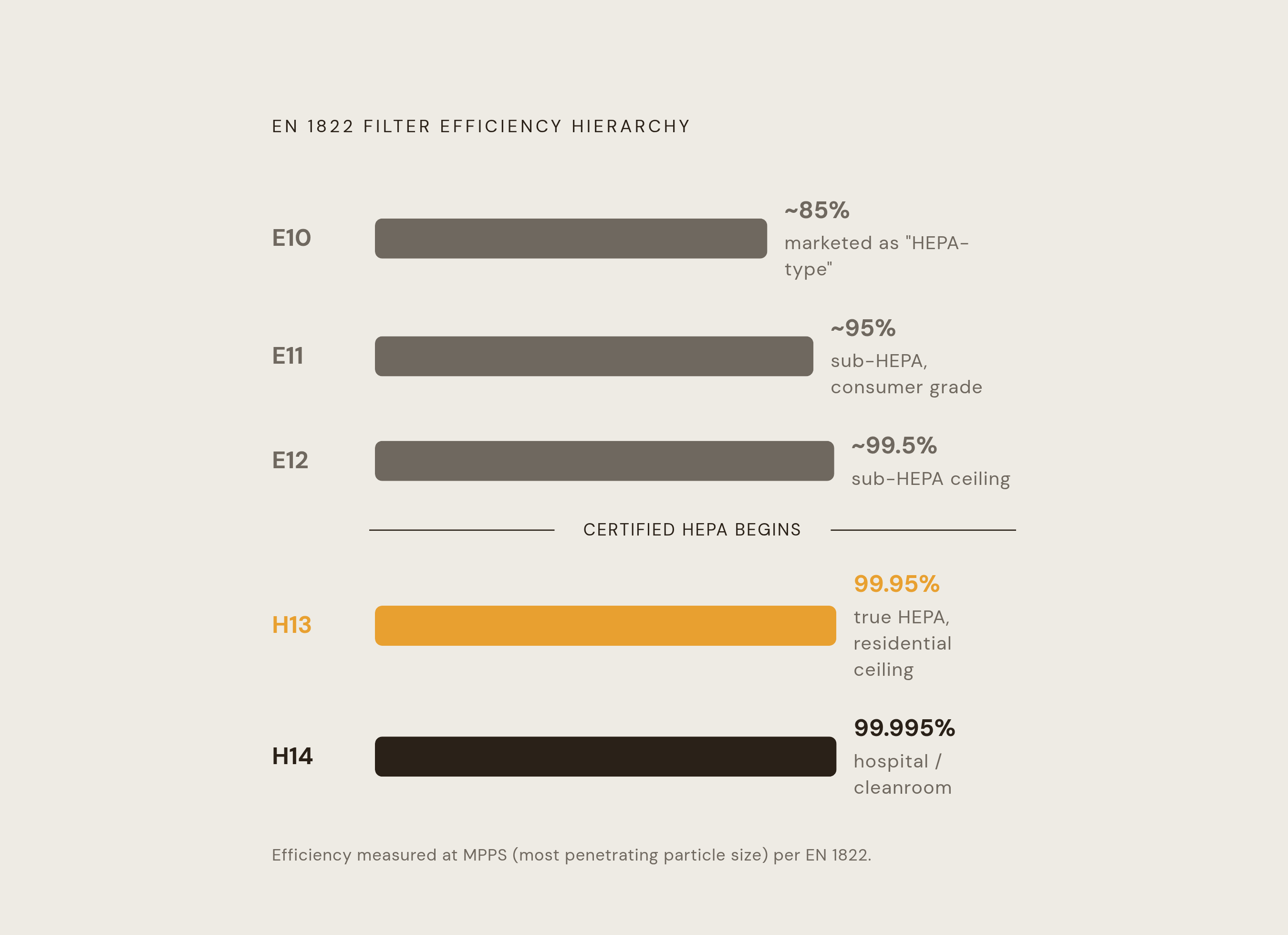
Once a buyer understands that HEPA is a real, measurable standard, the next question is which grade of HEPA actually fits the situation. The European EN 1822 standard lays out a graded hierarchy running from EPA filters at E10 through E12, up through HEPA filters at H13 and H14, and finally ULPA filters at U15 through U17. That hierarchy is what exposes the real gap between a filter marketed loosely as "HEPA-type" and one that genuinely clears the HEPA bar. At the bottom of that range, an E10-rated filter captures around 85% of particles at the test size, which offers some basic allergen reduction but gets marketed as "HEPA-type" in ways that overstate what it delivers. Moving up, the next grade offers higher efficiency and some real benefit for mild allergies, but it still falls short of the true HEPA threshold. E12-rated filters perform quite well, strong enough for a lot of general residential use, yet they still sit below where the HEPA category actually begins. HEPA proper starts at H13, which hits 99.95% efficiency at the MPPS and is individually tested and certified rather than approved on a batch sample. That grade is the one to look for when allergies are the reason for buying a purifier. H14 climbs further, to 99.995% efficiency, the grade used in hospitals and cleanrooms where airborne contamination control is a matter of patient safety. For a home, that extra fraction of a percent comes at a cost: higher pressure drop, more strain on the fan, more energy draw, and a filter that doesn't deliver a meaningfully better outcome for someone managing seasonal allergies or a cat at home. H13 is the effective ceiling for residential use, and H14 is overkill that adds cost without adding comfort. It's also worth testing the common assumption that any HEPA filter beats no filter. That's true as far as it goes, but an H10 or H11 filter still leaves a real share of fine allergen particles circulating, and that gap matters most overnight in a bedroom, where exposure is continuous for hours at a stretch.
Why filter grade alone does not predict how much allergen a purifier actually removes from a room
Picture someone who did everything right on paper: bought a certified H13 unit, checked the spec sheet, confirmed the 99.95% efficiency rating, and still finds dust and dander building up in the room. What went wrong? The filter grade describes what happens to the air that actually passes through the filter. It says nothing about how much of the room's air gets pulled through that filter in a given stretch of time, and that distinction is where most buying mistakes happen. This is where CADR, or Clean Air Delivery Rate, becomes the number that actually matters alongside filter grade. CADR measures how fast a purifier delivers clean air, expressed in cubic feet per minute, and matching that rate to the size of the room shows whether the air is actually being cycled often enough to matter. A phenomenal filter moving too little air in too large a room will leave allergen levels elevated no matter what the box says about efficiency. The industry benchmark here comes from AHAM-certified CADR ratings, which are based on 4.8 air changes per hour, a figure that reflects how fast unfiltered air finds its way back into a space and how quickly a purifier needs to keep pace with it. Studies that found little benefit from air purifiers were consistently running undersized units in oversized rooms. The filter wasn't the weak link. Air turnover was. None of this is really solved by chasing the highest filter grade available. It's solved by sizing the unit to the room and then running it enough to hit that turnover rate consistently, a point that leads directly into where and how a purifier should actually be deployed.
Where and How to Run a Purifier
A correctly sized, H13-certified purifier still underperforms if it's placed, run, or maintained the wrong way. Deployment decisions carry as much weight as the filter grade itself. Start with placement: a person spends roughly a third of each day in the bedroom, and allergen levels there have a direct line to sleep quality and how congested someone feels in the morning. A single well-placed unit in the bedroom usually does more for symptoms than the same unit running in a living room that only sees a few hours of use. Running the purifier continuously matters just as much as placement, because allergens don't pause when the unit is off, and a few hours of operation only clears a fraction of what accumulates over a full day. Auto mode addresses the obvious worry about energy cost here, letting the unit scale fan speed down when the air is already clean and ramp back up when particle counts rise. Maintenance is the step that gets skipped most often. A washable mesh pre-filter that catches visible pet hair extends the life of the HEPA filter underneath it considerably, letting it go far longer between replacements than a unit without that layer. A clogged HEPA filter loses effectiveness no matter how high its original certification was, so that mesh layer is doing real work, not just cosmetic upkeep. Finally, a purifier only ever addresses what's airborne. Allergens that have already settled onto bedding, carpet, and furniture need to be dealt with separately, through HEPA-filter vacuuming and weekly hot-water washing of bedding. Air purification and surface cleaning are complementary strategies, each covering ground the other can't reach.
What HEPA Filtration Can and Cannot Do
A well-chosen, correctly sized, continuously run H13 purifier meaningfully reduces how much allergen reaches the lungs and sinuses over the course of a day. What it cannot do is change how the immune system reacts to the allergen that still gets through, whether from the portion of air the purifier never reaches, settled dust on a surface, or exposure outdoors. Lowering the total allergen load does ease the burden on an already reactive immune system, and that can take the edge off symptom severity. For someone with persistent allergic rhinitis, that ceiling sits well below full relief, no matter how well the purifier is matched to the room. Antihistamines and nasal sprays work on the other side of that same gap. They manage symptoms after the allergen has already triggered a response, without changing the underlying sensitivity, and they come with their own costs: drowsiness, nasal irritation, and the risk of rebound congestion with repeated use. Allergen immunotherapy, whether delivered sublingually or subcutaneously, stands apart because clinical evidence shows it can modify the immune system's actual response over time, producing a reduction in sensitivity that persists after treatment ends. That is treatment aimed at the cause, not just the reaction that follows exposure. For anyone dealing with disrupted sleep, brain fog, or chronic congestion alongside their allergies, the two approaches cover different ends of the same problem: a HEPA purifier cuts down how much allergen is in the air to begin with, and doctor-guided immunotherapy works on how the body responds to whatever still gets through.