Pollen Infiltration Rates in Sealed Residential Buildings
Airtight homes trap indoor allergens while still letting pollen slip through.
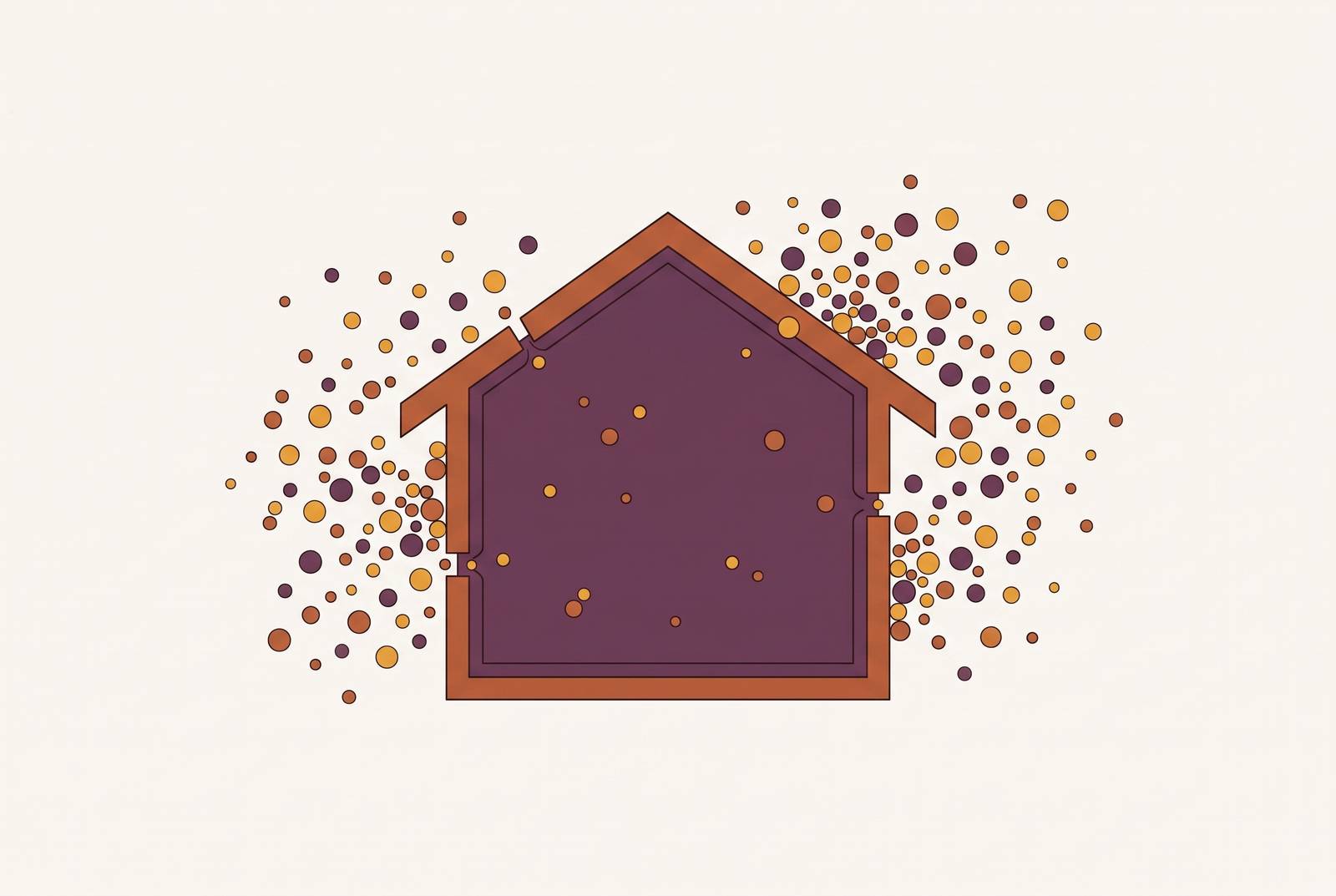
How air moves through a residential building
Retreating indoors when pollen counts spike feels like the obvious move. It doesn't work the way most people assume. Pollen gets into homes through leakage, ductwork, pets, and the people who live there, then settles into carpets and bedding where it sits for days after the outdoor count drops. This piece walks through how that happens, why tighter buildings don't fix it and sometimes make other allergens worse, and where environmental fixes run out of road.
No house is sealed shut. Every building leaks air, some more than others, driven by wind pressure, the temperature gap between inside and outside, and the basic fact that warm air rises and pulls replacement air in behind it. The industry measures this with a metric called air changes per hour, or ACH: how many times the full volume of air in a home gets swapped out in sixty minutes.
Older, drafty homes in cold or windy climates can post air exchange rates well above what's needed for healthy ventilation. There's a constant, physical pathway for outdoor air, and everything riding on it, to get inside. That's the whole story in one line.
So how do builders even measure this? Blower door testing is the standard. A calibrated fan mounted in an exterior door pressurizes or depressurizes the house to a reference level, and the equipment tracks how much air it takes to hold that pressure. The 2024 International Energy Conservation Code requires this test for new construction, with a leakage cap of 3.0 ACH50, the same number regardless of climate zone.
Passive House construction is at the tight end of the spectrum, well past code minimums. Even those homes need mechanical ventilation to bring in fresh air on purpose, since a building that airtight would otherwise trap moisture and stale air indoors. Fresh air has to come from somewhere, and it's rarely pollen-free. The very system that keeps a super-tight home livable doubles as a pathway back in for the thing homeowners are trying to keep out.
"Sealed" It is a spectrum, not a destination, and almost nothing built for people to actually live in is at the airtight extreme. The pathways for pollen are always there, in some amount, in some form.
The specific routes pollen takes from outside air into indoor spaces
Four routes account for most of it.
Air leakage is the quiet one. Gaps around window frames, door thresholds, baseboards, the small penetrations where plumbing and electrical lines pass through walls, attic hatches, and the top plates of exterior walls: these are the usual suspects in any air-sealing inspection. Pollen grains are small enough to ride the air moving through these gaps without much resistance.
HVAC systems move it on a bigger scale. Fresh-air intakes pull outdoor air, pollen included, straight into the duct system, and once it's in the ducts, it goes everywhere the ducts go. Air handlers build up a coating of pollen over a season, and that coating doesn't just sit there quietly. Every time the blower kicks on, some of it shakes loose and re-enters the airstream.
Then there's people and pets. Opening a door or window lets outdoor air mix with indoor air, and pollen rides in on clothing and hair after any stretch of time spent outside. Every person walking through the front door works, in a small way, like an intake vent. Pets do the same job on four legs: fur and paws pick up pollen efficiently, and a dog that goes out for a walk and comes back in repeats the delivery several times a day.
Once pollen is inside, it doesn't stay airborne long. It settles into carpets, bedding, pillows, upholstered furniture, and the inside of air ducts: soft reservoirs that hold onto it until a footstep, a bounced pillow, or a blower cycling on stirs it back into the air. That's why indoor pollen levels don't track outdoor counts in real time. A home can carry an elevated pollen load for days after the outdoor count drops to near zero, simply because nothing removed what already settled. It's also why professionals doing indoor air quality testing sample carpets, bedding, and HVAC components first. That's where the evidence sits.
Tighter, more energy-efficient buildings and the allergen problem
Tighter construction cuts air leakage, which sounds like good news for keeping pollen out. But that same tightness limits how much fresh outdoor air dilutes whatever allergens are already being generated inside. Less air exchange means whatever's in there stays in there, at a higher concentration than before. Sealing a house doesn't clean the air inside it; it just slows down the exchange with air that might have been cleaner.
A 2025 paper in Frontiers in Public Health lays out a relationship more complicated than "tight equals safe." Airtight, energy-efficient buildings restrict air exchange enough to reduce indoor microbial diversity, and that reduced diversity may work against healthy immune regulation. The same paper points to warmer, more climate-stable indoor environments, a direct byproduct of efficient building envelopes, as good living conditions for allergen-producing pests. The long-tailed silverfish gets named specifically as a species that benefits.
House dust mites follow the same logic. They need a narrow band of temperature and humidity, plus a steady food source in shed human skin cells, and airtight, climate-controlled homes hand them both, year-round, without the seasonal die-off a drafty older house might impose on its own.
A home that does a great job keeping outdoor pollen out may, at the same time, build up higher levels of dust mite allergen, pet dander, mold spores, and cockroach protein than a leakier house down the street. A home that does a great job keeping outdoor pollen out may, at the same time, build up higher levels of dust mite allergen, pet dander, mold spores, and cockroach protein than a leakier house down the street. None of these sources cancel each other out. A stacked indoor allergen load, several sources working at once, can end up more provocative to the immune system than pollen ever was on its own, even inside a home that looks, on paper, like the well-sealed one, because none of these sources cancel each other out and they stack. A stacked indoor allergen load, several sources working at once, can end up more provocative to the immune system than pollen ever was on its own, even inside a home that looks, on paper, like the well-sealed success story.
What matters is what happens to the air that still moves through that envelope, and what's already living inside before any of that air arrives. It's what happens to the air that still moves through that envelope, and what's already living inside before any of that air arrives.
What HVAC filters and air cleaners can and cannot do for indoor pollen
Most HVAC systems ship with a basic panel filter, and that filter exists to protect the blower motor and coils from dust and debris. It was never built to protect the people breathing the air, and against small allergen particles, it does very little.
Pollen, comparatively, is easy to catch. The grains are large enough that a decent filter grabs a meaningful share of them. Other allergens don't cooperate the same way: cat dander fragments and fungal fragments travel on particles small enough to slip through filters that would stop pollen without any trouble.
Higher-efficiency filters are generally recommended for any meaningful reduction in pet dander, with filters toward the upper end of the efficiency range performing better on smaller allergen particles like cat dander. Portable HEPA air cleaners, run in a closed room (the bedroom is the obvious candidate), are also backed as a useful add-on for people with allergic disease, working alongside central filtration rather than replacing it.
Research on air filtration in bedrooms has found measurable reductions in dust mite, cat, and dog allergen levels once filtration went in, though the size of the effect varied by allergen. Filtration only catches what's airborne at the moment it passes through the filter. It does nothing for pollen that already worked its way into carpet fibers or a pillow. Those reservoirs keep re-releasing particles every time something disturbs them, filter or no filter.
Upgrade the central HVAC filter to a mid-range tier or better, add a HEPA unit in the bedroom, then deal with the reservoirs directly through regular cleaning and mattress or pillow encasements. Each step handles a different piece of the exposure, but none of them, alone or stacked together, fixes the underlying problem. Filtration lowers the dose. It doesn't touch the immune system's decision to overreact to that dose, and that decision is where the real fight is.
Compounding indoor allergen exposure across pollen, dust mites, mold, pet dander, and other sources
Pollen entering a house typically joins an already-established community of indoor allergens that got there first.
Dust mites top the list by volume. They're microscopic, they live in bedding, mattresses, upholstered furniture, and carpet, and they account for a large share of the allergen burden behind asthma flare-ups. They're also among the most commonly encountered allergens across households in this country, and a well-documented driver of asthma flare-ups, full stop.
Pet dander comes next: tiny flecks of skin, plus proteins carried in saliva and urine, that cling to fabric and stay suspended in room air long after the animal has wandered off. A large share of households in this country keep a pet, so a large share of households carry this exposure whether anyone notices it or not.
Mold adds spores and cell fragments to the mix, usually tied to dampness. A leak that never fully dried out, a bathroom fan that doesn't move enough air, or a basement that stays humid will cause it. Beyond the allergens themselves, mold can produce irritants and, in some cases, mycotoxins.
Cockroach allergen, from droppings and body fragments, tends to concentrate more in certain housing types and geographic settings. Rodent allergen, from urine, dander, and saliva proteins, tends to go airborne mainly in dusty, undisturbed corners.
Pollen lands in the same carpets, bedding, and ductwork where dust mite debris and pet dander already live, and the combination is harder to escape than any single source alone, because treating one doesn't touch the others. The 2025 Frontiers in Public Health paper adds a climate layer on top: warmer indoor environments favor allergen-producing pests, while climate-driven changes are affecting what kinds of allergenic material people encounter both outdoors and indoors.
Someone who assumes their springtime symptoms indoors come purely from tree pollen might actually be reacting to a blend: pollen plus dust mite debris plus dander, all landing at once. If the exposure comes from several sources at once, why would a fix aimed at only one of them ever produce full relief?
The sleep and cognitive toll when indoor allergen exposure continues through the night
The bedroom is where all of this converges. People spend a huge share of their lives there, the bedding is one of the densest dust mite and settled-pollen reservoirs in the house, and it's also where the body does its most important repair work.
Histamine released during an allergic reaction drives sinus inflammation, and inflamed sinuses make nasal breathing difficult. Difficult nasal breathing overnight disrupts sleep in ways that go beyond just feeling stuffy. Untreated allergic rhinitis links to more frequent nighttime awakenings and less time spent in deep sleep, the stage where memory consolidation and mental recovery actually happen.
Losing enough deep sleep, night after night, causes grogginess, trouble concentrating, and a low-grade fatigue the next day that a lot of people never trace back to allergies. Why would they? Nobody wakes up thinking about pollen in their pillowcase.
Chronic congestion pushes people toward mouth breathing and snoring, both less restorative than normal nasal breathing, and both linked to sleep-disordered breathing patterns in children and adults alike.
Putting the pieces together sharpens the picture. Pollen that came in and settled into a pillow works against sleep quality, cognitive function, and daytime energy, every single night. That's a strong argument for treating the immune response directly, instead of just rearranging furniture in the bedroom.
The underlying problem left unsolved by environmental controls, however thorough
What does a genuinely well-managed home look like? Tight construction, a mid-range-or-better central filter, a HEPA unit running in the bedroom, encased mattress and pillows, regular vacuuming, pets kept out of the bedroom, shoes off at the door, a shower after yard work, a change of clothes coming back inside. That's a long list, and doing all of it consistently takes real, sustained effort.
Even then, exposure doesn't hit zero. Ventilation intakes still pull in outdoor air. Settled reservoirs still exist somewhere in the house. Pets still move around, people still walk through doors. In a home that's actually lived in, closing off every pathway isn't realistic, and chasing that goal wastes effort better spent elsewhere.
Suppose someone did manage to get indoor pollen exposure all the way to zero anyway. Would that fix the allergy? Suppose someone did manage to get indoor pollen exposure all the way to zero anyway; that wouldn't fix the allergy. The immune system already learned to treat pollen as a threat, and it keeps reacting that way the moment exposure resumes, indoors or out. Environmental controls lower the dose. They don't touch the relationship between dose and reaction, and that relationship is the actual problem, not the pollen count on any given day.
For people with moderate or severe symptoms, that leaves a familiar loop: ongoing environmental vigilance, plus medication, indefinitely. Antihistamines and nasal sprays calm the inflammatory response after it's already started. Neither one retrains the underlying reaction, and retraining it is the only way out of the loop.
Environmental management is worth doing, and it genuinely reduces suffering. But it has a ceiling, and most people who rely on it alone eventually hit that ceiling. Getting past it means addressing the immune system's overreaction directly, and that's a different category of intervention than anything covered so far.
How sublingual immunotherapy addresses what indoor air management cannot
Immunotherapy takes a different approach from everything above. Instead of trying to keep the allergen away from the immune system, it exposes the immune system to small, controlled, gradually increasing amounts of the allergen on purpose, training tolerance instead of blocking the reaction after it's already fired.
That targets the exact mismatch, between dose and immune response, that environmental control can't touch. After successful immunotherapy, the immune system stops mounting a disproportionate response to pollen that, realistically, is always going to find its way into a home eventually.
Two delivery routes show real efficacy for allergic rhinoconjunctivitis. Subcutaneous immunotherapy, the traditional allergy shot, gets given in-office with a required observation window afterward in case of a systemic reaction. Sublingual immunotherapy comes as drops or a tablet that dissolves under the tongue. Shots mean a clinic visit for every single dose, plus that mandatory wait afterward, which adds up to a real logistical burden for a lot of people. Sublingual immunotherapy, once the first dose is given under supervision, can be taken at home, which fits a lot more easily into a life that includes a job, travel, or kids.
The evidence base keeps growing. A 2025 phase III trial published in Allergy, led by Gappa and colleagues, confirmed that an SQ tree sublingual tablet is effective and well tolerated in children, a meaningful result given how much sleep-disordered breathing from allergic rhinitis affects kids specifically. Separately, the FDA expanded the approved age range for Odactra, a house dust mite sublingual tablet, down to children five through eleven as of February 2025, notable given how persistently dust mite allergen builds up inside tightly sealed homes. And a 2025 overview of systematic reviews and meta-analyses on sublingual immunotherapy for allergic rhinitis, published in the European Archives of Oto-Rhino-Laryngology and covering literature through June 2025, offers the most current synthesis of where the clinical evidence stands.
Both delivery routes need several years of consistent use before the tolerance they build becomes durable. Starting sooner, rather than spending years just managing symptoms, tends to be the decision with the better long-term payoff. Telehealth-based allergy care, virtual consults, at-home finger-prick testing, treatment plans shipped to the door, has removed a lot of the friction that used to keep immunotherapy out of reach for busy people. FSA and HSA eligibility on many of these plans knocks the cost barrier down further.
Understanding how pollen actually gets into a house, and doing what's reasonable to limit it, is worth the effort. But the bigger lever sits beyond the building itself, in what happens when pollen finally meets the immune system, whether that's on a hiking trail or in a pillowcase that's been collecting it for a week.
Sources
- Frontiers | Climate change and indoor biological exposures: a hidden risk to immune health
- Estimation of Infiltration from Leakage and Climate Indicators | Residential Building Systems Group
- Infiltration (HVAC) - Wikipedia
- Particle Sizes, Infiltration, and the Indoor/Outdoor Ratio
- Assessing the relevance of allergenic pollen in indoor environments—current knowledge base and research needs | Allergo Journal International | Springer Nature Link
- maineindoorair.org
- buildingenclosureonline.com
- buildingenclosureonline.com