Volatile Organic Compounds From Building Materials
Newly renovated homes release toxic chemicals at concentrations double what's considered safe.

People spend about 90% of their time indoors, according to widely cited EPA research. That single fact changes what "air quality" should mean to most people: it's not really about the smog outside the window, it's about what's evaporating out of the walls, floors, and furniture a few feet from your face. Indoor VOC concentrations run 2 to 5 times higher than outdoor levels, and a typical indoor air sample turns up somewhere between 50 and 300 distinct VOC species at any given moment. That gap between inside and outside is built, quite literally, into the materials used to construct and finish the rooms people live and work in. It's built, quite literally, into the materials used to construct and finish the rooms people live and work in.
What VOCs are and how building materials produce them
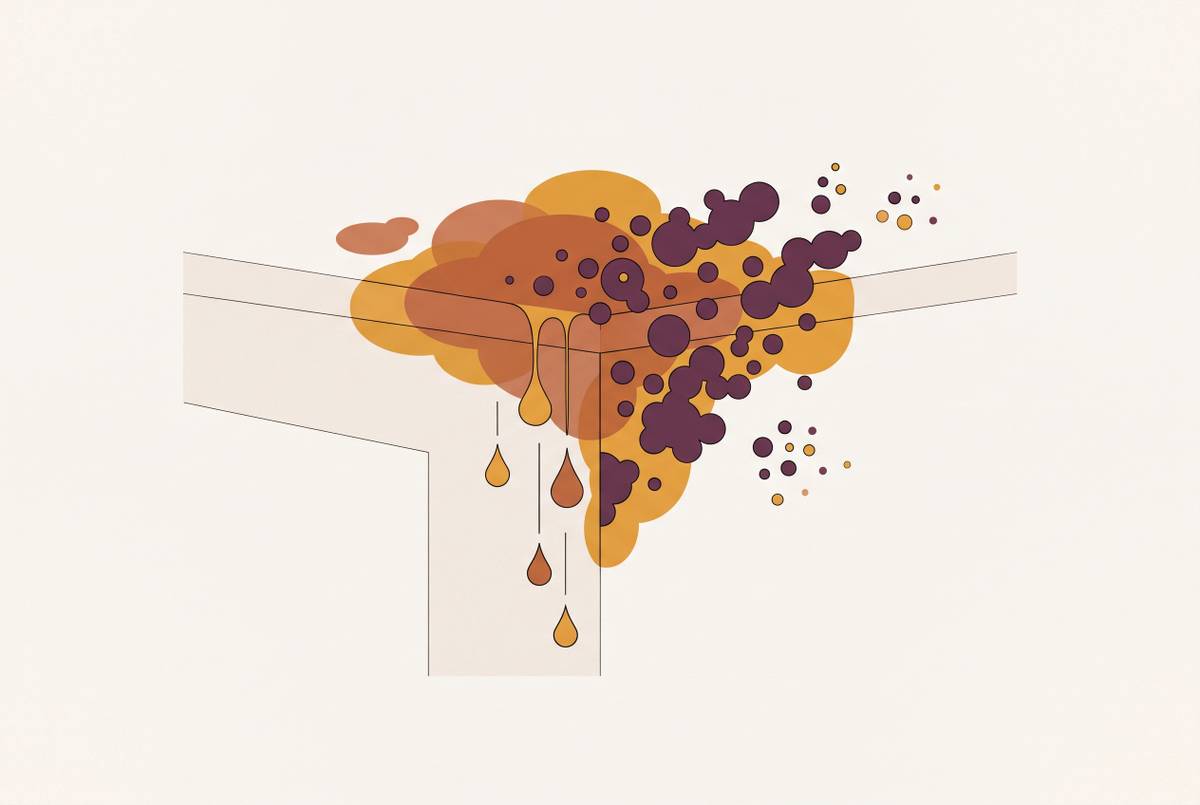
VOCs, or volatile organic compounds, are carbon-based chemicals that evaporate at normal room temperature. No fire needed, no malfunction, no chemical spill. A can of paint sitting on a shelf, a sheet of particle board screwed into a cabinet frame, a bead of adhesive under a floor plank: all of it releases gas simply by existing at 70 degrees.
A few chemical families do most of the damage. The BTEX group, benzene, toluene, ethylbenzene, and xylenes, shows up in gasoline and vehicle exhaust, but also in paints, solvents, and adhesives used indoors. Formaldehyde (chemical shorthand: HCHO) comes mostly from composite wood products; the glues that hold them together and the finishes applied on top add to the total. Phthalates and PFAS turn up in plastics, polymers, and certain flooring products.
Which materials emit the most? A short list, and it covers most of what goes into a renovation:
- Plastics and polymer-based products
- Cement
- Paints and lacquers, with solvent-based formulas being the most aggressive
- Adhesives and resins used in flooring, cabinetry, and general construction
- Wood-based composite boards like particle board and MDF
Off-gassing over time
Off-gassing doesn't stop when the smell fades. A 2024 study in the Journal of Hazardous Materials tracked VOC emissions from wood-based boards for 431 days straight, generating ten thousand data points across six different VOCs and three board types. The pattern: initial concentration decreases exponentially with time. Emissions peak right at installation, then taper off, but they don't shut off on any clean schedule.
Why does that matter for someone standing in a newly finished room? Because the diffusion coefficient and partition coefficient, the two numbers that govern how fast a compound moves from solid material into breathable air, fluctuate rather than decline in a straight line. Emission rate isn't fully predictable just from knowing how old the material is.
So a floor that "smells fine" after three weeks is still off-gassing. The invisible phase, the one with no odor cue to warn anyone, often runs the longest.
Actual indoor VOC concentrations: what the measurements show in real buildings
Numbers ground this better than description. Sampling of indoor air typically finds individual VOC compounds in the 1 to 10 μg/m³ range, with total VOCs (TVOC) landing somewhere between 200 and 5,000 μg/m³ depending on the building.
A study of newly finished residences put real numbers on it. Mean concentrations measured:
- Formaldehyde: 35.7 μg/m³
- Benzene: 4.34 μg/m³
- Toluene: 61.55 μg/m³
- Xylene: 19.14 μg/m³
- TVOC: ranging from 459.6 to 2,856 μg/m³, averaging 1,070 μg/m³
That average alone is more than double the national TVOC standard of 450 μg/m³. And this wasn't a fluke reading in one bad apartment: TVOC exceeded that standard in more than half the rooms measured. These are homes where people move in expecting a fresh start.
For reference, a TVOC reading below 0.3 mg/m³ counts as acceptable. If a reading crosses 1.0 mg/m³, it's time to actively investigate what's causing it.

Health effects of VOC exposure: from irritation to chronic disease
At elevated concentrations, the acute symptoms read like a bad flu: headaches, nausea, dizziness, eye and nasal irritation, respiratory infections, worsened asthma. Uncomfortable, but usually reversible once exposure drops.
The deeper concern is what happens with sustained exposure. Some VOCs cross the blood-brain barrier, so their effects appear not just in the lungs but as cognitive impairment and neurological symptoms. Chronic exposure has been tied to:
- Respiratory damage
- Neurological damage
- Cardiovascular damage
- Liver and kidney stress, particularly from persistent formaldehyde and benzene exposure
- Elevated cancer risk, since both formaldehyde and benzene are classified as Category I carcinogens
The scale here is not small. Estimates put premature deaths linked to this class of pollutants somewhere in the low millions, up to as many as 3.8 million. That range should reframe how anyone thinks about a can of solvent-based paint sitting in a closed room.
Sick building syndrome: when the structure itself is the diagnosis
A major health authority formally recognizes something called sick building syndrome, or SBS, and VOCs are a documented contributor. The symptom list looks a lot like the acute VOC list: mucous membrane irritation, headaches, nasal stuffiness, lethargy, drowsiness. The distinguishing feature isn't the symptoms themselves, it's the pattern. Symptoms track with occupancy in a specific building and ease up once someone leaves it.
Between 30 and 50 percent of new or refurbished buildings now produce SBS symptoms in their occupants. New and newly renovated office buildings show up disproportionately in this pattern, and the reason isn't mysterious: large quantities of fresh paint, adhesive, carpet, and composite wood all off-gassing at once, in a space that may not have had time to ventilate properly before people moved their desks in.
How energy-efficient construction made the VOC problem worse
The Institute of Medicine published a report warning that pushing buildings toward energy efficiency "may worsen existing indoor environmental problems and introduce new ones." That's a fairly direct admission for a government-adjacent body to make. Weatherproofing and tight construction cut ventilation rates down, sometimes to levels that don't clear indoor air fast enough.
Why would sealing a building tighter make indoor air worse? Follow the logic: VOCs off-gas from materials regardless of how the building is sealed. Reduce the air exchange rate and those compounds have nowhere to go. Instead of diluting out through open windows or mechanical ventilation, concentrations build up and stay elevated.
Pollutants identified as being trapped by tight construction include formaldehyde, radon, and VOCs generally, with older buildings also facing risks from materials disturbed during weatherization work.
The regulatory response has been catching up. The 2025 ASHRAE 62.1 updates now push demand-controlled ventilation, humidity control, and air-cleaning system performance as core requirements, not afterthoughts. That's an acknowledgment, arriving decades after the tight-building push started, that sealing a structure for energy savings creates an air quality problem engineers have to solve on purpose, rather than something that solves itself.
Populations at greatest risk from VOC exposure indoors
Not every occupant faces the same exposure. Children and adolescents carry outsized risk, partly because so much of their day happens inside educational buildings, classrooms, day cares, dorms, where VOC sources are dense and ventilation isn't always a priority.
A 2026 study in Scientific Reports, run by researchers from the University of Debrecen and the London School of Hygiene and Tropical Medicine, was built specifically to measure this. It assessed day care centers, schools, high schools, and universities across 17 EU member states. Formaldehyde posed elevated respiratory, neurological, and carcinogenic risk in 14 of those 17 countries. Benzene's neurological risk crossed the safety threshold in 4 of them.
Residential occupants face a different exposure profile, one where inhalation, ingestion, and dermal absorption are all active at once, since VOCs settle onto surfaces, dust, and skin, not just into the air people breathe.
People with existing respiratory conditions or allergies carry a compounding risk. Airways already irritated by VOC exposure tend to react more severely to allergens they might otherwise shrug off, turning a mild seasonal allergy into something closer to a persistent flare-up.
Reducing VOC exposure in homes and workplaces
Material choice is the highest-leverage decision, because it happens before the compound ever enters the air. A few concrete moves:
- Choose low-VOC or zero-VOC paints and finishes. Solvent-based formulas are consistently the most aggressive emitters on the market.
- Look for California Title 17 ATCM certification, which specifically limits formaldehyde emissions from composite wood.
- Established green building standards can offer a usable benchmark even outside commercial projects, including in a home renovation.
- The EPA's Indoor Air Exposure Assessment for Formaldehyde remains a solid reference point for formaldehyde-specific material limits.
Ventilation matters just as much, maybe more, once materials are already installed. HEPA filters do a good job on particulates but they don't touch gaseous VOCs. Only fresh air exchange and activated carbon filtration handle the gas phase. Air out a space aggressively during and right after any renovation, since new materials off-gas hardest in that early window. Keeping humidity under 60% relative humidity also helps: above that threshold, off-gassing speeds up, and it creates conditions for mold and other biological VOC sources to take hold.
Temperature plays a role too. VOC emission rates can increase as indoor temperature rises, so keeping a space on the cooler, more moderate side may help slow the release.
Personal TVOC monitors are widely available now, and they turn all of this from guesswork into a number on a screen. Below 0.3 mg/m³ reads as acceptable. A reading that crosses 1.0 mg/m³ calls for tracing down the source, which might be a new couch, a recent paint job, or a cabinet that's still curing.
Sources
- Assessment of health risks from exposure to indoor volatile organic compounds in European educational buildings
- Assessment of health risks from exposure to indoor volatile organic compounds in European educational buildings | Scientific Reports
- Volatile Organic Compounds Emission from Building Sector and Its Adverse Effects on Human Health | Springer Nature Link
- Long-term emission characteristics of VOCs from building materials - ScienceDirect
- Volatile Organic Compounds' Impact on Indoor Air Quality | US EPA
- health.sciencearray.com
- epa.gov
- sciencedirect.com