MERV Rating Selection for Commercial Air Handlers
Matching filters to actual operating conditions beats chasing the highest MERV number.
Choosing a MERV rating for a commercial air handler is a matching exercise, not a race to the highest number on the shelf. The scale measures filter efficiency under standardized lab conditions, and that number tells you almost nothing about how the filter behaves once it's sitting in an actual rack, in an actual building, moving actual air.
MERV actually measures the composite score across those bands, which becomes the number printed on the box. The composite score across those bands becomes the number printed on the box. But the test happens at one specific airflow, most commonly 492 feet per minute across the filter face. Installed systems rarely run at that exact velocity.
That's the first gap. The second is bypass, and it's the one that gets ignored more often because it's not printed anywhere on the packaging. ASHRAE requires filters to be sealed tightly against their rack, and EPA guidance echoes the same point: a snug fit matters as much as the media itself. A damaged rack, a missing gasket, an access door that doesn't latch flush, any of these lets contaminated air slip around the filter instead of through it. Once that happens, the MERV number becomes decorative. A properly sealed MERV 11 filter, gasketed tight, will outperform a MERV 13 filter mounted in a rack with visible daylight around the edges, because the rating describes what the media does, not what the installed system delivers.
A MERV 13 filter is rated to capture at least 50% of particles per pass in the sub-micron range, not total removal. That's a single-pass number, and it matters when a facility manager is choosing a rating to hit a specific indoor air quality target rather than just chasing a bigger number because it sounds safer.
So before asking "what MERV rating should this building have," the more useful question is whether the system currently in place would even deliver the rating stamped on the filter it's using. That's a face-velocity and installation-integrity question, and it comes before everything else.
Pressure drop, airflow, and energy problems from filter upgrades
Filter efficiency and airflow resistance move together, and that relationship is the single biggest reason a MERV upgrade can backfire. Every step up in efficiency adds resistance to airflow, known as static pressure, and that resistance eats directly into how much air the blower can push through the system.
Denser media catches more particles, which is the whole point, but denser media also blocks more air. As pressure drop rises, the blower's actual output in CFM falls, and the system either falls short of design airflow or the blower has to work harder, sometimes at a higher speed than it was built to sustain, just to keep up. That's not a hypothetical strain. Push a system past what its fan curve allows and the consequences appear in the equipment itself: furnaces running hot, evaporator coils icing over, blower motors burning out well ahead of their expected service life.
Winter Park, Florida, is the case to remember here. A group of office buildings had their filters upgraded to MERV 14 or higher without anyone checking whether the fans could handle the added resistance. The result wasn't better air, it was worse performance: system efficiency dropped, coils froze, and compressors came under strain they weren't designed for. Nobody set out to break anything. The upgrade was made with good intentions and a spec sheet, and the fan curve got skipped.
Not every high-MERV upgrade is a landmine. Whether a given commercial air handler can take a MERV 13 filter without modifying the fan depends entirely on that unit's own static pressure budget and fan curve. Fan curve verification before any upgrade is the safeguard, and once that step is standard practice, the pool of buildings where pressure drop is a genuine barrier to upgrading gets a lot smaller. The risk can undercut planning if ignored, but it's a checkable risk, not a fixed ceiling on ambition.
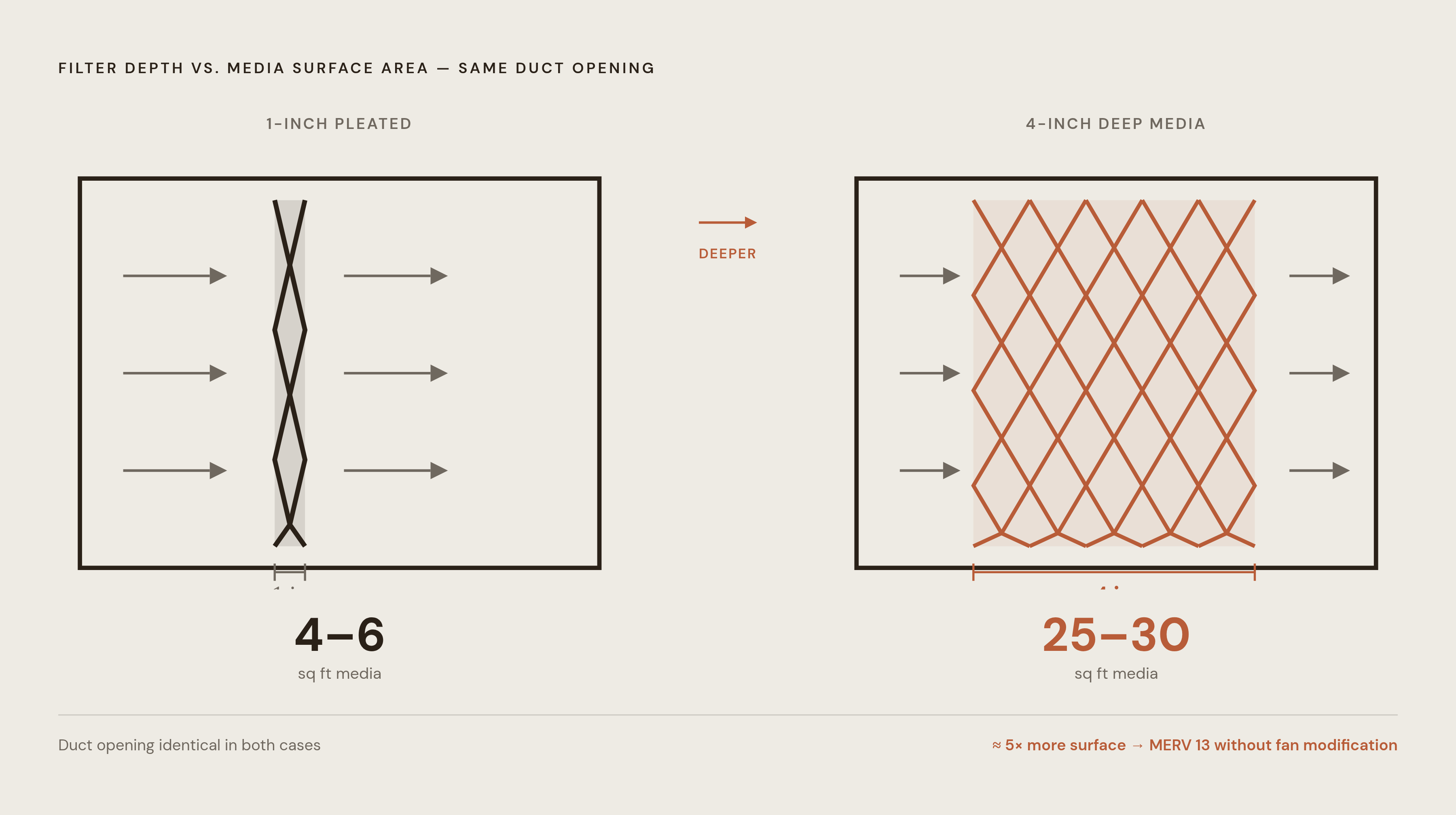
Energy cost climbs right alongside pressure drop, too. Every half-inch of water gauge added above a clean-filter baseline adds to fan energy draw, and that additional draw compounds across a full year of runtime. Filter depth is the key variable that breaks the efficiency-versus-resistance trade-off, since a standard 1-inch pleated filter has approximately 4–6 square feet of media surface area while a 4-inch deep media filter folds 25–30 square feet into the same duct opening, dramatically reducing resistance at equivalent MERV ratings.
ASHRAE 62.1 and the regulatory stack's requirements, and where recommendations exceed mandates
Most of the confusion in commercial MERV selection traces back to one habit: treating a recommendation as if it were a requirement, or the other way around. Regulatory codes set a floor. They don't set a target, and they were never meant to.
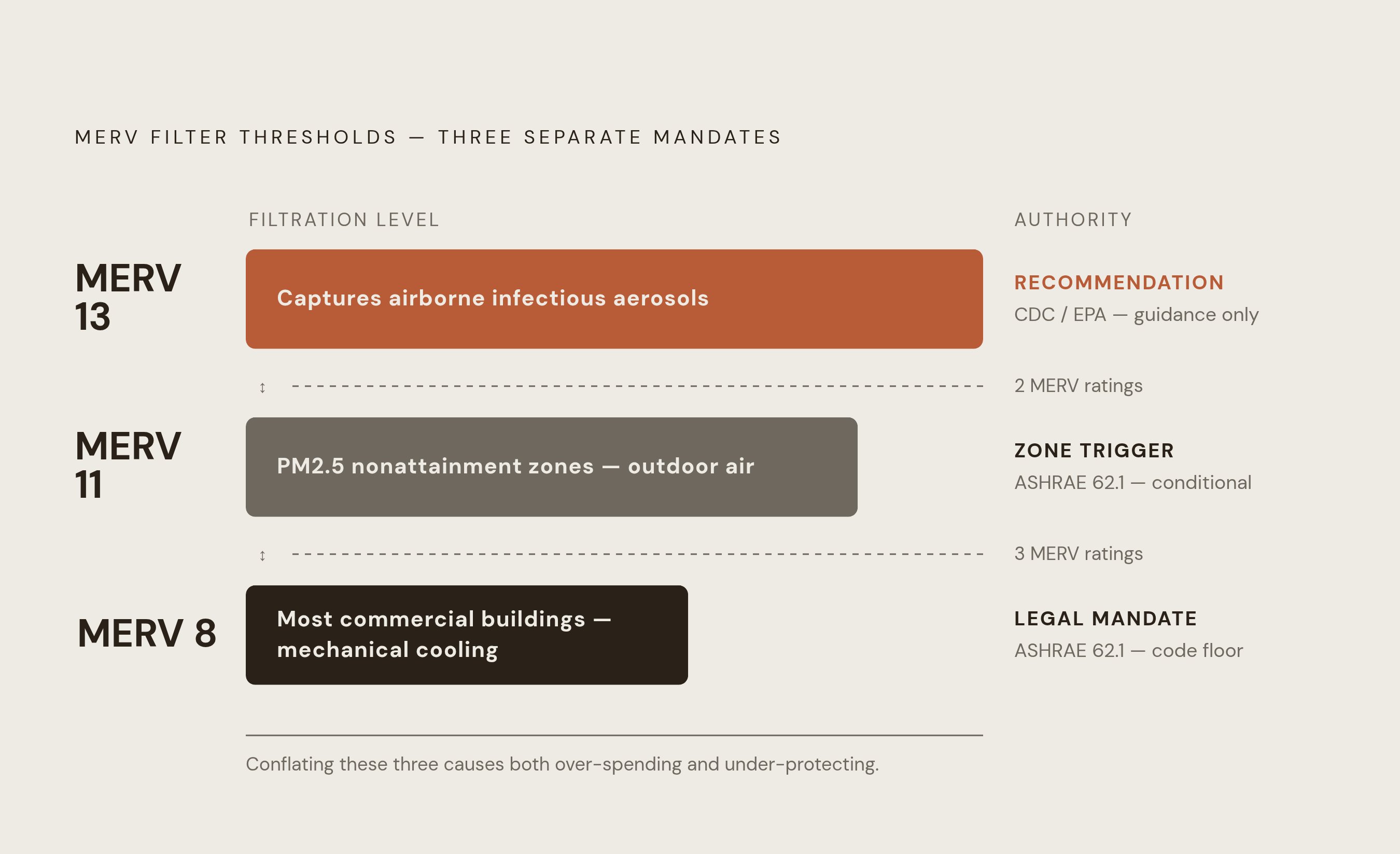
The floor itself is lower than most people assume. ASHRAE 62.1 requires a minimum of MERV 8 for commercial buildings running mechanical cooling, and MERV 8 specifically ahead of any wetted cooling coil. That's the baseline, full stop, for the vast majority of commercial construction. In PM2.5 nonattainment zones, where outdoor air itself exceeds federal fine-particulate standards, ASHRAE 62.1 bumps the requirement to MERV 11 on outdoor air, a jurisdiction-specific wrinkle. That trigger gets missed constantly, because it depends on where a building sits, not on what the building is.
Now compare that against what health agencies actually recommend. The CDC and EPA both point to MERV 13 as the target for reducing airborne infectious aerosol concentration in shared indoor spaces. That's guidance, not code, until the moment someone writes it into a project specification or a corporate IAQ standard. At that point it becomes binding, but only because a document made it so, not because ASHRAE 62.1 demands it.
Which edition of 62.1 even applies is its own moving target. Depending on the jurisdiction, the version in force could be 2019, 2022, or 2025, and as of now, no state has adopted the 2025 edition. Checking with the local Authority Having Jurisdiction isn't a formality here, it's the only way to know which set of numbers actually governs a given building. None of that changes the MERV 8 commercial floor today, but it signals where the floor is headed.
MERV 8 is the legal minimum for most commercial cooling systems, MERV 11 kicks in in specific air-quality zones, and MERV 13 is a health-agency recommendation that only becomes enforceable once someone puts it in writing. Confusing those three categories is where a lot of over-spending and under-protecting both start. ASHRAE 62.1-2025 major updates include expanded humidity control requirements, a new air density correction factor for ventilation zones, and requirements for air-cleaning system performance including end-of-useful-life efficiency calculations.
Building Type, Occupancy Profile, and the Appropriate MERV Target
Once the fan curve is checked and the regulatory floor is clear, the actual target comes down to a simpler question: who's breathing this air, how many of them are there, and what's floating around that shouldn't be. That's an occupancy question before it's a mechanical one.
Office buildings sit in the middle of the range. A mid-range MERV rating is the recommended baseline for commercial office buildings, effective for occupant air quality without overloading standard commercial air handling units. Schools sit higher. ASHRAE and CDC guidance both point to MERV 13 as the recommended minimum for classrooms, even though ASHRAE 62.1 itself only mandates MERV 8 as a technical floor. MERV 13 is the minimum recommended by ASHRAE/CDC guidance for schools (though ASHRAE 62.1 itself mandates only MERV 8 minimum), capturing particles down to 0.3 microns and reducing airborne transmission of bacteria and viruses among students and staff.
Warehouses and industrial space, by contrast, don't need that level of filtration. A moderate MERV rating handles the dust, pollen, and mold spores typical of that environment without adding pressure drop the system doesn't need to absorb. Hospitality properties land in a similar middle zone: a moderate rating balances guest comfort against the energy cost of running high-turnover HVAC systems around the clock. Government buildings often go the other direction. Federal specifications frequently mandate MERV 13 or higher, independent of what a comparable private office building would choose.
Then there's the category where standard filtration simply doesn't apply. Treating that environment the same as an office tower's filtration plan isn't a minor miscalculation, it's a mismatch between the contaminant and the tool meant to catch it.
None of these categories rank above another. A school isn't "more advanced" filtration than a warehouse, it's a different occupancy profile with a different contaminant risk and a different tolerance for airborne transmission. The target follows the building's actual use, not a hierarchy of ambition. In industrial and manufacturing environments with oil mist, metal dust, or chemical contaminants, specialty solutions including bag filters rated MERV 13–15 may be required, as standard pleated filters are not adequate.
Box rating limits versus filter depth and media area
Depth is the variable that makes a high MERV rating and a low pressure budget compatible with each other, and it's the part of the spec sheet that gets skipped most often. Specifying MERV rating without specifying filter depth is like specifying a car's top speed without mentioning how much room there is under the hood.
The physics that produces this effect is straightforward. More surface area spreads the same volume of air across more media, which lowers face velocity through the filter, which in turn lowers pressure drop at the same MERV rating, or even a higher one. That's the mechanism that breaks the trade-off outlined earlier: efficiency doesn't have to mean resistance if there's enough physical depth to spread the load.
The catch is that not every rack has room for it. Whatever track depth exists physically constrains which filter configurations are even possible, regardless of what rating someone wants to spec.
That constraint also opens a retrofit path. Older systems originally built around MERV 8 filters can sometimes accept a jump to MERV 13 simply by swapping a 2-inch filter for a 4-inch or 6-inch model, without touching the fan at all. It doesn't work everywhere, but where the rack depth allows it, it's often the cheapest upgrade available.
Facilities that standardize a fixed list of filter sizes and buy by the case tend to keep their ratings consistent across changeout cycles. Facilities that don't end up with a half-used box of the wrong size sitting on a shelf, and that's often how a building ends up running mismatched ratings across different air handlers, quietly undoing whatever IAQ target it was supposed to be hitting. And for buildings where depth alone still can't close the gap, newer low-pressure-drop filter technologies, Blade Air Systems among them, now deliver MERV 13 performance at pressure drops closer to what a MERV 8 filter would produce. It's one option among a growing set, and it's evidence that the old ceiling on efficiency-versus-resistance is starting to move. A standard 1-inch pleated filter has approximately 4–6 square feet of media surface area, while a 4-inch deep media filter folds 25–30 square feet into the same duct opening.
The business case for getting the match right, and the cost of getting it wrong in either direction
Both mistakes cost money. Over-specifying and under-specifying aren't opposite risks with one safe side, they're two different ways of losing money on the same decision, and the size of the loss is often bigger than the filter itself.
Over-specify, and the pressure drop penalty raises fan energy draw, accelerates equipment wear, and increases the risk of coil freeze or motor burnout, all of which compound the longer the mismatch runs. Under-specify, and the failure mode flips: contaminants that should've been captured stay airborne, recirculate through occupied space, and chip away at occupant health and, eventually, productivity. Neither direction is free. The question is just which cost a building is willing to absorb, and most facility managers would rather not choose either if the actual answer is available with a fan curve check and an occupancy assessment.
The productivity side has real evidence behind it. The Harvard COGfx study found that improving ventilation and filtration raised cognitive function scores tied to crisis response, strategic thinking, and information usage, with productivity gains estimated in the thousands of dollars per employee each year. It also reframes the filter line item as a productivity lever rather than just a maintenance cost.
Run the math on a specific upgrade and the case gets sharper. Moving a large commercial building from MERV 8 to MERV 11 adds a modest amount to filter and energy costs each year, but the potential savings in reduced absenteeism and lower coil-cleaning frequency tend to outweigh that added cost by a wide margin. Coil cleaning deserves its own mention here, because it's the line item nobody thinks about until the service call arrives. A filter properly matched to the system keeps coils cleaner longer, which means fewer cleaning calls and a longer coil lifespan, so in a sense the filter cost is partially substituting for a maintenance cost that would otherwise occur later.
Zoom out and the stakes stop looking operational. IAQ has become a strategic consideration in commercial real estate, not just a facilities line item. Buildings that can't demonstrate safe, well-ventilated space now face real tenant retention risk and, in some cases, legal exposure. That's the context a MERV decision sits inside today: not "which filter is cheapest," but "which filter protects the asset."
Operationalizing MERV selection: from system audit to maintenance protocol
Every failure mode described above traces back to a step someone skipped. Getting the match right isn't a single decision made once at spec time, it's a repeatable sequence: audit the system, check what's actually required, configure for depth, verify the installation is sealed, and maintain on a condition basis rather than a calendar basis.
Start with the system audit, because everything downstream depends on it. Measure the actual face velocity at the filter rack directly, rather than trusting whatever the original design documents assumed. Pull the fan's external static pressure rating and its fan curve, and confirm exactly how much depth the rack physically allows, whether that's 2-inch, 4-inch, or something deeper. This is the step Winter Park skipped, and it's the cheapest insurance available against repeating that outcome.
From there, move to the regulatory and certification check. Check whether the project is pursuing LEED v5 certification, which carries its own MERV 13 prerequisite, and confirm whether the building falls inside a PM2.5 nonattainment zone that would trigger the MERV 11 outdoor air requirement.
With the mechanical ceiling and the regulatory floor both established, depth configuration becomes the actual specification decision, not just a technical footnote. That means selecting media area based on the rack's available depth, checking whether a retrofit to 4-inch or 6-inch filters clears room for a MERV upgrade without fan modification, and standardizing on one size list so changeout doesn't quietly reintroduce mismatched ratings down the line.
Installation integrity produces all of that, so nothing holds without it. A correctly rated filter sitting in a damaged rack, missing its gasket, still lets contaminated air bypass the media entirely, so verifying seal integrity at every changeout isn't optional, it's the difference between a rated filter and a functioning one. Maintenance protocol closes the loop: monitoring pressure drop over time and replacing filters on measured condition, rather than a fixed calendar interval, catches the moment a filter is loading up before it starts costing energy or straining the fan.
Sources
- MERV Ratings Guide for Florida Commercial Properties
- Guidelines for Selecting MERV 13 Filters for Different Building Types and Sizes | HVAC Laboratory
- Switching To A Higher MERV Rated Filter? Pump The Brakes
- Why MERV 13 Filters May Be Straining Your HVAC & What to Do Instead
- What Is ASHRAE Standard 62.1? A Beginner’s Guide to Commercial Ventilation Standards
- 2025 ASHRAE Ventilation Standards for Commercial Buildings Guide
- Q1. What filters are recommended for HVAC systems? Q2
- High-MERV Filters | Building America Solution Center