ASHRAE 62.1 Ventilation Standards and Occupant Health
Proper ventilation under ASHRAE 62.1 protects respiratory health across millions of indoor spaces.

ASHRAE 62.1 sets the technical floor for indoor air quality, and understanding its requirements (filtration, humidity control, outdoor air rates) reveals why ventilation design is a first-line defense for the millions of occupants whose respiratory health depends on what's in the air they breathe indoors.
ASHRAE 62.1: scope and applicability
ASHRAE Standard 62.1 sets the minimum ventilation rates and related requirements that make indoor air fit to breathe. It is not a suggestion. Mechanical engineers design against it as the technical floor, and code officials check both plans and installed systems against that same floor.
The standard defines success in a way that deserves close attention. Acceptable indoor air quality means no known contaminants are at harmful concentrations, as judged by the relevant authorities, and at least 80% of the people breathing that air don't complain about it https://blog.ansi.org/ansi/ansi-ashrae-62-1-2025-ventilation-indoor-air/. That 80% threshold carries the whole standard on its back. Built into the definition of success from the start, it resurfaces later as the standard's real limit: a floor that satisfies 80% of people still leaves one in five out in the cold.
Coverage runs wide. Office floors, school classrooms, hospital waiting rooms, anywhere people occupy a building, all fall under it. One line stays fixed, though: nontransient dwelling units in residential buildings sit outside its scope. Apartments and houses answer to a separate standard.
Engineers working under 62.1 get to pick their path rather than follow one fixed formula. The standard lays out three separate procedures, the Ventilation Rate Procedure, the Natural Ventilation Procedure, and the IAQ Procedure, since no single approach fits every building type.
The standard's evolution from a 1973 baseline to its current form
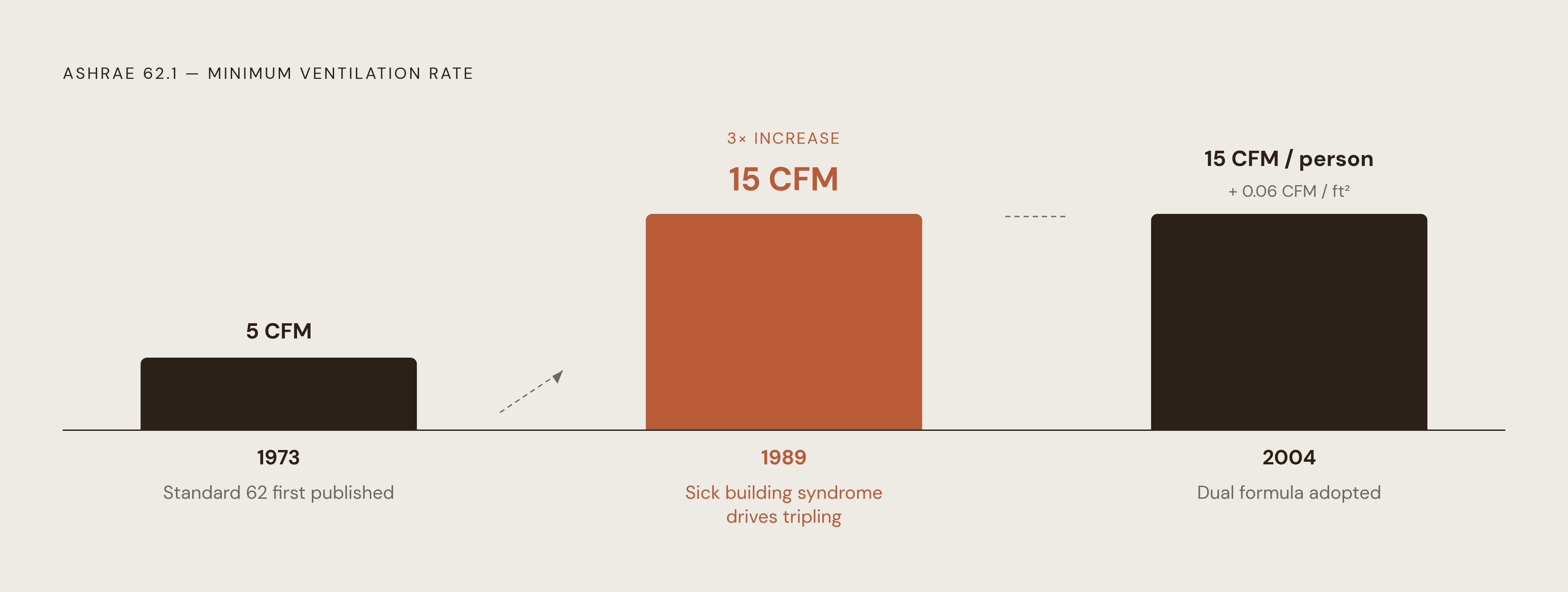
The standard goes back further than most people assume. ASHRAE first published it in 1973 as Standard 62-73, covering both natural and mechanical ventilation https://blog.ansi.org/ansi/ansi-ashrae-62-1-2025-ventilation-indoor-air/.
1989 marked the real turning point. That update tripled the minimum acceptable ventilation rate, from 5 cubic feet per minute per person to 15 CFM per person https://blog.ansi.org/ansi/ansi-ashrae-62-1-2025-ventilation-indoor-air/. Growing evidence showed the original 5 CFM figure was insufficient. Sick building syndrome was entering the vocabulary around this same stretch, and the revision reflected how seriously the industry had started taking occupant complaints.
Then came 2004, and this one changed the math itself. Before that revision, ventilation requirements ran on a simple per-person rate, straightforward but incomplete. The 2004 revision introduced the dual calculation still in use today, setting requirements based on both occupancy and floor area https://blog.ansi.org/ansi/ansi-ashrae-62-1-2025-ventilation-indoor-air/. The split exists because people aren't the only source of indoor contaminants. Carpet, paint, adhesives, furniture: all of it off-gasses, and a room can sit completely empty while still accumulating volatile organic compounds from the materials inside it. The floor-area component accounts for that, independent of how many people ever walk through the door.
Since then, revisions have landed on a steady clock: 2007, 2010, 2013, 2016, 2019, 2022, and now 2025. Some editions bring drastic change, some bring almost nothing. The cadence itself says something, though: this is a document that keeps getting rewritten as the underlying science, and the buildings themselves, keep changing.
ANSI/ASHRAE 62.1-2022 requirements and changes
Take a typical office under current requirements. The formula calls for 5 CFM per person, plus 0.06 CFM per square foot of floor area https://blog.ansi.org/ansi/ansi-ashrae-62-1-2025-ventilation-indoor-air/. Both numbers do different jobs, and neither one covers for the other. The per-person figure accounts for what occupants themselves generate: carbon dioxide from breathing, plus the biological particles people shed just by existing in a room. The per-square-foot figure accounts for what the building itself generates, VOCs off-gassing from finishes, particulates from furnishings, moisture held in materials. Adding a person to the room raises the requirement. Adding square footage raises it again, independent of how many people are standing in it.
Schools work off a related but distinct benchmark. A school with a well-maintained HVAC system complying with the standard needs a minimum of 5 liters per second per person of outdoor air, the figure a compliant classroom gets measured against https://blog.ansi.org/ansi/ansi-ashrae-62-1-2025-ventilation-indoor-air/. That's the number a compliant classroom gets measured against. A room full of kids breathing recycled air below that threshold isn't meeting the floor the standard sets, full stop.
The 2025 edition brings a handful of real changes. Humidity control requirements got refined and expanded, and that turns out to be the single most health-relevant update for anyone dealing with allergies, for reasons the next section unpacks. New requirements now address emergency ventilation control, covering how systems behave during atypical operating modes like a wildfire smoke event or a nearby chemical release. New calculation methods cover several things at once: how far outdoor air intakes need to sit from exhaust outlets, an air density correction factor applied across ventilation zones, rules for buildings that have to satisfy more than one standard at once, and a new control sequence for demand control ventilation. The 2025 edition also adds requirements for air-cleaning system performance, including a calculation for how efficient a filter remains at the end of its useful life against certain contaminants. The performance path for exhaust systems got revised as well.
As of August 2025, a couple of addenda were still working through approval. One would adjust the default occupant densities listed in Table 6-1, lining them up with the occupant density allowances in the 2024 International Building Code. Another would change documentation requirements so the occupant component and the building component get recorded separately for every demand control ventilation zone. Neither change is dramatic on its own. Together, they show the standard tightening its own bookkeeping, closing gaps between related codes instead of letting them drift apart.
Humidity control as the hinge between ventilation compliance and allergen load
Of everything in the 2025 revision, the expanded humidity control requirements matter most for anyone with allergies. Humidity gets singled out because it's the one variable in a building that decides that biological allergens grow or stay dormant. Get it wrong, and a building can hit every other requirement in 62.1 and still turn into a breeding ground.
Take mold first. Dampness shows up in roughly 15% of households, and where there's dampness, mold follows https://blog.ansi.org/ansi/ansi-ashrae-62-1-2025-ventilation-indoor-air/. Specific genera, Penicillium, Alternaria, and Cladosporium, appear repeatedly in research tied to allergic rhinitis. A literature review covering 2006 through 2017 found enough evidence to link mold exposure and allergic rhinitis in children, though whether ongoing exposure worsens symptoms over time stays murkier. The mechanism itself is not murky at all: mold needs moisture to grow, and humidity control cuts that moisture off at the source.
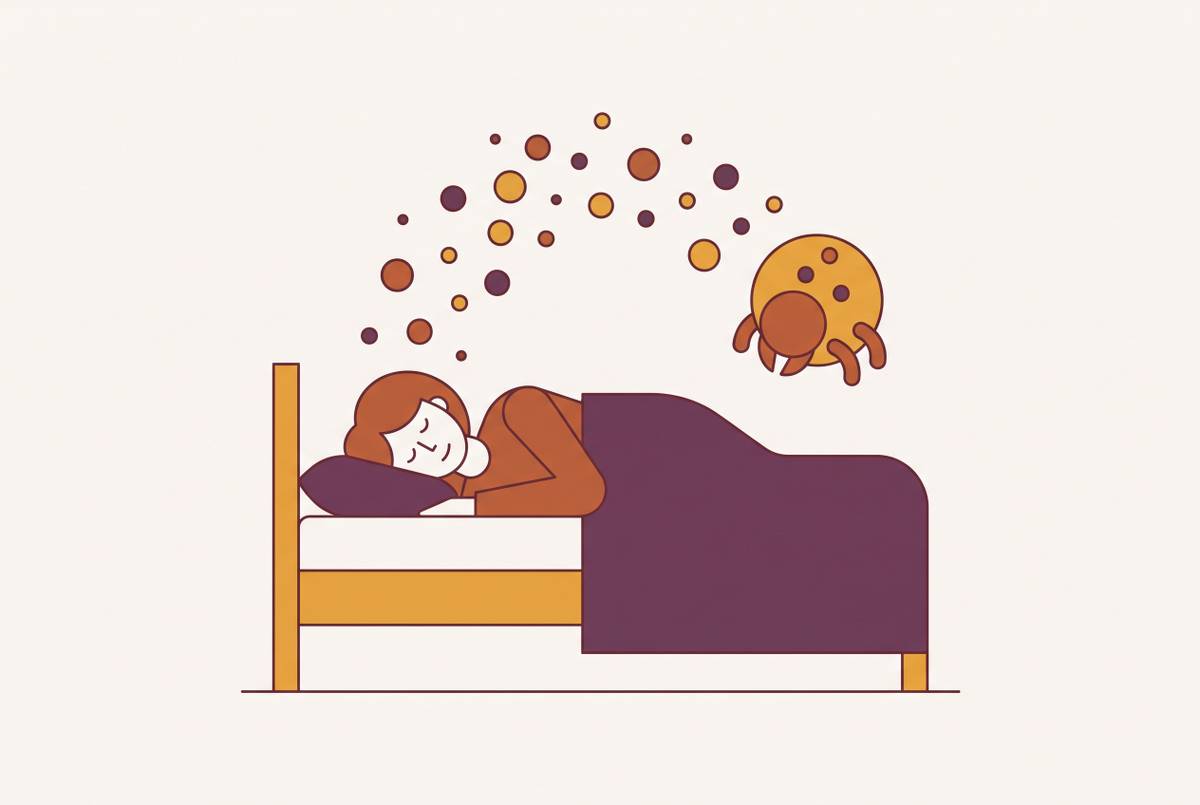
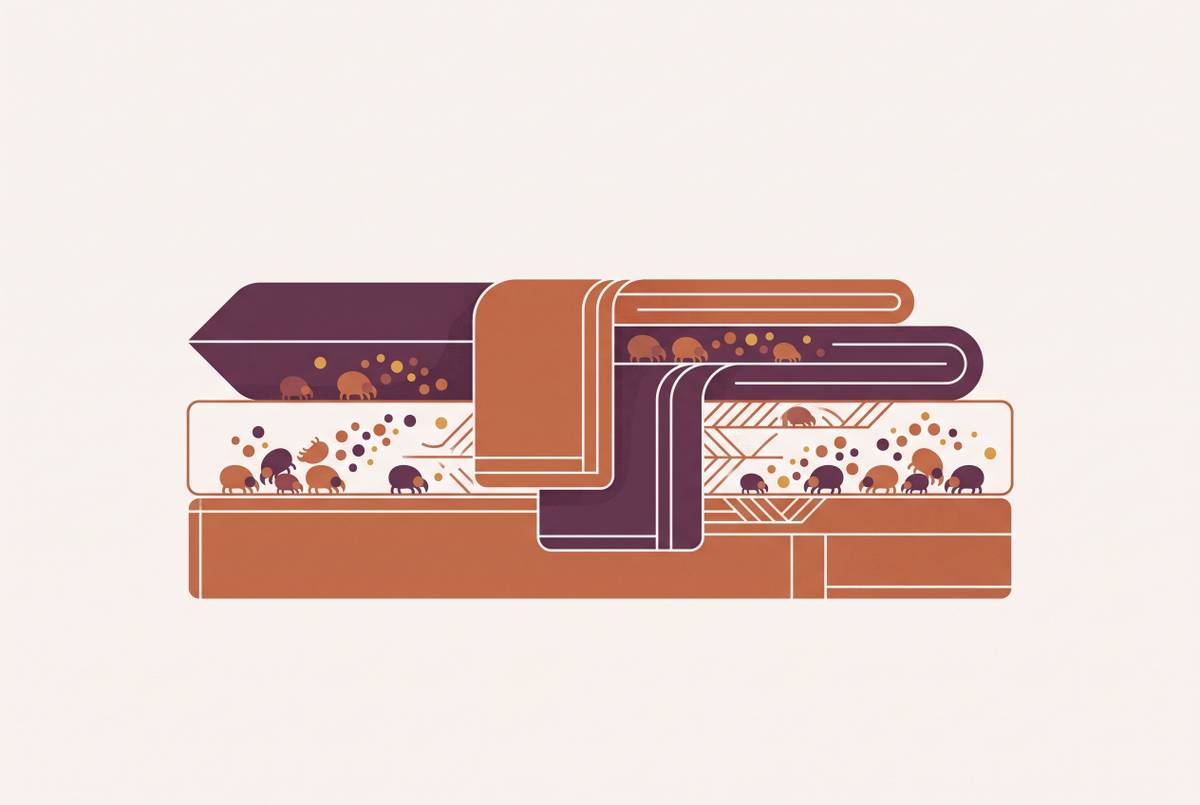
Dust mites tell a similar story with a sharper seasonal edge. May through August marks mite season, the stretch when they breed most actively. They don't need much room to do it. A single gram of household dust can hold anywhere from 100 to 500 mites, and each one produces 10 to 20 waste particles a day https://blog.ansi.org/ansi/ansi-ashrae-62-1-2025-ventilation-indoor-air/. That waste, not the mites themselves, is the primary allergen. High indoor humidity speeds up mite reproduction, and the waste output climbs right along with it. Bring humidity down, and the whole reproductive cycle slows with it.
The standard treats moisture and biological growth as contaminant sources in their own right. Most of what 62.1 does works by dilution: move enough outdoor air through a space and pollutant concentrations drop. Humidity control is different. It suppresses allergen production at the biological root, before there's anything to dilute.
The indoor allergens that inadequate ventilation and humidity control allow to accumulate
Buildings get treated as shelter from the outside world. When it comes to allergens, that framing flips: indoor exposure often produces more severe symptoms than outdoor exposure does. A building without adequate ventilation and humidity control doesn't protect occupants from allergens. It concentrates them.
Dust mites carry the largest global footprint of any indoor allergen in this picture. Two species drive most of that burden, Dermatophagoides pteronyssinus and Dermatophagoides farinae, known in shorthand as Der p and Der f. Researchers have identified roughly 30 proteins in allergenic preparations from each species, and two groups stand out as the major allergens: group 1, with a molecular weight around 25,000, and group 11, around 14,000 https://blog.ansi.org/ansi/ansi-ashrae-62-1-2025-ventilation-indoor-air/. Ventilation and humidity control remain the primary environmental tools for keeping mite populations down, because unlike a lot of allergen sources, mites respond directly and predictably to moisture levels.
Mold follows a parallel track. Penicillium, Alternaria, and Cladosporium keep surfacing across the research, and a meta-analysis found a significantly higher risk of allergic rhinitis tied to home dampness and mold exposure. The mechanism runs straight back to ventilation: adequate air exchange removes the moisture mold needs to establish itself, and that's the actual pathway through which 62.1 compliance lowers mold risk. No moisture, no mold.
Somewhere between 15% and 30% of people with allergies react to pet allergens, whether that's dander, saliva, or urine residue, and cat allergies occur roughly twice as often as dog allergies https://blog.ansi.org/ansi/ansi-ashrae-62-1-2025-ventilation-indoor-air/. Dander proteins go airborne easily and land straight in the respiratory tract on inhale. Humidity control doesn't touch this pathway at all, so filtration and outdoor air dilution become the ventilation-system tools that actually matter here. An estimated 65 to 130 million people are affected globally, including around 20 million in the United States.
The effects of poor indoor air quality on occupants who breathe it every day
Americans spend up to 90% of their time indoors https://blog.ansi.org/ansi/ansi-ashrae-62-1-2025-ventilation-indoor-air/. Indoor air quality is a concern for close to the entire population. Most of every day, most people are breathing whatever a building's ventilation system happens to be delivering.
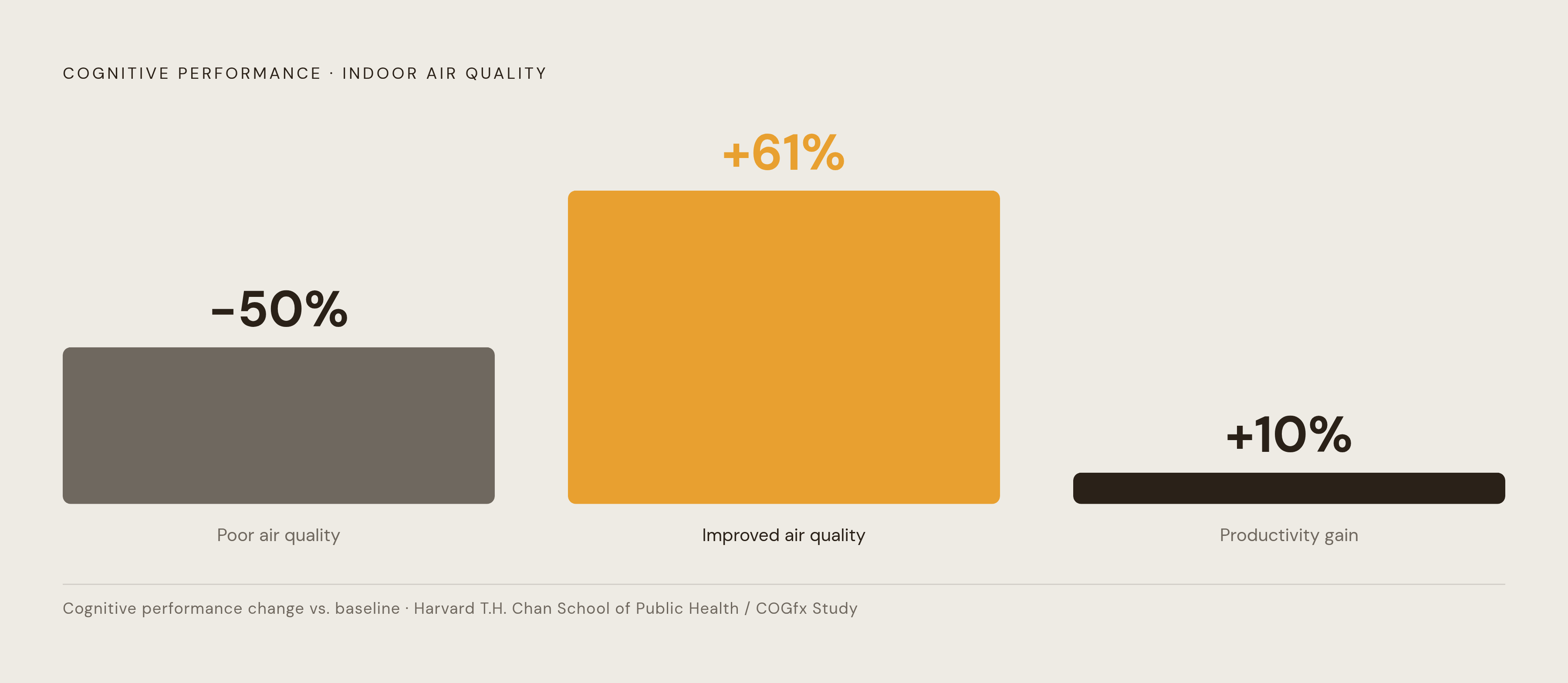
The cognitive cost is where this stops being abstract. Poor indoor air quality can drag cognitive performance down by as much as 50% https://blog.ansi.org/ansi/ansi-ashrae-62-1-2025-ventilation-indoor-air/. Improved air quality links to a 61% boost in cognitive performance and a 10% gain in productivity when the numbers run the other way https://blog.ansi.org/ansi/ansi-ashrae-62-1-2025-ventilation-indoor-air/. Those figures make the economic case for building past the 62.1 minimum rather than just clearing it.
Part of the mechanism is straightforward chemistry. The brain requires roughly 20% of the body's oxygen supply despite making up only about 2% of body weight https://blog.ansi.org/ansi/ansi-ashrae-62-1-2025-ventilation-indoor-air/. The per-person component of the ventilation rate calculation exists specifically to counter this. It's not an incidental side benefit; it's the reason half the formula exists.
A second, less obvious pathway runs straight through allergies. Histamine isn't only the chemical behind a runny nose. It also works as a neurotransmitter, helping regulate alertness and sleep cycles. So when allergen exposure sets off an inflammatory response, the histamine dysregulation that follows can dull mental sharpness on its own, separate from any sneezing or congestion a person notices. Someone can feel mentally foggy from allergen exposure when the histamine dysregulation triggered by that exposure dulls mental sharpness, without a single classic allergy symptom appearing. The cognitive toll of bad indoor air reaches well past people who already know they're allergic to something.
Ventilation Compliance and Allergy-Sensitive Occupants
Credit where it's due first. A building that meets 62.1 delivers real, measurable protection. Continuous outdoor air exchange dilutes airborne allergens before they build to problem levels. Air-cleaning performance requirements keep filtration from quietly degrading as a system ages. Intake placement rules cut down on pollen working its way into the building in the first place. None of that is trivial: it amounts to a genuine, engineered first line of defense.
What compliance doesn't fix traces straight back to the standard's own definition of success. "Acceptable" IAQ means satisfying 80% or more of occupants https://blog.ansi.org/ansi/ansi-ashrae-62-1-2025-ventilation-indoor-air/. Compliance was never built as a guarantee for every single person in the room. It was built as a population-level floor, and floors have people standing below them by design.
Outdoor air quality is another variable no building fully controls. Section 4 of the standard governs it, but a high pollen day or a heavy mold count outside can overwhelm even an intake system doing everything right.
Operations and maintenance gaps do their own quiet damage, and this is where the gap between design and reality tends to open up. Section 8 covers ongoing system upkeep, and a compliant design on paper can fail here in practice. A filter that doesn't get swapped on schedule undermines the entire air-cleaning performance calculation the design was built around.
There's a scope issue easy to miss, too. 62.1 governs commercial and institutional buildings. Most people's actual allergen exposure happens at home, where a separate standard, ANSI/ASHRAE 62.2-2025, applies and enforcement runs a lot thinner. An office might clear every requirement in the book while the bedroom someone sleeps in eight hours a night sits under no comparable oversight at all.
Taken together, these gaps point at something the standard was never built to solve. Environmental allergen control cuts down exposure, but it does nothing to change how a sensitized immune system reacts to whatever allergen load still gets through. That's a separate problem, and it needs a fix aimed at the immune system itself rather than the air around it.
Immunotherapy's role in retraining the immune response, which ventilation standards cannot do
No ventilation system, however well engineered, reaches into the immune system and changes how it responds to an allergen. That sits outside what airflow and filtration were ever built to do. Allergic rhinitis starts when the immune system mistakes something harmless, dust mite waste, mold spores, pet dander, pollen, for a threat and starts churning out IgE antibodies against it. Once someone's sensitized this way, even a much smaller allergen load can still set off the same reaction. A building could cut allergen exposure in half through excellent ventilation, and a sensitized person could still react to whatever's left over.
Sublingual immunotherapy, usually shortened to SLIT, works on that exact mechanism instead of the air around it. It introduces small, controlled amounts of an allergen to specialized dendritic cells sitting just under the tongue. Over time, exposure at this level nudges those cells to shift the immune response away from IgE production and toward IgG4 antibodies, which work protectively instead of triggering a reaction. That's retraining, in the most literal sense available. The immune system learns to stop treating the allergen as a threat.
The clinical record backs this up with real outcomes. SLIT reduces both symptoms and medication use in allergic rhinitis and rhinoconjunctivitis compared with placebo, and it carries a favorable safety profile. A systematic review published in JAMA found moderate-grade evidence supporting SLIT for allergic rhinoconjunctivitis, with no life-threatening events reported across the studies reviewed. That's a meaningful bar for any treatment working directly with the immune system to clear.
How does SLIT stack up against the older approach, allergy shots given subcutaneously? SLIT tends to pull ahead on convenience: it skips the repeat clinic visits that shots require, which matters for occupants whose schedule or location makes regular in-person appointments a real obstacle. For plenty of people managing allergies around a full week of work and commuting, the option that fits into daily life wins out over the one that technically works just as well.
Stepping back, the two halves of this problem come into focus together. Ventilation design under 62.1 is the first line of defense, cutting down what's in the air before it reaches anyone's lungs. Immunotherapy is the second line, changing how the body reacts to whatever gets through anyway. Neither replaces the other, because they solve different halves of the same problem, and skipping one to lean harder on the other leaves a gap no amount of airflow or antibody shifting can close alone. Allergies affect more than 50 million Americans every year, making it one of the most common chronic health conditions in the country https://blog.ansi.org/ansi/ansi-ashrae-62-1-2025-ventilation-indoor-air/. Worldwide, prevalence runs from 10 to 40% of the population depending on the country, the World Allergy Organization finds, and house dust mite allergy alone is estimated to touch 65 to 130 million people globally, with around 20 million of those cases in the United States https://blog.ansi.org/ansi/ansi-ashrae-62-1-2025-ventilation-indoor-air/. A building only needs both once it's asked them both. The Sleep Foundation reported that individuals with untreated allergic rhinitis experience more frequent nighttime awakenings and reduced deep sleep https://blog.ansi.org/ansi/ansi-ashrae-62-1-2025-ventilation-indoor-air/.