Open-Plan Office Design and Allergen Circulation
Open-plan offices spread allergens across entire floors through shared ventilation systems.

More than 82 million Americans carry a seasonal allergic rhinitis diagnosis, which works out to roughly 25 out of every 100 adults AAFA. Most of what gets written about allergen exposure points at the home, or at pollen counts outdoors, and rarely at the place where adults spend the bulk of their waking hours AAFA. Open-plan design, now the default for modern offices, trades something real for its collaboration and space-efficiency benefits: the physical enclosures that used to keep airborne particles contained.
The tension is straightforward once you name it. The openness that makes a floor feel collaborative is the same openness that lets dust, mold spores, and dander travel farther and reach more people. Nobody's claiming the office replaces pollen season as the main trigger for allergy sufferers. But for someone already sensitized, the office adds a layer of exposure most people never trace back to their environment, because nobody thinks to look there.
There's also a dollar figure attached to this that tends to get ignored. AAFA puts the annual economic burden of allergies at approximately $34 billion, a number that includes lost productivity. Once you count productivity losses as part of that burden, workplace exposure becomes a direct line item rather than a side note.
Why open-plan design increases particles in the air
Picture the office layout that open-plan replaced: enclosed rooms, cubicle walls, doors that close. None of that was designed with allergens in mind, but all of it did double duty as a barrier that slowed how far a stray particle could travel. Open-plan strips that away. Fewer walls, partitions that are lower or missing outright, bigger shared floor areas, and often higher ceilings fed by a single HVAC system that serves everyone on the floor.
Walls do more than divide space visually. They create small, separate environments, so that the dust settling in one cubicle, the mold-prone corner in one office, or the dander shed by one person's coat stays roughly where it started. Without the walls, there's nothing local about it anymore. Foot traffic, desk fans, and ordinary air currents move particles across the entire floor plate instead of keeping them boxed into one room.
A few design choices make this worse than it has to be. Shared couches, rugs, and fabric-covered chairs in common areas collect dust mites and dander at a much higher rate than hard surfaces do. Open storage and exposed desks and tables give dust somewhere to land and then get kicked back up. And fewer doors means fewer of the small air-lock transitions that used to interrupt airflow between zones.
None of this is hypothetical. AAFA names dust mites, mold spores, cat and dog dander, and rodent dander among the most common indoor and outdoor triggers, and every one of them appears in office buildings, behaving exactly like the particles they are: they go where the air takes them.
The four main allergen sources that concentrate in open offices
Start with dust and dust mites. Office dust builds up from paper, fabric fibers, skin cells, and whatever gets tracked in on shoes and clothing. Shared upholstered seating and carpeted breakout areas, both staples of open-plan common space, are where dust mites do best. Higher foot traffic kicks settled dust back into the air more often, which means it stays airborne longer than it would in a quieter, partitioned space.
Pet dander travels on people, not just on pets. A worker who lives with a cat or a dog carries dander home on clothing, on hair, in a bag, and then deposits it on a shared chair or a hot-desk surface at the office. Cat allergen in particular is light and sticky enough to stay airborne a while and linger on surfaces long after the source pet is gone. Open seating puts colleagues who'd never otherwise share a room right next to each other, so dander crosses from one person's belongings to the next desk over with nothing in between to stop it. Offices that welcome pets directly just skip the middleman.
Mold is a building problem more than a person problem. HVAC drip pans, the inside of ductwork, potted plants, water-damaged ceiling tiles, kitchen areas where water sits: these are the usual sources. Mold spores are light enough to loft into circulating air easily, and in an open floor plan, one compromised ceiling tile can seed a space far bigger than the room it's actually in.
Then there's pollen, which nobody generates indoors but everybody brings in. Lobby areas and open floors near entrances take repeated pollen deposits all day long as people come and go. In a partitioned office, hallways and door thresholds break up that spread. In an open one, there's nothing to stop foot traffic from carrying it straight across the floor.
How centralized HVAC systems turn a single allergen source into a floor-wide problem
Open-plan offices tend to run on one centralized HVAC system covering a large, undivided floor, and that system is circulating air continuously, not occasionally. In a partitioned office, each room's supply and return air stays roughly local. Something airborne in one room mostly recirculates in that room.
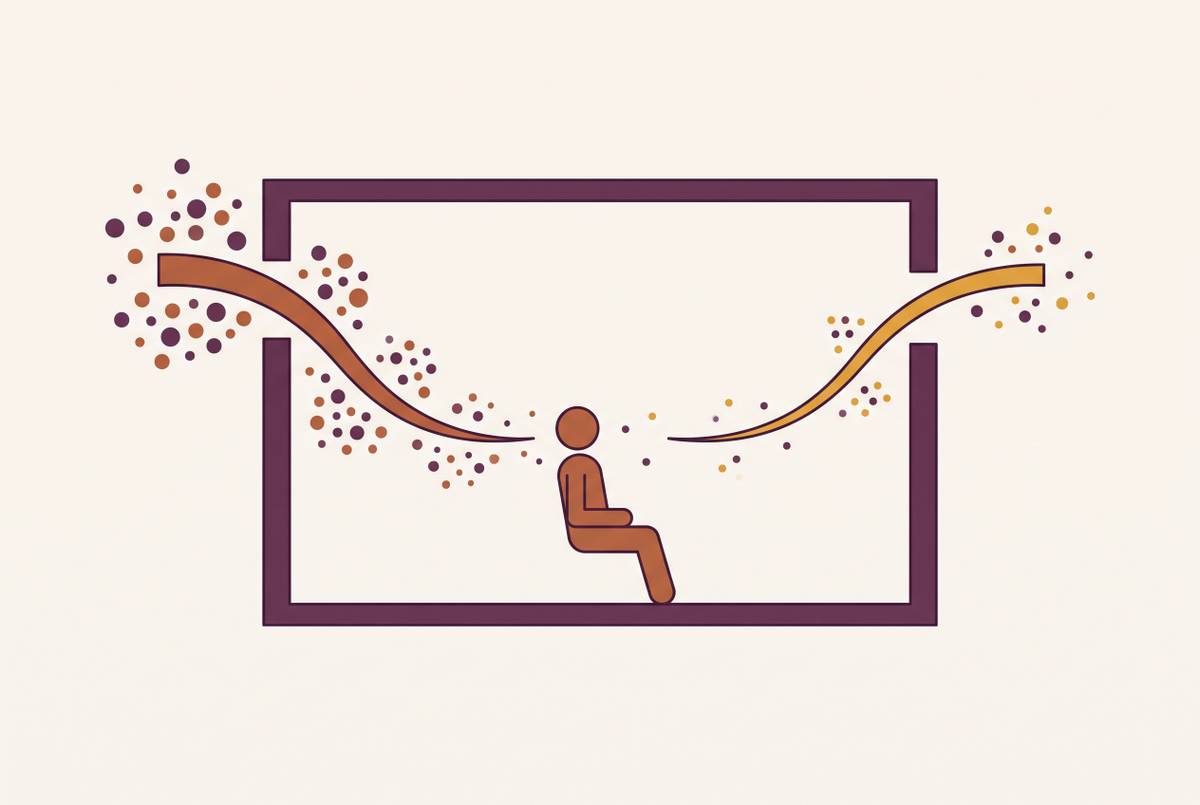
Without the walls, the math changes completely. One air handler now draws from, and delivers to, the whole floor. A mold spore that lifts off near the kitchen, dander shed near a window seat, dust kicked up by a cleaning cart, all of it can reach the far side of the floor within minutes, because there's one shared air supply instead of many separate ones.
Filter quality varies a lot and affects what particles actually get caught. Standard commercial filters are good at catching bigger particles, but they're weaker against the fine stuff, small mold spores, certain pollen fragments, ultrafine dander, which happen to be the particles that get deepest into the airway. Ductwork that doesn't get cleaned often becomes a reservoir: dust and biological material build up inside the ducts and get released whenever airflow ramps up, like when the system switches from heating to cooling.
Put together, the picture is fairly stark. Open-plan HVAC doesn't just fail to contain allergens, it actively spreads them across the whole floor, turning what would've been one person's localized problem into a shared exposure for everyone downstream of the same vent.
Why workers don't connect their symptoms to their office
Sneezing, congestion, itchy or watery eyes, postnasal drip, a headache that won't quite go away. All of these overlap so heavily with a cold, or with generic fatigue, that most people never think to blame the building. Nobody walks into an open floor plan and thinks "allergen environment." So the default explanations become seasonal illness, dry air, or just being run down, none of which point at the actual cause.
But what if the fog itself is the tell? Histamine doesn't just cause sneezing, it acts as a neurotransmitter that affects alertness and sleep, so when allergic inflammation disrupts that signaling, both energy and sharpness can dip. Brain fog and that afternoon slump aren't separate from the allergy story, they're part of it. Congestion that gets worse at night, thanks to swollen nasal tissue pushing people into mouth breathing, fragments sleep, and that carries straight into the next day's cognitive dip on top of whatever's happening at the desk.
Symptoms that ease up on the weekend, or vanish entirely on vacation, then come roaring back Monday morning, form a pattern. That's a diagnostic clue tied to the calendar itself. That's a diagnostic clue, and one most people never stop to read.
The brain needs roughly 20% of the body's total oxygen supply, which means even a modest drop in breathing efficiency from congestion can produce a real, measurable dip in cognitive performance Advanced Integrated Health. "Feeling foggy at work" Gains real weight as a productivity claim in that light. It's a physiological consequence with a mechanism behind it Advanced Integrated Health.
How office exposure interacts with existing allergies in sensitized workers
An allergic reaction doesn't come out of nowhere. It requires the immune system to have already built IgE antibodies against a specific allergen, so exposure alone isn't the trigger, sensitization is. With more than 82 million Americans carrying a seasonal allergic rhinitis diagnosis, any given open-plan floor likely holds several sensitized people already, whether or not any of them realize it AAFA.
Exposure adds up across a day, not just within one moment. A worker who's careful at home, who manages pollen exposure on the commute, can still get pushed over their personal threshold by the office's added allergen load, simply because it's one more source stacked on top of everything else. And sensitization rarely runs in isolation: someone reactive to dust mites is often also reactive to mold or pet dander, and open-plan offices are exactly the kind of place where all three concentrate together, which makes the whole thing harder to manage than a single, identifiable source would be.
Seating arrangement plays its own role here too. In a closed-door office, a colleague who owns a cat sits behind a wall. In an open plan, that same colleague sits at the next desk, and the physical distance that would've limited dander transfer simply isn't there anymore. Some workers respond by reaching for sedating antihistamines, which manage the sneezing but introduce their own drag on focus, adding a medication side effect on top of the exposure that caused the problem in the first place.
Practical steps for identifying and reducing allergen exposure in open office settings
Facilities teams have a handful of concrete levers to pull. Upgrading to higher-grade particulate filters, and actually inspecting and cleaning ductwork on a schedule, cuts down the reservoir effect that lets allergens accumulate and then get released in bursts. Choosing hard flooring over carpet in open areas matters too, since hard surfaces can be damp-mopped rather than vacuumed, which avoids kicking dust back into the air. Where upholstered furniture is unavoidable, cleanable covers and regular professional cleaning keep the dust-mite load down.
Potted plants and standing water near HVAC returns are a mold risk worth taking seriously, and the fix is often as simple as relocating them. Air quality monitoring, tracking CO₂ and particulate counts, can flag a problem zone on a floor before it becomes an obvious complaint. And giving sensitized workers access to an enclosed, low-allergen room to retreat to, especially during peak pollen weeks, costs little and helps a real subset of the workforce.
Individual workers have their own diagnostic tools, even without any facilities changes. Tracking the weekly pattern, noting whether symptoms build through the week and ease by Saturday, is one of the clearest signals available that the office itself is the trigger. Where someone sits matters too: a desk near an HVAC vent, a carpeted zone, a cluster of plants, or a busy walkway all correlate with higher exposure. Changing clothes or brushing off a coat before walking in cuts down on tracked-in pollen and dander. And a desk-level HEPA purifier can clean up the immediate air around one workstation in situations where the central HVAC clearly isn't doing the job.
Why environmental controls alone are not enough for the 82 million already sensitized
All of the steps above genuinely reduce exposure. None of them eliminate it. An open-plan office is, by definition, a shared environment, and a sensitized worker has no real control over what a colleague brings in on their coat, what the HVAC pushes through the vents, or what's been quietly accumulating in a decades-old duct system.
Avoidance isn't a workable long-term plan either. Nobody can simply stop going to the office indefinitely, and even remote work doesn't remove allergen exposure, it just relocates it to a different environment with its own dust, dander, and mold sources. Antihistamines and nasal sprays offer real relief, but only while someone's actually taking them, and they come with their own costs: sedation, a rise in blood pressure, a bitter taste that makes people quit early. The relief stops the moment the medication does.
That part underlies the symptoms and produces the office's allergy problem. The sensitization underneath the symptoms produces the office's allergy problem, and it doesn't change however carefully an office manages its filters and its flooring. Environmental management and symptom relief both have their place, but they're working on the surface. The actual cause sits one layer deeper, in an immune system that's been trained to treat a harmless particle like a threat, and that's a different kind of problem to solve.
How immunotherapy addresses the root cause rather than the exposure or the symptom
Allergen immunotherapy has been a clinical practice for over a century. It's been used clinically since 1911, and unlike an antihistamine or a filter upgrade, it targets the immune dysregulation itself rather than managing what that dysregulation produces. That distinction was reiterated recently in Dr. Larenas-Linnemann's presentation at the 2026 AAAAI annual meeting in Philadelphia.
The mechanism is where this gets genuinely interesting. Sublingual immunotherapy, SLIT, induces T regulatory cells that produce IL-10. In someone with untreated atopic disease, those cells largely fail to produce IL-10 at all. In patients who go through SLIT, the cytokine profile shifts toward what's seen in people without allergies in the first place, according to research published in the Journal of Allergy and Clinical Immunology. That reflects the immune system being retrained rather than the symptom being masked. That's the immune system being retrained, which is why the benefit doesn't require someone to keep dosing forever to keep working.
The evidence behind this has kept building. A 2026 World Allergy Organization position paper pulled together an internationally harmonized framework covering efficacy, safety, adherence, and disease modification, a sign that clinical guidance is actively converging around this approach rather than treating it as fringe. And a Cochrane review covering 60 randomized controlled trials found SLIT reduced symptom scores and medication use compared to placebo, with no anaphylaxis recorded across the trials analyzed Wyndly SLIT Evidence & Guidelines Hub.
Set against everything covered so far, that mechanism matters for office allergen exposure specifically. Filters, flooring, and desk placement can only ever reduce what reaches a person. Immunotherapy changes what happens once an allergen does reach them, which means a worker who completes treatment carries a lower reactivity into that same open floor plan, the same shared HVAC, the same dander-carrying colleague at the next desk over, none of which had to change for the exposure to matter less. Per the Frontiers in Allergy review (Paoletti et al.), robust RCT evidence supports clinically meaningful reductions in symptoms and medication use with grass and house dust mite SLIT tablets, with sustained benefits observed up to 1–2 years after a 3-year treatment course.
Sources
- Sublingual Immunotherapy for Allergy in 2026, With Désirée Larenas-Linnemann, MD | HCPLive
- How does sublingual immunotherapy work? - Journal of Allergy and Clinical Immunology
- Sublingual Immunotherapy (SLIT) Evidence & Guidelines Hub (2025)
- Frontiers | Sublingual allergen immunotherapy: evidence from randomized trials, real-world studies and meta-analyses
- Control Indoor Allergens to Improve Indoor Air Quality | AAFA.org
- The productivity tax of new office concepts: a comparative review of open-plan offices, activity-based working, and single-office concepts
- Asthma, Airway Symptoms and Rhinitis in Office Workers in Malaysia: Associations with House Dust Mite (HDM) Allergy, Cat Allergy and Levels of House Dust Mite Allergens in Office Dust
- Aeroallergens and work-related respiratory symptoms among office workers - Journal of Allergy and Clinical Immunology