Dust Mite Allergy and Sleep Disruption in Adults
Dust mite allergen fragments sleep by triggering nightly immune reactions.
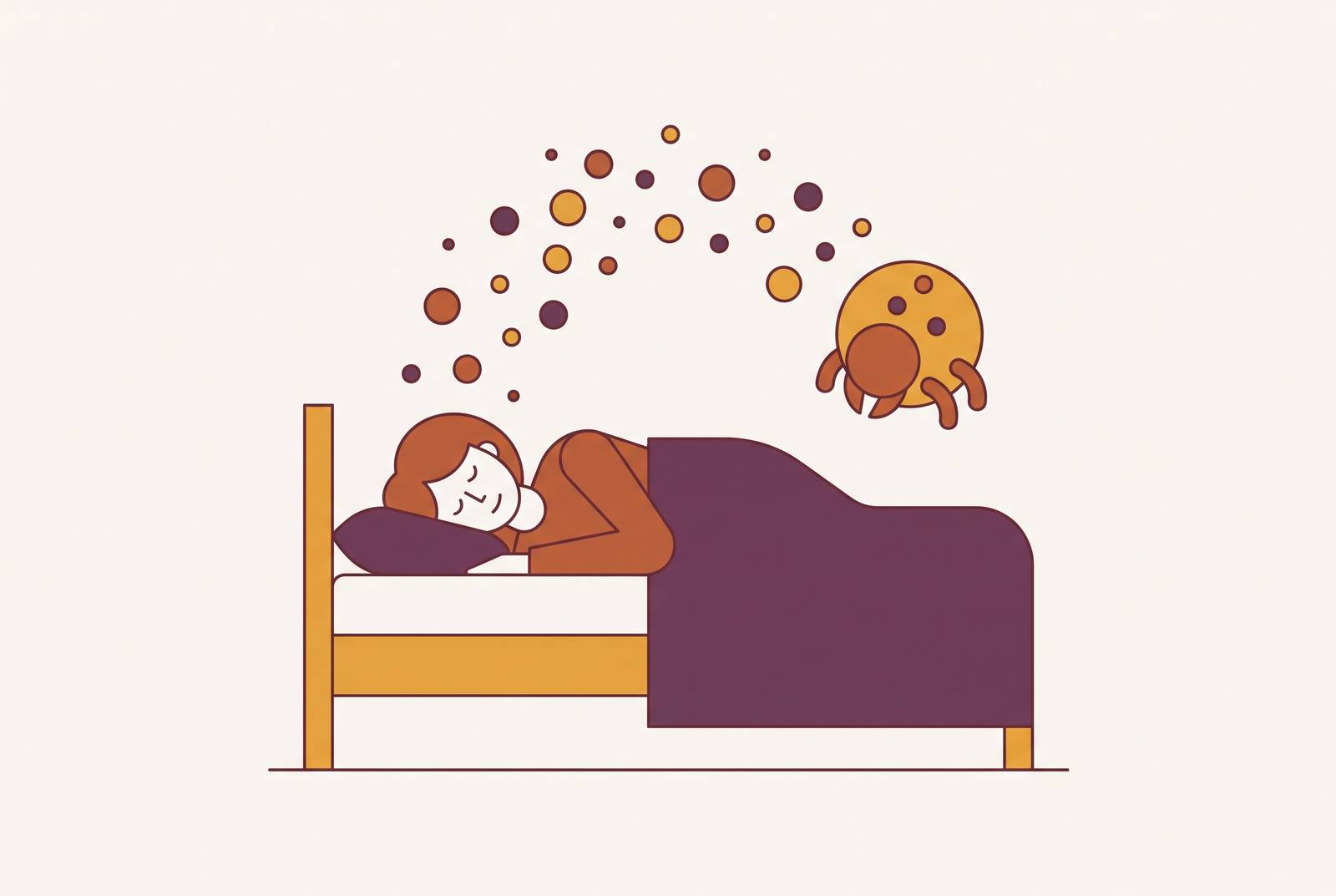
Dust mite allergy turns the bedroom into the site of a nightly immune reaction, and that reaction is quietly wrecking sleep for millions of adults. Allergen exposure triggers inflammation, inflammation fragments sleep architecture, and fragmented sleep produces the fatigue and brain fog people usually blame on stress or aging. Most people chasing that fatigue look everywhere except the mattress a few inches from their face. Most people chasing that fatigue look everywhere except the mattress a few inches from their face, and that's the mistake to correct.
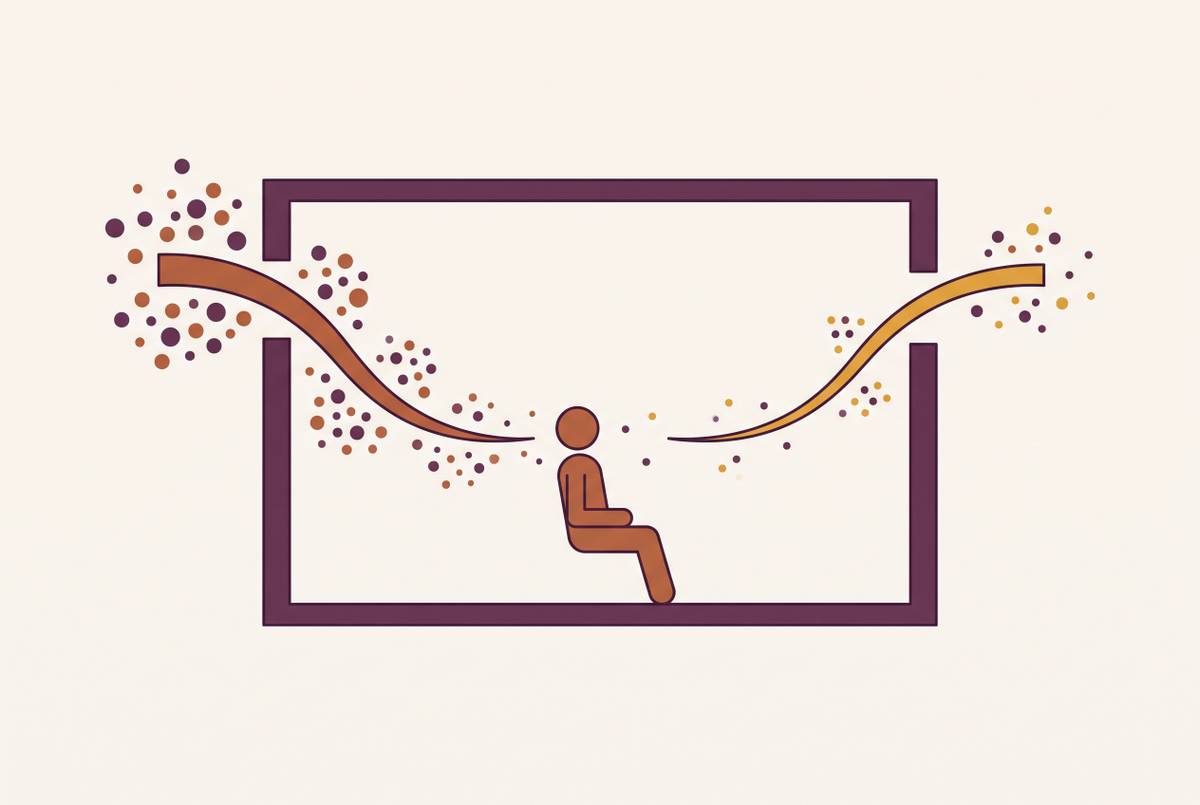
The airway response to inhaled mite allergen at night in a sensitized person
Two mite species do most of the damage: Dermatophagoides pteronyssinus and Dermatophagoides farinae. A third, Euroglyphus maynei, appears less often. All three shed allergenic proteins into a space most people occupy for roughly a third of their lives, and the proteins that matter most, Der p 1, Der p 2, and Der p 23, concentrate in mite waste. That's why the mattress, not the carpet or the curtains, is where exposure actually piles up.
Der p 1 is an enzyme, a papain-like cysteine protease, and it breaks things down. Specifically, it degrades the tight junction proteins holding together the sinonasal epithelium, the thin tissue lining the nose and sinuses. Once those junctions loosen, the barrier gets leakier, and more allergen crosses into tissue where immune cells find it. Repeated exposure to Der p 1 has been linked to higher asthma risk, which says something about how aggressively this allergen behaves once it's inside.
From there, the immune cascade runs a familiar script. IgE antibodies flag the allergen, mast cells degranulate, and histamine floods the tissue. Histamine widens blood vessels, and the nasal mucosa swells in response. Lying down makes that worse: venous pooling in the nose increases when a person is supine, stacking mechanical congestion on top of inflammation that's already underway.
Cytokine signaling keeps that inflammatory state running for hours, not minutes, a low simmer that lasts as long as the person stays asleep and exposed. Post-nasal drip, sneezing, and coughing add mechanical irritation on top, and each one can trigger a micro-arousal, even when the sleeper never fully wakes or remembers it by morning. Trace the whole chain and it reads like a relay: allergen inhalation triggers immune activation, immune activation causes mucosal swelling, swelling narrows the airway, and a narrowed airway disrupts breathing enough to fragment sleep. Break any one link and everything downstream changes with it.
Why does the bedroom stay hospitable to mites when most homes try to control humidity? Mites struggle below 50% humidity, but body heat and breath push bedroom humidity above that line most nights, especially under blankets. Add the horizontal sleeping position, which increases skin contact with allergen-loaded bedding, and exposure gets worse right when the body most needs to power down.
How congestion and histamine specifically fracture sleep architecture
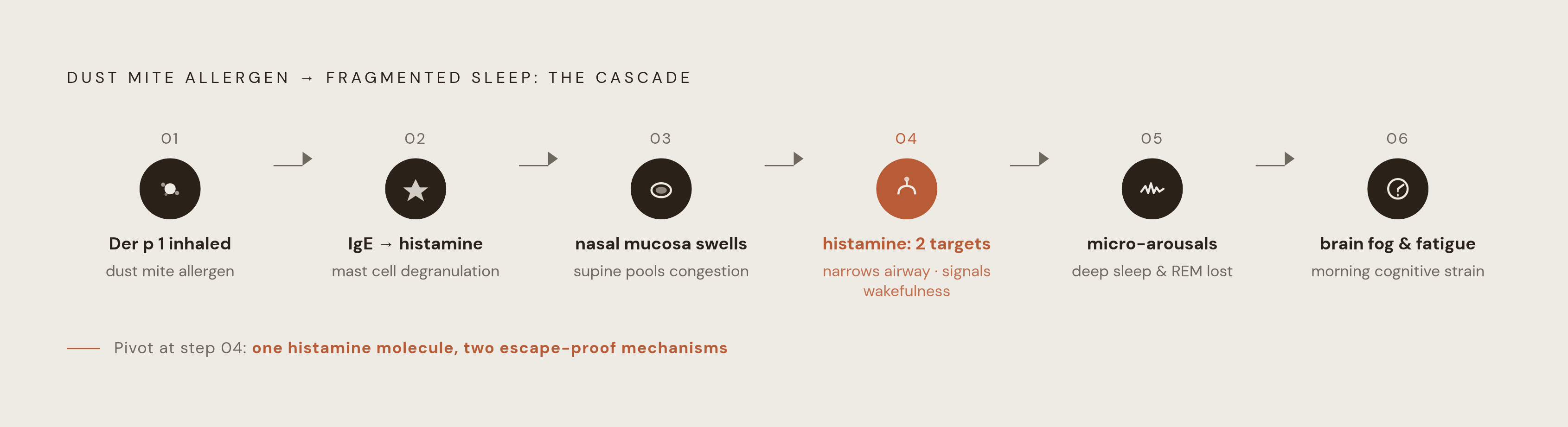
Histamine does two jobs that work against each other for someone with dust mite allergy. In the nose, it drives swelling. In the brain, it acts as a neurotransmitter that promotes wakefulness. The same molecule causing the congestion is also fighting, at the neurological level, the exact signals the brain needs to fall and stay asleep.
Nasal obstruction pushes people toward mouth breathing and more frequent micro-arousals, and that combination cuts into deep sleep, the stage responsible for memory consolidation and physical recovery. Lose enough of that stage, night after night, and recovery just doesn't happen the way it's supposed to.
REM sleep takes a more specific hit. A study in the American Journal of Otolaryngology (Berson et al., 100 patients, 47 HDM-positive) found dust mite-positive patients were significantly more likely, with an odds ratio of 4.29, to be in the moderate-to-severe range for REM respiratory disturbance, meaning 15 or more disruptive events per hour during REM specifically. That happened even when those same patients' overall apnea-hypopnea index across the whole night looked normal.
That distinction is the one most people miss. Standard sleep studies average disruption across the whole night, so a normal all-night AHI can hide a REM-specific problem completely. Someone walks out of a sleep study with a clean report and still wakes up exhausted, because the study measured the wrong window.
A large prospective observational study surveyed 1,750 people, split between 907 adults and 843 children. Among the adults, 50.3% reported poor-quality sleep, 48.1% reported snoring, and 37.6% reported nocturnal awakening, and severity tracked with the allergy itself: adults with severe persistent allergic rhinitis reported sleep complaints far more often than those with intermittent or mild persistent cases. Worse allergy, worse sleep, in a fairly straight line. And 73.5% of adults in that same study reported sleep problems bad enough to prompt a doctor's visit. Most people already know something is wrong. What they usually don't know is that the allergy sitting in their nose is the reason for it.
The downstream effects that show up the next morning, and every morning
The brain is disproportionately sensitive to any reduction in oxygen delivery, which explains why even a modest dip in nighttime breathing efficiency raises a cognitive problem the next day, not just a physical one.
Difficulty concentrating, memory lapses, grogginess that doesn't lift even after a full night in bed, moodiness, low motivation: all of it traces back to reduced deep and REM sleep. Mouth breathing compounds the problem by increasing snoring, which drags sleep quality down further and leaves a dry throat and a dull headache the next morning that feels unrelated but isn't.
What makes this cycle so sticky is that it runs in both directions. Daytime histamine effects, the fatigue and brain fog, never get repaired at night because sleep is already broken, and the broken sleep never recovers because the underlying inflammation was never addressed to begin with. Each side feeds the other, and dust mite allergen sticks around year-round, so the cycle has no natural break. There's no two-month window where the immune system gets to rest and reset the way it might with a seasonal allergy.
Brain fog that might otherwise come and go becomes a fixture instead, and fixtures tend to drag along stress, anxiety, and a slow erosion of motivation. Most adults dealing with chronic morning fatigue rarely list dust mites as a cause when asked. Stress, aging, bad sleep habits, those get the blame instead. The actual driver, sitting in the mattress a few inches away, usually goes unconsidered.
Why symptom-masking approaches don't solve a nightly exposure problem
Antihistamines block histamine's effects but leave the IgE-mediated reaction that triggers histamine release completely untouched. First-generation antihistamines carry their own cost too: they cause sedation, which can add another layer of disruption on top of the old one. Second-generation versions skip the sedation, but the underlying airway inflammation and allergen exposure keep running exactly as before.
Environmental controls such as allergen-proof covers, regular vacuuming, and keeping humidity down are worth doing. None of it eliminates exposure, though. Mite allergen lingers in settled household dust even after the mites themselves die, and human skin, shed continuously overnight, keeps restocking the food supply for whatever mites remain. Nasal sprays work the same way antihistamines do. They provide symptomatic relief that requires nightly use, leaving how the immune system responds to the allergen unchanged.
This is where most treatment plans get it backwards. The immune system fires every single night, symptoms masked or not, and that nightly firing is the actual problem, the sneezing or the stuffed nose someone happens to notice is only its visible trace. Inflammation continues below the threshold where a person feels it, and sleep architecture stays disrupted whether or not anyone's stuffy that particular morning. Because HDM exposure runs year-round, there's no off-season where the immune system gets a break the way it might with pollen. Because HDM exposure runs year-round, symptom management becomes an indefinite commitment, one that's much bigger than most people realize they're signing up for.
That raises the real question: is there a treatment that changes how the immune system responds to the allergen, instead of one that just blunts the reaction after the fact?
How immunotherapy addresses the nightly cycle's root cause
Allergen immunotherapy works by gradually exposing the immune system to increasing doses of the allergen so it learns tolerance instead of overreaction. It stands out in the research as an approach that can change the course of allergic disease, rather than managing it dose by dose, forever.
For dust mite allergy specifically, an FDA-approved sublingual immunotherapy (SLIT) tablet called Odactra targets HDM allergen directly. It dissolves under the tongue and gets taken daily. Compounded SLIT drops offer something different: because they can combine multiple allergens in one formulation, they suit patients sensitized to HDM plus mold, pet dander, or other perennial triggers, where a single-allergen tablet wouldn't cover the whole picture.
A 2024 study in the Journal of Allergy and Clinical Immunology: Global followed 140 patients with asthma and allergic rhinitis, all sensitized to HDM, randomized to pharmacotherapy alone or pharmacotherapy plus SLIT, and tracked across 5 years. The SLIT group showed significant improvement in asthma control and quality of life across every year of follow-up. A 2025 systematic review of 15 studies, with a literature search updated through January 22, 2025, looked at HDM SLIT tablets in patients with HDM-driven asthma and assessed the evidence for HDM SLIT tablets as a treatment option in patients with HDM-driven asthma, supporting immunotherapy as a real add-on rather than a nice-to-have.
Safety data from a 2025 pediatric trial found systemic allergic reactions in 0.41% of the HDM SLIT group, versus 0.27% on placebo. Neither number is alarming by itself, but the rates are a relevant data point for anyone weighing which format to pursue.
Many people notice improvement within weeks to a few months, though durable, lasting relief typically takes around three years of consistent therapy under physician guidance. That's a real commitment, and it should get treated as one. But trace it back to the original chain: if the immune system stops overreacting to nighttime mite exposure, the whole cascade, congestion, histamine surge, REM disruption, morning brain fog, gets interrupted at the source instead of managed piecemeal, symptom by symptom, every night, indefinitely.
The practical difference between at-home SLIT and in-office allergy shots for people with sleep-disrupting HDM allergy
Allergy shots (SCIT) mean subcutaneous injections given by a healthcare professional in a clinic, usually weekly or every other week during the build-up phase. Because of anaphylaxis risk, patients typically wait in the office after each injection before leaving, which adds up to real time lost over months of treatment.
SLIT, whether drops or tablets, gets self-administered at home under the tongue, daily, with no clinic visit per dose and no mandatory waiting period afterward. It fits into a consistent time each day, including at night, which matters for anyone trying to build a routine around an already exhausting schedule. SLIT drops carry one more practical edge for people with multiple perennial sensitivities: they combine several allergens into a single formulation, where tablets treat one allergen per preparation.
For someone whose main obstacle is time, SLIT is the more realistic choice. The pediatric trial data above, showing a 0.41% systemic reaction rate with SLIT, backs up its safety profile for home use without direct clinical supervision at every dose.
A nine-year cohort study of 11,036 patients found allergen immunotherapy associated with a 9% additional drop in allergic rhinitis medication use, 21% fewer asthma medications, and 33% fewer new oral steroid prescriptions compared to controls. Whichever format a person chooses, the pattern points toward lower medication burden over time, not a one-time fix.
Telehealth-based allergy care now makes physician-guided SLIT available without repeated in-person visits, which matters directly for adults whose fatigue and schedule already make weekly clinic trips a hard sell. FSA and HSA funds can often offset the cost too. The right format still depends on a person's sensitization profile, lifestyle, and physician input. None of that changes the bigger point: a root-cause option exists, and it fits around an already full life instead of demanding a person rearrange everything to make room for it.
Steps for adults with poor sleep when dust mite allergy might be involved
Year-round morning congestion, chronic fatigue that doesn't track with hours actually slept, grogginess that persists despite a full night in bed, and snoring that's crept up over time form a pattern. Those aren't just symptoms of a bad sleep routine. They're the signature of ongoing exposure to a perennial allergen.
Testing comes before treating, and that order matters more than people assume. At-home allergy testing with a simple finger-prick method can identify HDM sensitization without a clinic visit, and the result settles the actual question: is the immune system reacting to dust mite protein, or is something else driving the symptoms? Immunotherapy only works on allergens a person is actually sensitized to, so treating the wrong target accomplishes nothing. A personalized, physician-guided plan has to start with the real sensitization profile.
Environmental steps belong alongside testing and treatment, not instead of them: allergen-proof mattress and pillow covers, keeping bedroom humidity under 50% where realistically possible, washing bedding in hot water on a regular schedule. None of it replaces immunotherapy, but it lowers the nightly exposure load while tolerance builds over the months and years SLIT requires.
There's a real cost to waiting. Since durable relief from SLIT takes roughly three years of consistent use, every year spent without treatment is another year of fragmented sleep, cognitive strain, and inflammation stacking on top of itself. Starting sooner doesn't just speed up relief. It shortens the whole window of cumulative damage.
Telehealth removes what used to be the biggest barrier here: getting evaluated and started on treatment no longer requires in-office appointments that someone already running on empty has to somehow squeeze into a week. A virtual consult paired with at-home testing can get a physician-guided, personalized plan moving without adding another exhausting errand to an already full list.
The bedroom is the exposure site, and that exposure drives a real, nightly immune cascade with a beginning, middle, and end that can be traced step by step. Once that's clear, poor sleep stops looking like a lifestyle problem to muscle through. It looks like what it actually is: a medical condition with a specific, identifiable cause, and a treatment path built to address that cause directly.