Cockroach Allergen in Urban Apartment Buildings
Kitchen floors carry three times more cockroach allergen than living rooms.

Cockroach allergen is a mix of feces, shed skin, saliva, and dead body fragments, and scientists have sorted it into 12 recognized allergen groups. Two of them, Bla g 1 and Bla g 2, get most of the research attention. But a notable share of people who react to cockroaches don't respond to any single known allergen on its own. That's the first clue that this isn't a one-target problem the way cat dander or dust mite allergen usually is, and it's why treating it like one has failed so many people for so long.
Allergen Concentration in Urban Apartments: Kitchens and Bedrooms
Cockroaches go where the food and water are. That means kitchens carry the worst of it, and it isn't close.
A study out of NC State, run in multi-unit apartment buildings in Raleigh, measured this directly: kitchens carried more endotoxin than bedrooms, which tracks with where roaches actually forage. The contamination didn't sit still on the kitchen floor either. Researchers found allergen and endotoxin in settled dust, in airborne samples, and on HVAC filters, and contamination was found beyond the immediate apartment unit. So the idea that infestation is a strictly unit-by-unit problem doesn't hold up once you look at where the material turns up.
Bedrooms aren't clean, just less loaded. Research out of Columbia University's Mailman School of Public Health found elevated cockroach allergen in bed dust collected from high-asthma neighborhoods, so a resident who's never seen a roach in the bedroom can still be sleeping in a low dose of it every night.
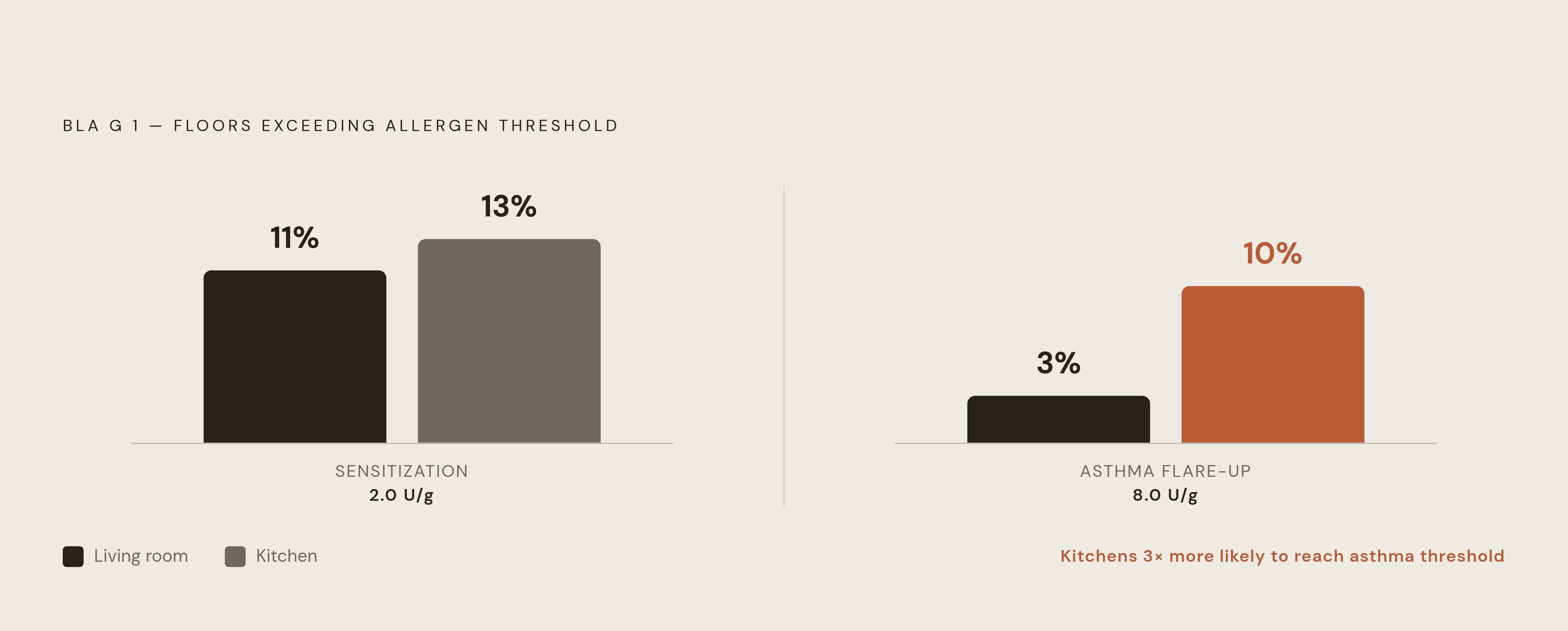
National floor-dust surveys put numbers to the kitchen-versus-living-room gap. Testing shows Bla g 1 above the sensitization threshold of 2.0 U/g in 11% of living room floors and 13% of kitchen floors. At the higher threshold tied to asthma flare-ups, 8.0 U/g, the gap widens: 3% of living rooms versus 10% of kitchens. A kitchen floor is roughly three times more likely to hit that worst-case level. If someone wants to know where the real risk sits in an apartment, it's the room with the stove and the sink, not the room with the bed.
Cockroach Contamination of Indoor Air with Bacterial Endotoxins
Allergen isn't the only thing riding along in cockroach waste. Endotoxins, fragments of the outer membrane of gram-negative bacteria, get shed continuously as those bacteria live and die inside a cockroach's gut. Roaches carry dense bacterial communities, and their feces track that bacterial signature straight into household dust.
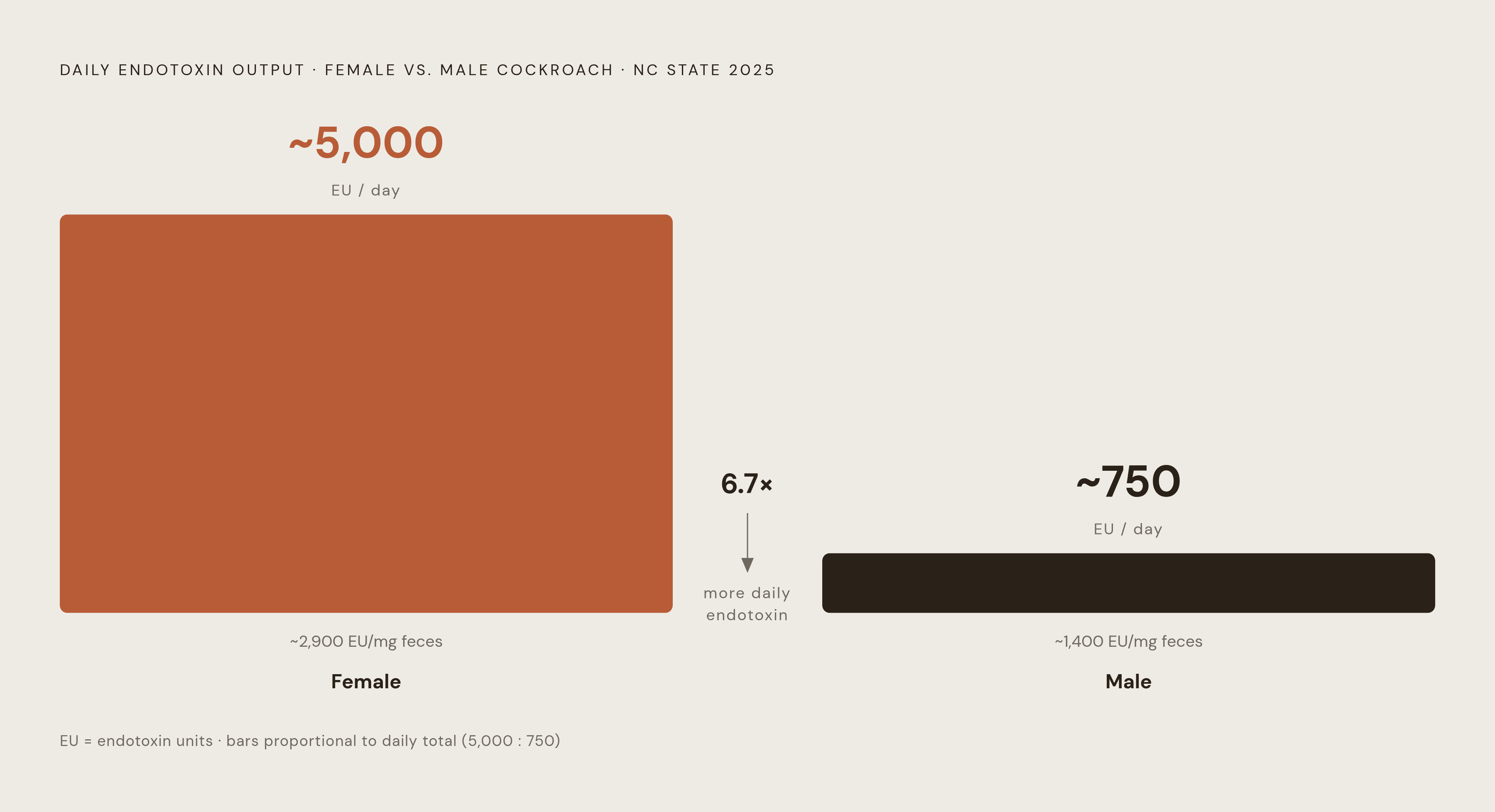
The 2025 NC State study measured the output, and the sex difference is stark. Female cockroaches produced about 2,900 endotoxin units per milligram of feces, adding up to roughly 5,000 EU per day. Males produced about 1,400 EU/mg, totaling around 750 EU a day, a small fraction of what females put out. The mechanism is almost mundane: females eat more, so they excrete more.
The raw numbers matter because of what endotoxin does alongside allergen. Endotoxin doesn't just ride alongside allergen in the dust, it acts like an adjuvant, cranking up the immune system's response to whatever allergen happens to be sitting next to it. Studies show that even weakly allergenic proteins can trigger sensitization and allergic asthma when paired with endotoxin exposure. An infested apartment delivers more than cockroach allergen. It's priming the immune system to overreact to other things in the same room, dust mite protein included. The sheer scale of bacterial load carried in cockroach feces is its own quiet confirmation of how far these insects reshape an indoor environment.
Infestation Size and Allergen and Endotoxin Levels in a Home
Common sense says fewer cockroaches means less allergen. The NC State study found a direct, measurable link between infestation size and the concentration of Bla g 2 allergen and endotoxin in dust and on HVAC filters, but the relationship is not straightforwardly forgiving.
Small reductions in cockroach numbers don't move allergen levels down, because the roaches that survive an incomplete treatment leave allergen levels largely intact. Partial pest control doesn't buy partial relief. It buys almost nothing. Homes that went through full extermination in the study saw both cockroaches and their allergens clear out in most cases. Homes left untreated stayed high, holding steady across measurements taken at three and six months.
Does that mean one aggressive pesticide spray solves it? Not quite, and most people get this backwards: a single aggressive pesticide spray does not solve it. A separate study of Integrated Pest Management (IPM) in public housing found significantly lower cockroach allergen in kitchens at three months, and in both beds and kitchens at six months, using less pesticide overall than repeated conventional spraying. The IPM approach outperformed repeated conventional spraying. The method matters as much as the will to do it, maybe more.
The urban, low-income, apartment-dwelling populations carrying a disproportionate burden
Cockroach allergen turns up in 85% of inner-city homes nationally, and up to 80% of children with asthma in those homes test positive for sensitivity on skin tests. Suburban children with asthma show sensitization at just 21%. That gap comes from exposure, not biology. It's exposure, plain and simple, tied to older housing stock, shared walls, and pest pressure that doesn't stop at a lease line.
Columbia's Mailman School research shows childhood asthma prevalence across New York City neighborhoods ranges from 3% to 19%, and children living within walking distance of each other can face a two- to threefold difference in asthma risk depending on which side of that line they land on. Cockroach allergen sensitivity ran more than twice as common in high-asthma neighborhoods (23.7%) as in low-asthma neighborhoods (10.8%). Same city, same climate, wildly different outcomes, and the difference tracks the infestation data almost exactly.
Sensitization, Ongoing Exposure, and the Respiratory System
Sensitization runs in two stages. First, the immune system learns to treat cockroach protein as a threat worth fighting. After that, every re-exposure triggers a response worse than the one before it. In an apartment with a live infestation, re-exposure never really stops, so neither does the second stage.
Children sensitized to Bla g 1 and living with high allergen exposure show higher rates of asthma-related hospitalization, more daytime symptoms, and more missed school days than their peers. Across multiple studies, urban children with this kind of exposure show a wider pattern: more flare-ups, more acute care visits, more hospital stays, and lower lung function overall.
The endotoxin adjuvant effect belongs back in this conversation, because it widens the scope of the damage well past cockroach allergen alone. If endotoxin acts as an adjuvant amplifying responses to other allergens present, a cockroach-infested apartment may be priming the immune system to react to far more than the roaches. That's the more troubling half of the picture. The harm doesn't stay contained to one identifiable trigger sitting in the kitchen.
Residents' Symptoms and Cockroach Allergen
This allergen has no smell and leaves no visible residue in most homes. The insects producing it are nocturnal, tucked into wall voids, under appliances, inside drains. A resident can live above a serious infestation and never see a cockroach in daylight, so the exposure keeps going unquestioned.
So the symptoms get explained away by something else. Nasal congestion gets blamed on a cold or dry winter air. Fatigue and brain fog get chalked up to bad sleep or a rough week. Wheezing gets treated as a chest infection that won't clear. None of it gets traced to cockroach exposure, because none of it looks specific to cockroach exposure on its own.
Chronic, year-round symptoms have a way of turning into background noise. When something never fully goes away, people stop digging for a cause and start calling it "how I feel." Making it worse: even after a resident is sure the roaches are gone, the dust carrying allergen may not have been fully removed. The symptoms continue, and from the resident's side of it, the trigger already left the building weeks ago.
Allergy Testing for Cockroach Sensitization and Treatment Implications
Skin testing and specific IgE blood testing both identify sensitization to cockroach allergens, including Bla g 1 and Bla g 2, and this kind of testing is standard in the allergist workup for urban children with asthma. At-home finger-prick testing exists now too, giving apartment dwellers who suspect an environmental trigger a way to check before booking an office visit.
But what does a positive result actually mean, past "you react to cockroaches"? It means the immune system has been trained by real, repeated exposure, and that training doesn't undo itself just because the exposure stops. Pest control and cleaning cut the antigen load sitting in the home. Neither one retrains an immune response that's already locked in. A lot of treatment plans quietly stall out at that point.
That's the case for building a plan around what the test actually shows, instead of a generic allergy protocol. Cockroach-sensitized urban residents frequently share housing environments with dust mite and mold allergens, so treating cockroach exposure alone can miss the bigger picture. These allergens share the same housing environments, so a one-size-fits-all approach leaves gaps a patient notices later, usually the hard way.
The role of immunotherapy in achieving lasting immune-level relief
Antihistamines and nasal sprays do real work managing symptoms of allergic rhinitis and asthma triggered by cockroach allergen. What antihistamines and nasal sprays don't do is touch the sensitization underneath it: repeated exposure primes the immune system to react the same way on the next exposure, and no amount of symptom control in the moment changes that priming.
Allergen immunotherapy stands apart because it modifies the immune response itself instead of just blunting what it produces. It's often described as the only etiological therapy for respiratory allergies with efficacy established through controlled studies: treatment aimed at the cause.
Sublingual immunotherapy (SLIT) works through a specific mechanism. Placing allergen under the tongue exposes dendritic cells in the oral lining to that allergen without triggering the body's danger signals. That absence of alarm gradually shifts the immune response away from the inflammatory cascade that drives allergic symptoms. This delivery route is associated with a favorable safety record compared with injected immunotherapy. Research into cockroach-specific immunotherapy keeps building on that same mechanism, working to apply it to one of the most stubborn indoor allergens urban residents face, and one of the hardest to simply clean or spray away.
Sources
- Indoor allergens and endotoxins in relation to cockroach infestations in low-income urban homes - PubMed
- Cockroach Infestation Linked to Home Allergen, Endotoxin Levels
- Cockroaches release toxic compounds that pollute indoor air
- Indoor allergens and endotoxins in relation to cockroach infestations in low-income urban homes - Journal of Allergy and Clinical Immunology: Global
- ncbi.nlm.nih.gov
- Determinants of allergen concentrations in apartments of asthmatic children living in public housing - PubMed
- Determinants of Allergen Concentrations in Apartments of Asthmatic Children Living in Public Housing | Journal of Urban Health | Springer Nature Link
- (PDF) Abatement of cockroach allergen (Bla g 1) in low-income, urban housing: a randomized controlled …