Humidity Control as an Allergen Reduction Strategy
Keeping indoor humidity below 50% stops dust mites and mold from thriving.

Indoor humidity is the lever that makes dust mite and mold control possible at all, because both organisms are built around a dependency on moisture that gives homeowners something concrete to manipulate. A dust mite's body is roughly 70 to 75% water by weight, and the mite has no way to drink liquid water. It pulls every bit of moisture it needs out of the surrounding air using specialized glands, so a room's humidity level directly controls a dust mite's survival. University of Kentucky entomologist Michael Potter has noted that dust mites grow and reproduce best in warm conditions paired with elevated relative humidity.
Mold runs on the same logic. Research cited by Dr. Michael Ruff confirms that mold and dust mites both thrive in humid climates, and neither survives well once relative humidity drops low enough. That overlap is not a coincidence of two unrelated organisms happening to like the same conditions. Mold and dust mites also share a structural compound called chitin, found in mold's cell walls and in a dust mite's exoskeleton, and research out of the University of California, San Francisco suggests this shared compound may play a role in triggering the body's inflammatory response, though the research is still early. A fungus and an arachnid are not biological relatives, but they overlap in the chemistry that makes a human airway react to them, and in the environmental condition that lets them thrive. That second overlap, humidity, is the one a homeowner can actually control.
What the evidence says about the target humidity range
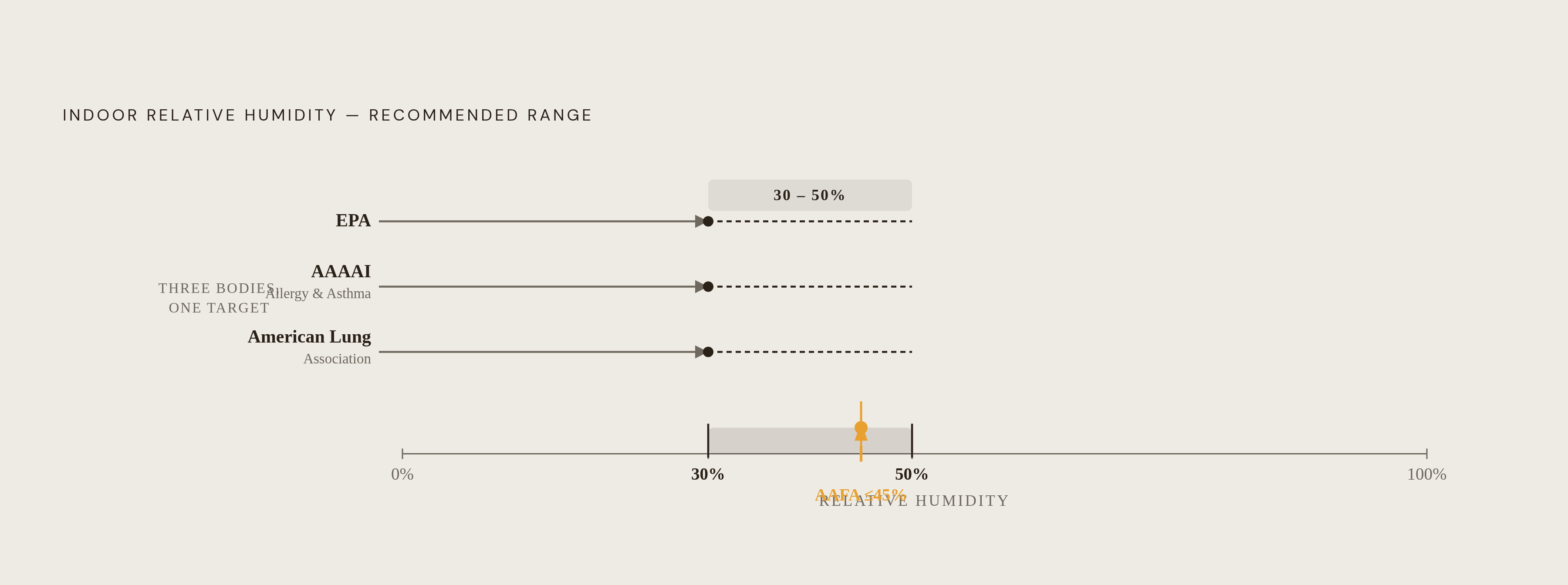
Once you understand that moisture is the fuel, the next question is simple: how low does humidity need to go? There is real consensus here: the EPA, the American Academy of Allergy, Asthma and Immunology, and the American Lung Association all point to the same target, keeping indoor relative humidity between 30% and 50%. That is three independent institutions, with three different mandates, landing on the same number.
The Asthma and Allergy Foundation of America (AAFA) specifically recommends keeping relative humidity below a tighter bound than the general guidance, to choke off both mold growth and dust mite survival. The tighter number from AAFA extends the broader range. It is a more conservative target for anyone who wants to bias the odds further in their favor, particularly in homes with a history of mold or a resident with diagnosed dust mite allergy.
The range holds up outside the lab, too. Home data tracked over an extended period found that when indoor relative humidity is consistently held below that threshold, live mite populations drop sharply, which confirms the number is not a theoretical ceiling but something that plays out in real houses over real months. Separate research by Andersen, cited in patent literature on humidity control systems, found that almost no dust mites survive when relative humidity and temperature are both kept moderate, and that the same conditions suppress mold growth and spore production. Hitting that target starts with knowing where a home actually sits, and that means a hygrometer. A basement can vary significantly in humidity compared with other rooms in the home, so a single reading from one part of the house rarely tells the whole story.
Why sustained humidity control is hard to maintain
Knowing the number is the easy part. Holding a home inside 30 to 50% relative humidity, day after day, across every season, is a different kind of challenge, and it has more to do with discipline than with any single appliance. A dehumidifier is a tool, not a guarantee. Several ordinary household patterns work against it constantly.
Outdoor air is often the first problem. Summer air, especially in humid climates, carries far more moisture than the inside of a well-managed home, and it finds its way in through open windows, doors, and small gaps in the building envelope. A dehumidifier can spend hours pulling moisture out of a room, and a single afternoon with the windows open can undo most of that work. Keeping windows closed during humid stretches matters significantly. It is often the difference between a dehumidifier keeping pace and one that is perpetually playing catch-up.
Not every room in a house behaves the same way, either. Basements, bathrooms, and kitchens generate their own moisture through water use, laundry, cooking, and showering, and a single whole-home dehumidifier may not reach every one of those microenvironments. Supplemental point-of-use units in the rooms that run wettest often keep a house managed everywhere rather than just on average.
Winter flips the problem. Cold outdoor air holds very little moisture, and once it is heated indoors, relative humidity can fall well below the comfortable range, sometimes to levels dry enough to aggravate sinus conditions. That pushes many households toward humidifiers, and a humidifier run carelessly becomes exactly the kind of moist environment that dust mites and mold prefer. Any humidifier in regular use needs antimicrobial safeguards and frequent cleaning, or it risks becoming the very incubator the whole strategy is trying to prevent.
The engineering required to do this with real precision is more involved than most people assume. A patent filed by Johnson et al. describes a humidity control system built around a reversible hydrogel desiccant, with remote sensor arrays, controller logic, and regeneration cycles working together to hold humidity steady. That level of coordinated, continuous correction is what true precision looks like, and it is more than a standard consumer dehumidifier can match, even though a good consumer unit gets close enough to matter. Home humidity control works best as an ongoing habit, checked with a hygrometer, adjusted by season, and backed up in the rooms that need it most.
The residual allergen problem: why humidity control alone is not enough
Even a home that nails the humidity target does not become allergen-free the moment the mite population collapses. This is the central limit of the whole strategy, and understanding it is what keeps expectations realistic. A dead dust mite does not stop being a source of allergen. Its body fragments and fecal matter remain in dust, bedding, and carpet fiber long after the mite itself is gone. Allergen levels fall more slowly than the mite population that produced them.
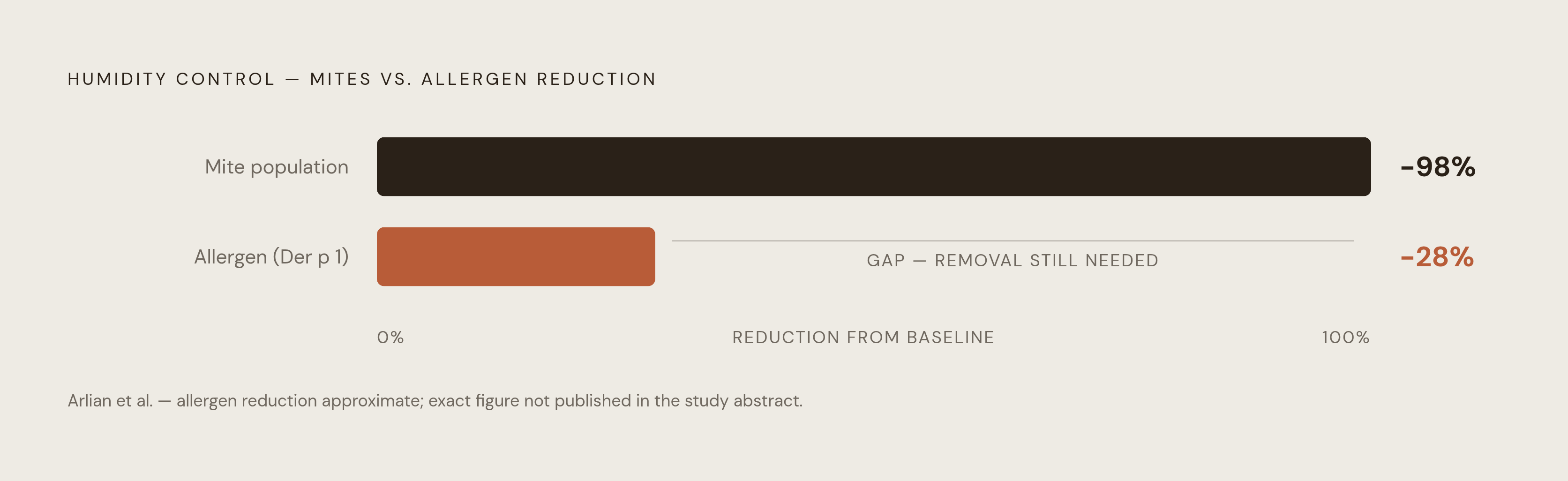
The Arlian et al. study puts a number on that lag. After a sustained stretch of humidity control, live mite populations fell by 98%, but allergen levels, measured as Der p 1 per gram of dust, fell by a considerably smaller margin. A 98% drop in living mites sounds like victory, and in one sense it is. But the allergen that those mites left behind does not disappear on the same timeline, and that gap is what drives ongoing exposure even in a well-managed home.
Closing that gap takes physical removal. Allergen-resistant encasements, the zippered kind that cover mattresses, pillows, and box springs, keep mites that are already embedded in bedding away from the sleeper and block new colonization. AAFA has found that encasing a mattress reduces allergy symptoms more effectively than an air cleaner used on its own. Hot-water washing of sheets, pillowcases, and stuffed toys at 130°F or hotter, done weekly, kills mites directly and rinses away the allergen they have already shed. A standard vacuum can kick fine allergen particles back into the air instead of capturing them. HEPA air purifiers pick up what is already circulating, working as a complement to a dehumidifier rather than a replacement for one, since the dehumidifier suppresses future mite survival while the purifier addresses what is already airborne. MERV 8 or higher furnace filters reduce the airborne allergen load that circulates system-wide.
A patent held by Skelton et al., developed through the London School of Hygiene & Tropical Medicine and Rothamsted Research, describes a different kind of physical control: a lure built from neryl formate and limonene in powder form, designed to attract and concentrate dust mites rather than dry them out. That approach works on a different mechanism entirely, trapping mites rather than starving them of moisture, and it illustrates that humidity control is one tool in a larger toolkit rather than the only one available.
Allergen Exposure and Symptoms Beyond a Runny Nose
The reason any of this is worth the effort goes well past sneezing and a stuffy nose. For someone already sensitized to dust mites or mold, ongoing exposure sets off effects that reach into sleep, mental clarity, and long-term respiratory health, often without the person ever connecting the dots back to their bedroom.
Sleep is one of the clearest pathways. Swollen nasal tissue restricts airflow, which pushes people toward mouth breathing and fragments sleep across the night. The Sleep Foundation reported that people with untreated allergic rhinitis experience more nighttime awakenings and less deep sleep than people without it. Anyone chalking up a string of groggy mornings to stress or a mediocre mattress may be missing a much simpler explanation sitting in the air they breathe all night.
The chain extends into brain chemistry, too. Allergen exposure triggers the release of histamine and cytokines, and some of this can cross the blood-brain barrier, producing low-grade neuroinflammation that disrupts how neurotransmitters function. That neuroinflammation raises the brain fog, irritability, and trouble concentrating that a lot of people quietly attribute to a bad week at work or just getting older, when the cause may be sitting closer to home than that.
Left unaddressed long enough, the effects compound. Persistent respiratory inflammation from poorly managed allergies raises susceptibility to respiratory infections and chronic bronchitis. In children, untreated allergies raise the risk of ear infections driven by fluid buildup, which can in turn affect hearing and speech development at exactly the age when both are developing fastest. None of this makes allergy management optional. It makes the case for taking allergen load seriously well before it escalates into something harder to reverse.
What exposure reduction cannot do: addressing immune sensitization directly
Humidity control and physical allergen removal both work on the same side of the equation: how much allergen a person encounters. Neither one touches the other side of the equation, which is how the immune system reacts to whatever allergen does get through.
That distinction matters because perfect avoidance is not realistic. People spend time in homes other than their own, in hotels, offices, and cars, environments where nobody is running a hygrometer or washing bedding at 130°F. Sensitization means that any meaningful exposure in any of those places can still trigger a reaction, no matter how well-managed the primary residence is.
Medication treats the symptoms of that reaction rather than the reaction itself. Antihistamines and nasal sprays block histamine release and calm nasal inflammation, but they do not touch the underlying immune imbalance, often described as a Th2-dominant pattern, that is driving the response in the first place. Stop the medication, and the underlying sensitivity is exactly where it was before. This is an immune system that has learned the wrong lesson about a harmless protein and keeps repeating that lesson every time it sees the protein again.
Sublingual immunotherapy works at that deeper level instead. It targets the Th2 imbalance directly, shifting the balance between Th1 and Th2 immune activity, regulating how CD4+ T cells behave, encouraging the death of certain reactive cells, and suppressing mast cell activation. Studies using radiolabeled allergen show the mechanism in action: allergen placed under the tongue is taken up by dendritic cells in the sublingual tissue and carried to regional lymph nodes, where it is presented to the immune system in a way that nudges the whole response toward tolerance rather than alarm. A review published in Frontiers in Allergy, the most recent major synthesis of the evidence, found solid randomized-controlled-trial support for meaningful reductions in symptoms and medication use among people using grass and house dust mite SLIT tablets, with benefits holding for one to two years after finishing a three-year course. Real-world cohorts tracked outside of trial conditions report something further: a reduced risk of developing new asthma, along with lower long-term use of allergy medication after treatment. None of this replaces a well-managed home. It complements one, by addressing the half of the problem that humidity control was never built to touch.
Practical adherence: why sublingual immunotherapy fits alongside a home allergen-reduction routine
Any allergy strategy, no matter how well it is supported by evidence, only works if people actually stick with it. That is where sublingual immunotherapy has a real practical edge over traditional allergy shots, and it is why it pairs naturally with a home-based allergen reduction routine rather than competing against it.
Allergy shots ask a lot logistically. Allergy shots require weekly or biweekly visits to a clinic, each followed by an observation period to watch for reaction, and Mitchell Medical Group data show that scheduling burden drives completion rates down sharply. A treatment that gets abandoned partway through never finishes the job of retraining the immune system, however strong its biology is on paper. A large real-world cohort studied by Tharpe et al. and published in Frontiers in Allergy found that sublingual immunotherapy delivered through telemedicine was associated with sustained symptom improvement and high adherence. That fits naturally alongside home allergen management, since both humidity monitoring and SLIT dosing happen in the same place, at home, on a schedule the patient controls.
The evidence does come with honest caveats. Liquid sublingual drops are used off-label in the United States and do not carry the same FDA approval that SLIT tablets have. Overall, sublingual efficacy is graded as moderate for some allergens rather than definitive, and allergy shots still hold a stronger evidence base for several allergen categories. The sensible path is doctor-guided personalization rather than assuming one method fits every person and every allergen.
Cost friction has also eased. Prescription allergy medications and immunotherapy are automatically eligible for FSA and HSA spending, and over-the-counter allergy medications like Claritin, Zyrtec, and Benadryl became eligible without a prescription following the 2020 CARES Act. Telehealth has closed most of the remaining gap in access, letting people start doctor-guided treatment plans and at-home finger-prick allergy testing without ever sitting in a waiting room, which opens the door for people who have been managing symptoms with over-the-counter medication indefinitely.
Putting the two layers together completes the picture. A home held inside 30 to 50% relative humidity, backed by encasements, hot-water washing, and HEPA filtration, keeps the allergen load as low as the environment allows. Sublingual immunotherapy, taken consistently, works on the immune system itself, correcting the response that exposure alone can never fix. Neither layer does the other's job, and a person doing both is doing what the evidence actually supports.
Sources
- System for allergen reduction through indoor humidity control
- Lure
- Control Indoor Allergens to Improve Indoor Air Quality
- Dehumidification: The Allergy Sufferer's Secret Weapon
- EPA & CDC Recommend 30-50% Humidity to Control Dust Mites and Mold
- How does sublingual immunotherapy work? - Journal of Allergy and Clinical Immunology
- Efficacy and safety of sublingual immunotherapy for allergic rhinitis: A network meta-analysis