Mold Growth in Car Air Conditioning Evaporators
Clogged AC drain tubes trap moisture that breeds mold colonies.
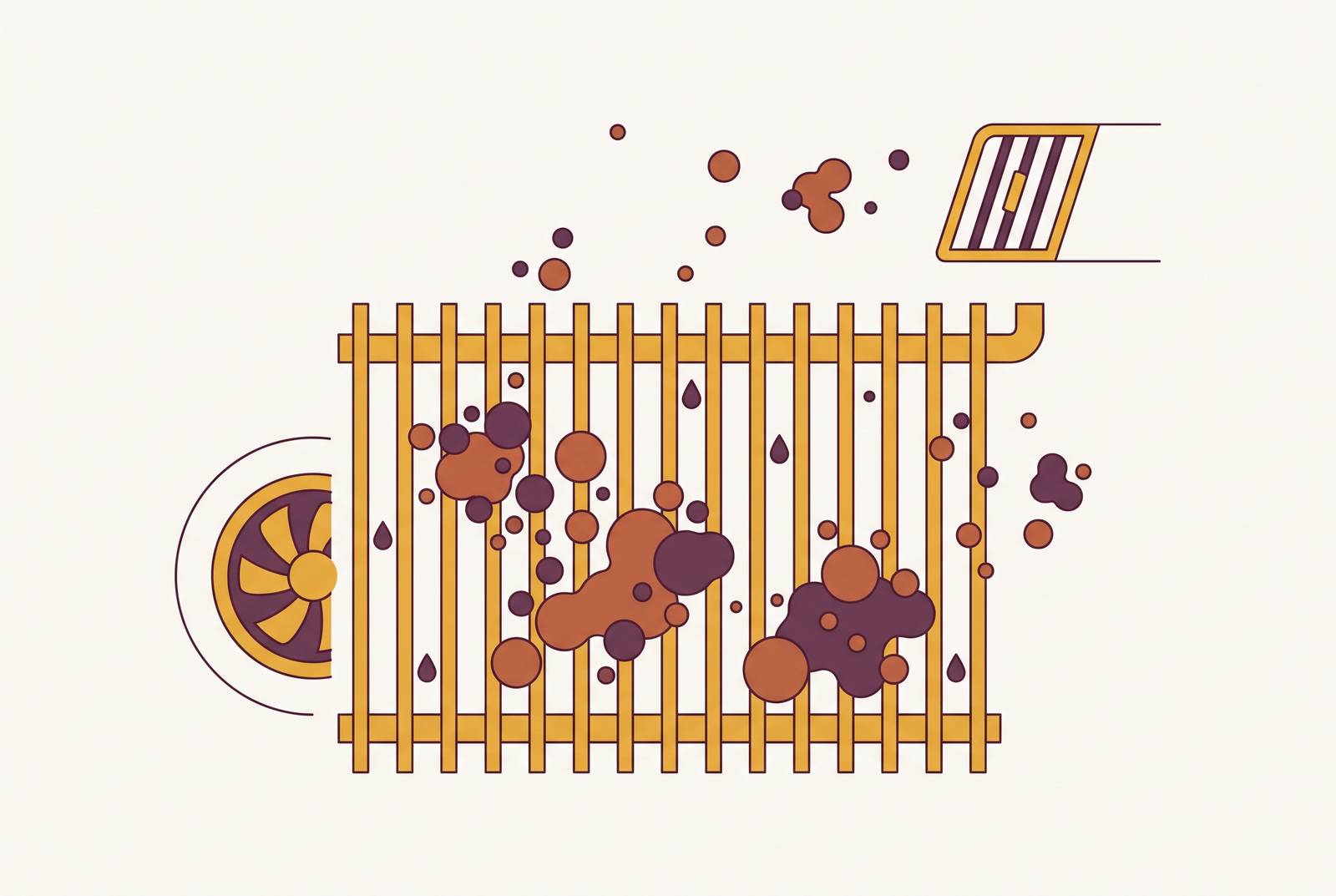
Every car air conditioner is built around a contradiction. Its whole job is to pull moisture out of the cabin, and doing that job well means the evaporator core has to stay cold and wet, sometimes for hours after the engine shuts off. Warm air moves across the super-chilled fins, water vapor condenses out of it the same way droplets form on a glass of ice water, and that condensate is supposed to run down into a drain pan and out through a tube under the car. The puddle left on the pavement after a summer drive is the system doing what it was designed to do.
The trouble starts after the engine stops. The evaporator does not dry out on its own schedule. It sits there, cold and damp, inside a dark, enclosed housing that traps humidity instead of letting it escape. Dust and pollen pulled in through the intake settle onto those wet fins and mix with the standing condensate, and what starts as clean moisture becomes a nutrient-rich film. That film gives any mold spore that lands there both water and food at the same time, which is close to ideal conditions for colonization. The evaporator is the one component engineered to be wet on purpose, parked in the dark, for a machine that runs a few hours a day at most.
How a clogged drain tube turns dampness into mold
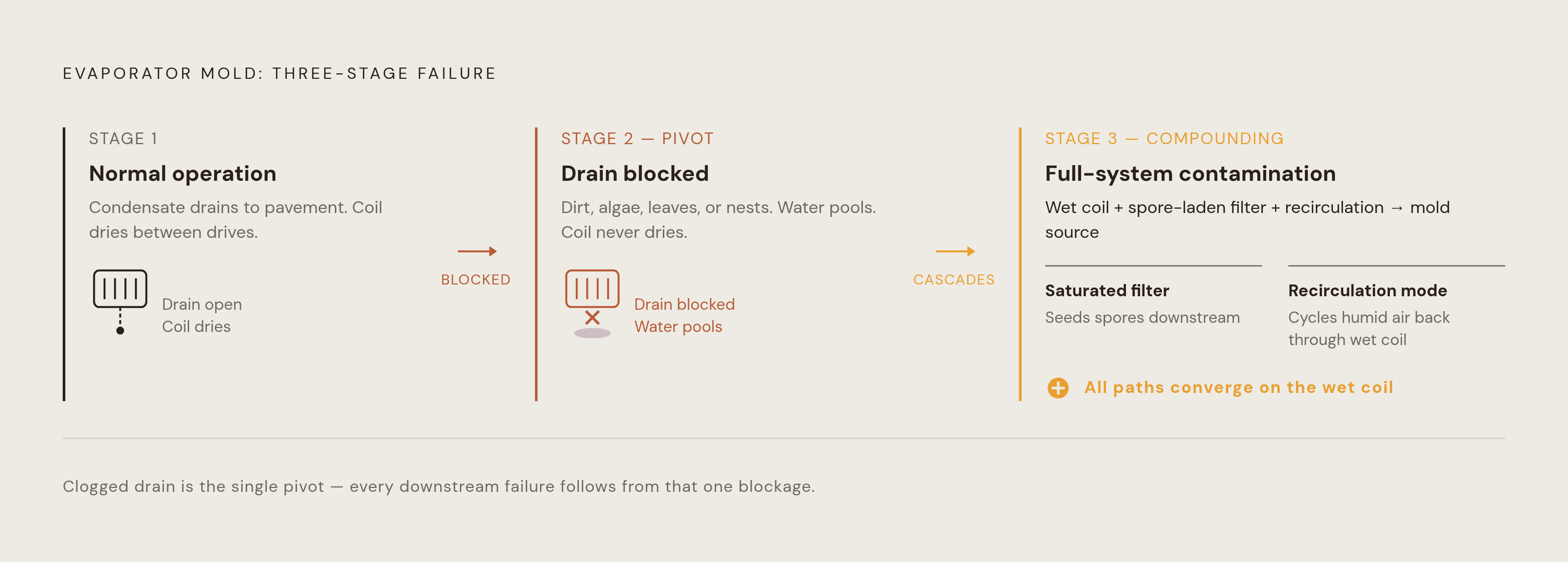
A working drain tube keeps the evaporator's dampness temporary. A clogged one turns it permanent, and that single mechanical failure is the most common reason a periodically damp coil becomes a standing reservoir of mold that can double in population within days.
Drain tubes clog for ordinary reasons: dirt, algae, decomposing leaves. But some of the more stubborn blockages come from somewhere less expected. Bobby Rahal Lexus of Lancaster County has documented insect nests, including nests built by certain regional spider species, clogging the drain hose in 2018-and-newer Toyota and Lexus models such as the RAV4, Highlander, Camry, Corolla, RX, ES, and NX. When that happens, water intrusion into the vehicle can produce remediation costs well beyond a simple drain-clearing job. The spider-nest detail is a warning: the failure point isn't always something a driver would think to check, and by the time water shows up somewhere it shouldn't, the clog has usually been building for a while.
Once the drain backs up, condensate has nowhere to go but into the HVAC case itself. It pools there instead of draining to the pavement, and the evaporator stops drying out between drives entirely. That's a meaningful shift. A coil that dries out even partially between uses resets the clock on colonization somewhat. A coil sitting in standing water never gets that reset, and the dust-and-moisture sludge coating the fins keeps the surface from drying even when the car sits idle overnight. Every condition needed for fungal regrowth stays continuously in place.
There's a second failure point working in the same direction. The cabin air filter sits upstream of the evaporator, and it traps the same organic debris and moisture the coil does. A saturated filter becomes its own incubator, feeding spores downstream into the system it was supposed to be protecting. Recirculation mode during a humid drive compounds the problem: interior air, already carrying its own moisture and particulates, gets cycled back through the damp system instead of getting exhausted outside. Three separate mechanisms, all pushing in the same direction, all converging on the same wet coil.
Species that grow in the evaporator and what they emit into the cabin
What actually colonizes a car evaporator is not vague, unnamed "mildew." Peer-reviewed research has identified Aspergillus, Penicillium, Cladosporium, and Alternaria species in tested vehicles. These are common environmental molds that happen to find a five-star habitat inside a car's ventilation system, not exotic organisms discovered under unusual conditions.
One study testing 25 vehicles across eight varieties found mold present in 22 of them. Contamination in this study was close to the default state of an ordinary car's AC system, not the exception.
Colonies established on the fins don't just sit there producing spores. They emit (1-3)-β-d-glucan, mycotoxins, and microbial volatile organic compounds, or MVOCs. The MVOCs are responsible for the musty smell most drivers associate with a neglected AC system, and the mycotoxins are what push this past a smell problem into something with real biological weight. None of this stays put on the coil, either. The blower motor doubles as a dispersal system: when the AC kicks on, high-velocity air physically shears spores, fungal fragments, and mycotoxins off the wet fins and sends them straight into the passenger breathing zone. The worst moment for this is the first few seconds after startup, when moisture has been sitting undisturbed during parking and the initial blast carries the highest spore load of the entire drive.
What breathing evaporator air does to occupants
A car cabin is a tight, enclosed space, smaller than most bathrooms. Breathing air pumped from a contaminated evaporator inside that space is a fundamentally different exposure than brushing past mold outdoors on a walk, and the daily repetition of a commute turns what would be an incidental exposure into a chronic one.
The acute symptoms line up with what anyone would expect from breathing in fungal spores and irritants: sneezing, coughing, headaches, a kind of flu-like fatigue and drowsiness that's easy to blame on a long day instead of the car itself. Mold growth heavy enough can physically block vents, cutting into airflow on top of everything else. Symptoms that show up worse while driving and ease up once outside the car point specifically at the AC system rather than seasonal pollen or outdoor allergens. That's a useful diagnostic a driver can run on themselves, just by noticing when symptoms flare and when they fade.
Chronic exposure raises the stakes further. Commuters spending an hour or more each way in a contaminated vehicle show associations with persistent respiratory issues, worsened asthma, skin rashes, and, in more severe cases, neurological effects tied to mycotoxin load, including mood disturbance and cognitive difficulty. People with existing allergies or asthma and immunocompromised individuals face heightened risk here. People with existing allergies or asthma see their symptoms aggravated. Immunocompromised individuals face something more serious: the possibility of opportunistic infection from species like Aspergillus fumigatus.
Consumer Reports Senior Director of Auto Testing Jake Fisher has pointed to mycotoxins specifically as compounds linked to neurological health concerns. What makes them stubborn is that no amount of air freshener or surface wipe-down touches them. They persist inside the evaporator housing and re-enter the airstream every single time the AC runs afterward.
How regulatory bodies and the automotive industry have responded to cabin air quality
Cabin air quality has moved past the category of driver complaint and into the category of regulated safety issue, at least in one major market. Germany's engineering and automotive trade bodies issued a binding hygiene standard for vehicle ventilation systems in 2024, and the timing signals something: this is no longer treated as a comfort preference to be handled with an air freshener.
The standard itself, VDI/ZDK Guideline 6032 Part 1 (Blatt 1), was issued jointly by the Association of German Engineers and the German Association of the Motor Trade. It regulates hygiene requirements for ventilation technology across passenger cars and trucks, covering design, construction, operation, and maintenance, with an explicit stated purpose of protecting occupant health and safety. That's a notably broad scope for a hygiene guideline. It's not limited to telling owners when to change a filter. It reaches back into how these systems get designed and built.
The guideline also professionalizes the maintenance side. Automotive mechatronics technicians and service technicians now have to complete recurring qualification training specifically in AC system hygiene, which takes what used to be informal shop advice and turns it into something closer to a certified skill. On the maintenance intervals themselves, the guideline is specific: cabin air filters replaced at least once a year, professional AC system cleaning every two years.
Those intervals didn't come out of caution alone. Recent studies motivating the standard found that every third vehicle interior in Germany carries contamination from bacteria, mold, particulate matter, pollen, and harmful gases. David Keerl, an expert in biofunctional filter materials at Mann+Hummel who contributed to the guideline revision, said regular replacement of the cabin air filter, ideally once a year or at set mileage intervals, is essential, and high-efficiency filters help protect the AC system from contamination in the first place. The underlying physics and biology don't change from one country's roads to another. What a formal guideline like this does is give drivers anywhere a concrete benchmark, a set of intervals to measure their own maintenance habits against, regardless of what their local regulations happen to require.
Why common fixes fall short
Most drivers who notice the musty smell reach for the same fix: an aerosol spray, a can of disinfectant, an air freshener clipped to a vent. These products deal with the smell. They do nothing about the colony producing it, and without addressing the moisture conditions that let mold establish itself in the first place, the smell tends to come back within weeks.
Standard aerosol foggers, run in recirculation mode, distribute treatment through the ductwork well enough because they don't reliably reach the evaporator fins themselves, which is exactly where the colony sits densest. Spraying the vents treats the delivery system. It doesn't treat the source.
One professional cleaning process, airco well, certified as allergy-friendly by the European Centre for Allergy Research Foundation, draws a sharp line between surface disinfection and targeted cleaning applied directly at the site of contamination. The argument behind that distinction is straightforward: getting a cleaning agent onto the evaporator itself requires more than hoping an aerosol drifts far enough to reach it. That's not brand promotion so much as a diagnosis of why so many DIY attempts fail. The fix has to physically reach the same surface the problem lives on, or it isn't really a fix.
The guideline calls out cabin air filter replacement at least once a year and professional AC system cleaning every two years as key requirements. First, the dust-and-moisture film bonded to the coil resists drying even after a cleaning treatment, so any spores left behind in that substrate can re-establish within days once moisture returns. Second, mycotoxin residue isn't captured by standard antimicrobial sprays. It sits on surfaces and keeps off-gassing into cabin air regardless of how the space smells. Enzyme-based formulations, which break down organic mold residue rather than simply coating over it, address that residue layer in a way fragrance-based products structurally cannot.
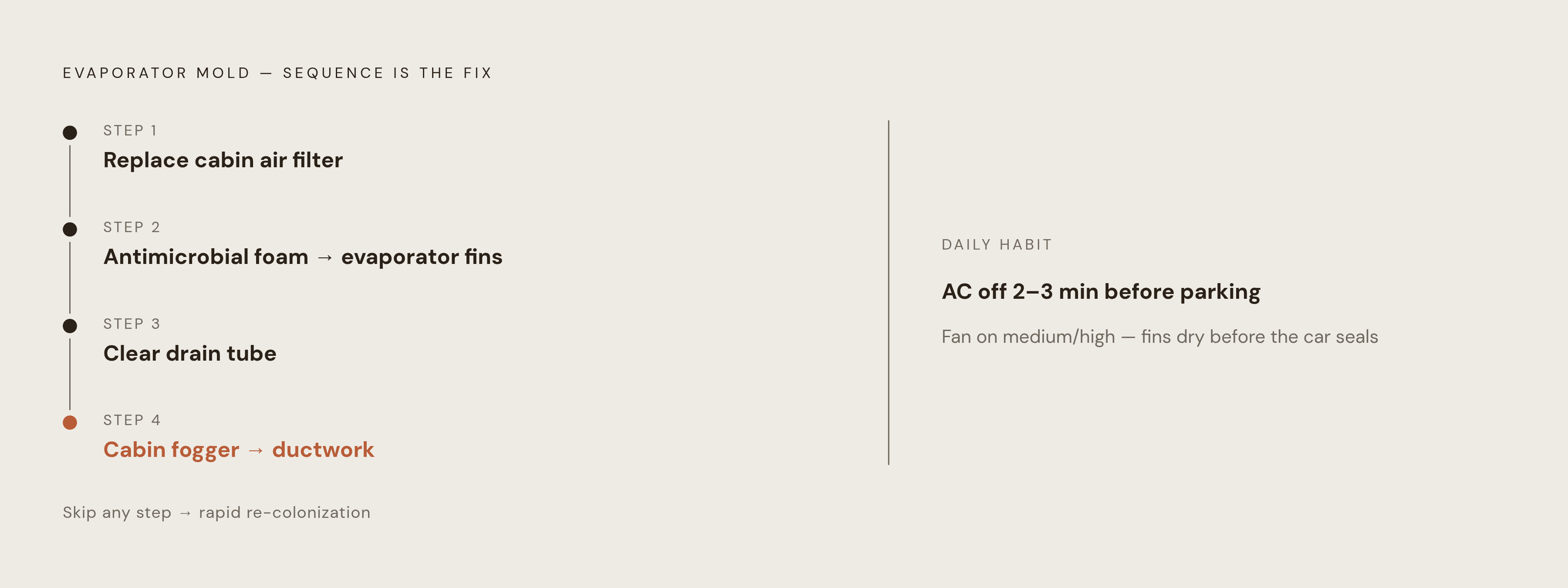
The most durable professional approach, as described by Knoedler Automotive, treats the problem as a sequence rather than a single step: filter replacement, specialized evaporator coil cleaning, drain tube clearing, and a finishing antimicrobial treatment. If any one link in that chain is skipped, the system stays vulnerable to rapid re-colonization. Left unaddressed long enough, mold does more than smell bad. It damages the evaporator core's components directly, and the eventual fix becomes full core replacement, by far the most expensive outcome available.
A practical prevention and remediation sequence that addresses the moisture root cause
Preventing evaporator mold costs far less, in money and in effort, than remediating it after the fact. The most effective habit available to any driver requires no tools, no products, and no trip to a shop. Switch off the AC compressor a few minutes before arriving at the destination while leaving the fan running on medium or high. That circulates ambient air over the still-wet fins and lets residual moisture evaporate before the car gets parked and sealed up, which removes the standing-water condition mold needs to establish itself in the first place. It costs nothing and takes about as long as pulling into a driveway.
Recirculation mode deserves caution in humid weather specifically, since fresh-air mode exhausts interior humidity outward instead of cycling it back through an already-damp evaporator. On the filter side, replacing the cabin air filter every 12,000 to 15,000 miles, or on whatever schedule the manufacturer recommends, keeps a saturated filter from continuously seeding the system downstream with trapped spores and debris. On a warm, humid day, run the AC for several minutes and look for a puddle forming under the car to check the drain tube. A puddle means the drain is clear. No puddle is a signal worth investigating before water starts backing up into the housing instead of onto the pavement. Keeping the fresh-air intake at the base of the windshield clear of leaves and pine needles cuts off part of the food supply before it ever reaches the coil.
For a system where mold has already taken hold, the order of operations matters as much as the products used. Replace the cabin filter first, before any chemical treatment, so a fresh filter isn't immediately reseeded with spores. Apply a specialized antimicrobial foam cleaner through the filter housing or drain tube access point so it makes direct contact with the evaporator fins rather than drifting toward them from a vent. Clear any drain obstruction so the dissolved contaminant actually has somewhere to exit, then finish with a cabin fogger to reach spores sitting in ductwork the foam couldn't touch.
Some situations call for a technician rather than a driveway fix. If the odor persists after a genuine DIY attempt, if water starts pooling on the passenger floorboard, or if the system has gone long enough without filter or drain maintenance that neglect has compounded, professional intervention becomes the sensible move. A shop can clear the drain, deep-clean the coil, and apply a finishing antimicrobial treatment aimed at inhibiting regrowth rather than just masking what's already there.
For anyone with allergies or asthma, all of this carries a heavier weight. Evaporator mold introduces the same Aspergillus, Cladosporium, and Alternaria species responsible for environmental mold sensitization generally. A driver noticing allergy symptoms getting worse specifically behind the wheel is looking at more than an inconvenience. That's a live allergen source sitting a few feet from their face for however long the commute runs, and it's worth treating the vehicle accordingly. Addressing the car itself is a necessary step. Whether it's sufficient depends on how reactive that person's immune system already is, and that's a question a mechanic's toolkit can't answer.