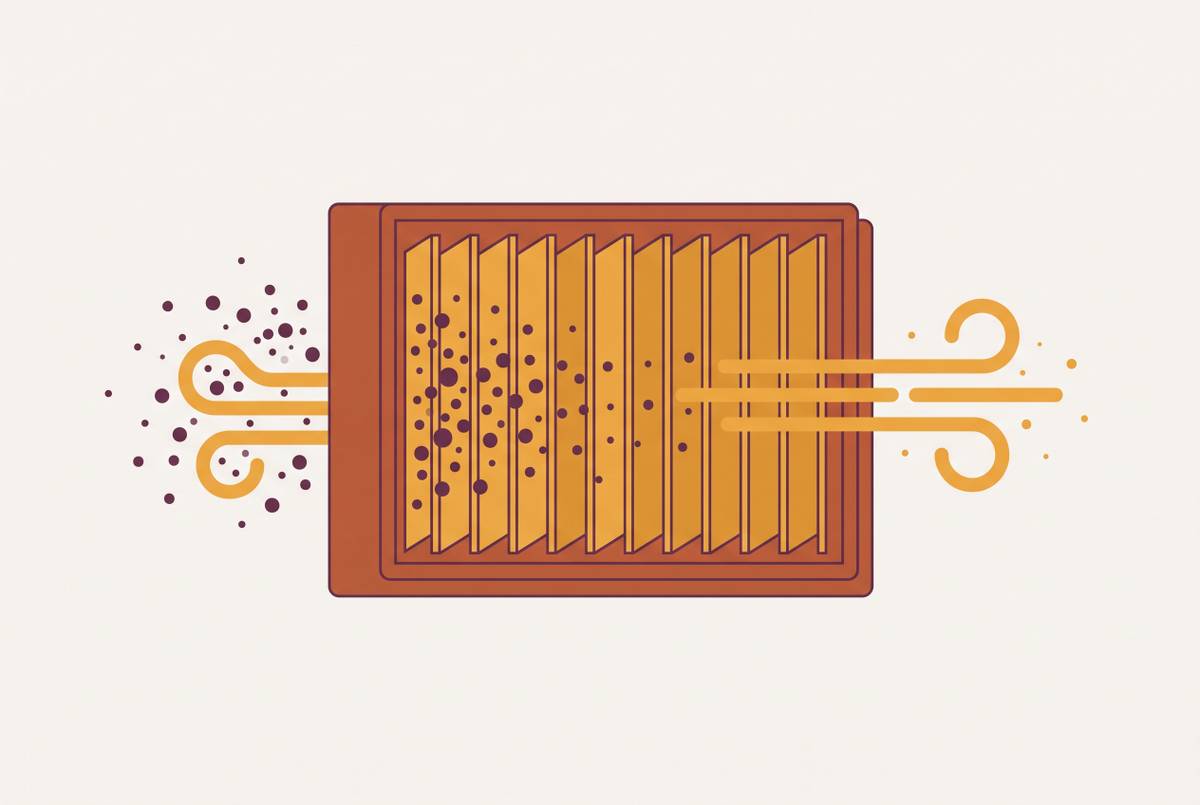
Pollen Load Inside Vehicles During Commuting Season
Your car's cabin can concentrate pollen to six times outdoor levels during high pollen season.

You get into the car, shut the door, and assume the worst is behind you. The yellow-dusted windshield says otherwise. The cabin is not a shelter from pollen season. It is a concentrated exposure environment, and the drive to work can be the highest-allergen part of your day.
Why the car interior becomes a concentrated pollen environment, not a shelter from it
Pollen enters the cabin through several pathways at once. The ventilation system pulls in outside air. Windows crack open at drive-throughs and stoplights. Every door opening carries particles in on clothing and shoes. A car parked outdoors through a spring night arrives at the morning commute already coated, and that exterior load moves inside with you.
Once pollen is in, it settles into surfaces that rarely get cleaned. Dashboards, seats, floor mats, vent housings. These collect the fine particles, then release them again every time the HVAC runs or a passenger shifts in their seat. The cabin becomes a small, enclosed space with a circulating load of allergen.
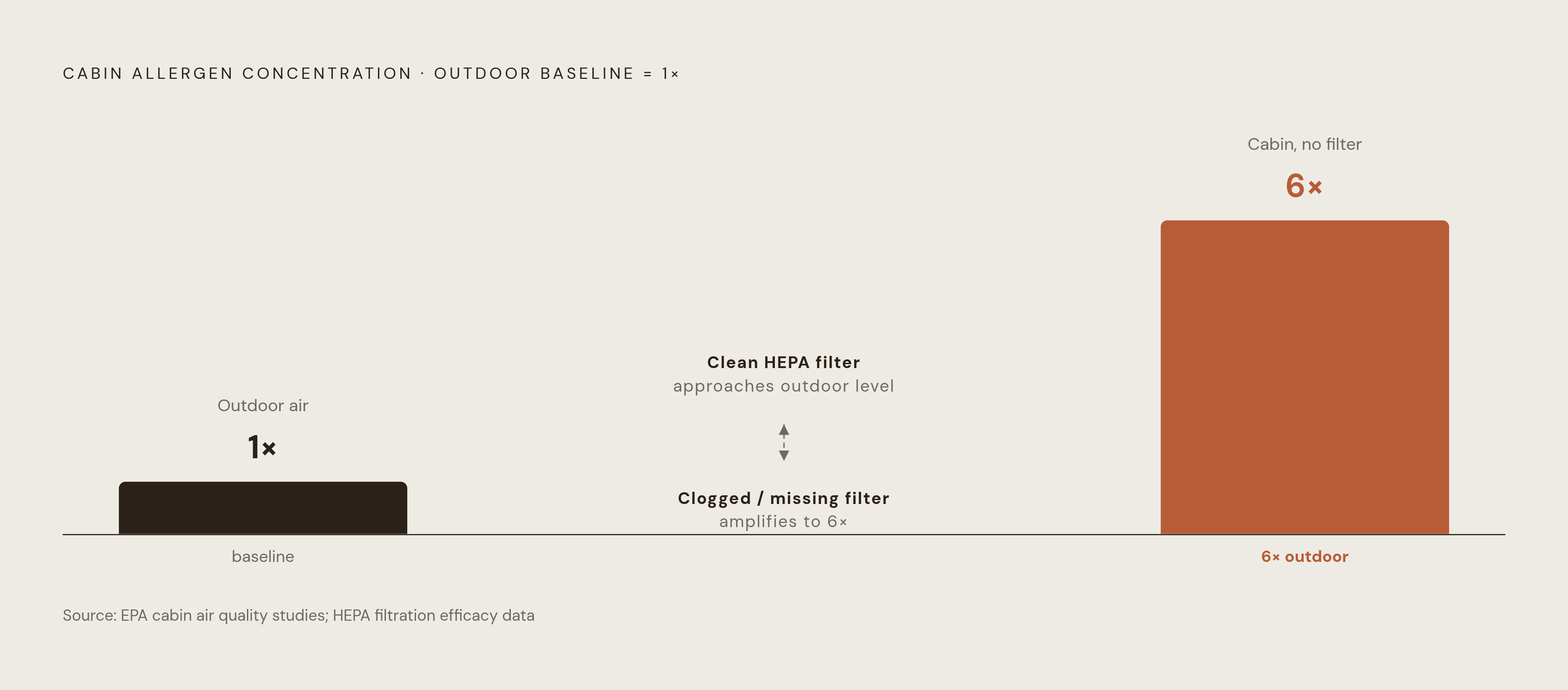
The result matters more than most commuters expect. Some studies suggest that, in certain conditions, allergen concentrations inside vehicles can reach up to six times outdoor levels when filters are not properly maintained. That makes the cabin a more intense exposure zone than the parking lot outside. The filter is the hinge point. When it works, the car cleans its air. When it fails, the car concentrates the problem.
What pollen is actually triggering symptoms inside the car — and what is just visible noise
The yellow film coating a car's exterior is mostly pine and conifer pollen. It is dramatic, it accumulates overnight, and it is largely not responsible for allergic symptoms. Washing pollen off the car's exterior is a paint-protection measure. The acidity in that residue can stain and corrode clear coat over time, so regular washing is worth doing, but it is not primarily an allergy-reduction strategy.
The allergens causing symptoms are invisible and already inside the cabin or entering through the ventilation system. Oak, birch, grass. These are microscopic airborne particles, not the heavy, visible grains sitting on the hood. The distinction matters because it redirects attention. Exterior cosmetics and interior air quality are two separate problems. One affects the paint. The other affects your sinuses. Inside the cabin, it is the fine particles the cabin air filter must intercept. Understanding that filter's job, and where it falls short, is what turns generic car-care advice into something that actually explains why your eyes itch by mile five.
How the ventilation system either intercepts or amplifies pollen exposure during a commute
Your cabin air filter is the one part that decides if the ventilation system cleans incoming air or delivers allergen-laden air directly to the driver's breathing zone. Sleep & Sinus Centers of Georgia describes the cabin filter as functioning like a security checkpoint: located behind the glove compartment or under the dashboard in most vehicles, it processes all air flowing through the heating, ventilation, and air conditioning system before it reaches the cabin. Filter type changes what gets through. Standard particle filters capture larger particles, which makes them adequate for heavy pine pollen but not for the fine airborne allergens that cause most symptoms. HEPA-rated cabin filters provide filtration comparable to hospital-grade HEPA standards, catching microscopic particles that standard filters pass through. Activated carbon filters add a layer of charcoal that traps not just particles but gases such as nitrogen dioxide and sulfur dioxide that can co-enter the cabin alongside pollen.
A clogged filter reverses the system's function. Instead of intercepting allergens, it allows them to accumulate and recirculate, pushing in-cabin concentrations above outdoor levels. The filter you ignored for a year is not neutral. It is actively working against you.
HVAC mode setting is the other variable. Recirculation mode cuts off the intake of outside air entirely, so fresh pollen is not drawn in. Fresh-air mode draws outside air continuously through the filter. That works well with a clean HEPA-rated filter, but becomes a liability with a clogged or low-grade one. Honda City's spring allergy guide says to switch to recirculate mode and keep windows and sunroofs closed, so outside air full of pollen stays out of the car. These are controls you already have, and they cost nothing to use.
Why commuting hours and parking patterns make the morning drive the highest-exposure window of the day
Outdoor pollen levels are usually highest in the morning, so a car parked outside collects pollen fast during that time. A car that has sat outside overnight arrives at the morning commute already coated. Each door opening during the highest-pollen period of the day draws that exterior load into the cabin.
Moisture makes it worse. Morning dew causes pollen to settle more firmly onto surfaces and become stickier. The exterior load is harder to displace, and more of it transfers inward on clothing and shoes. Tidal Wave Auto Spa confirms that pollen sticks more when moisture is present, which is precisely the condition of a dew-covered car at 7 AM. Light rain moves residue around rather than removing it, compounding the buildup.
Parking location matters more than most drivers realize. Vehicles parked near trees and grass accumulate pollen faster than those parked in garages or covered structures. Outdoor parking essentially guarantees the car enters each morning commute already loaded. And on peak pollen days, high-burden metros can see outdoor counts classified as extremely high by the National Allergy Bureau. At those levels, even a brief door-open or window-down moment gives you a meaningful allergen dose. The morning drive is not just a bad time for pollen. It is a specific convergence of timing, moisture, and accumulated load. These exposures are not spread evenly across the year.
How longer pollen seasons are extending the window of in-vehicle exposure beyond traditional spring
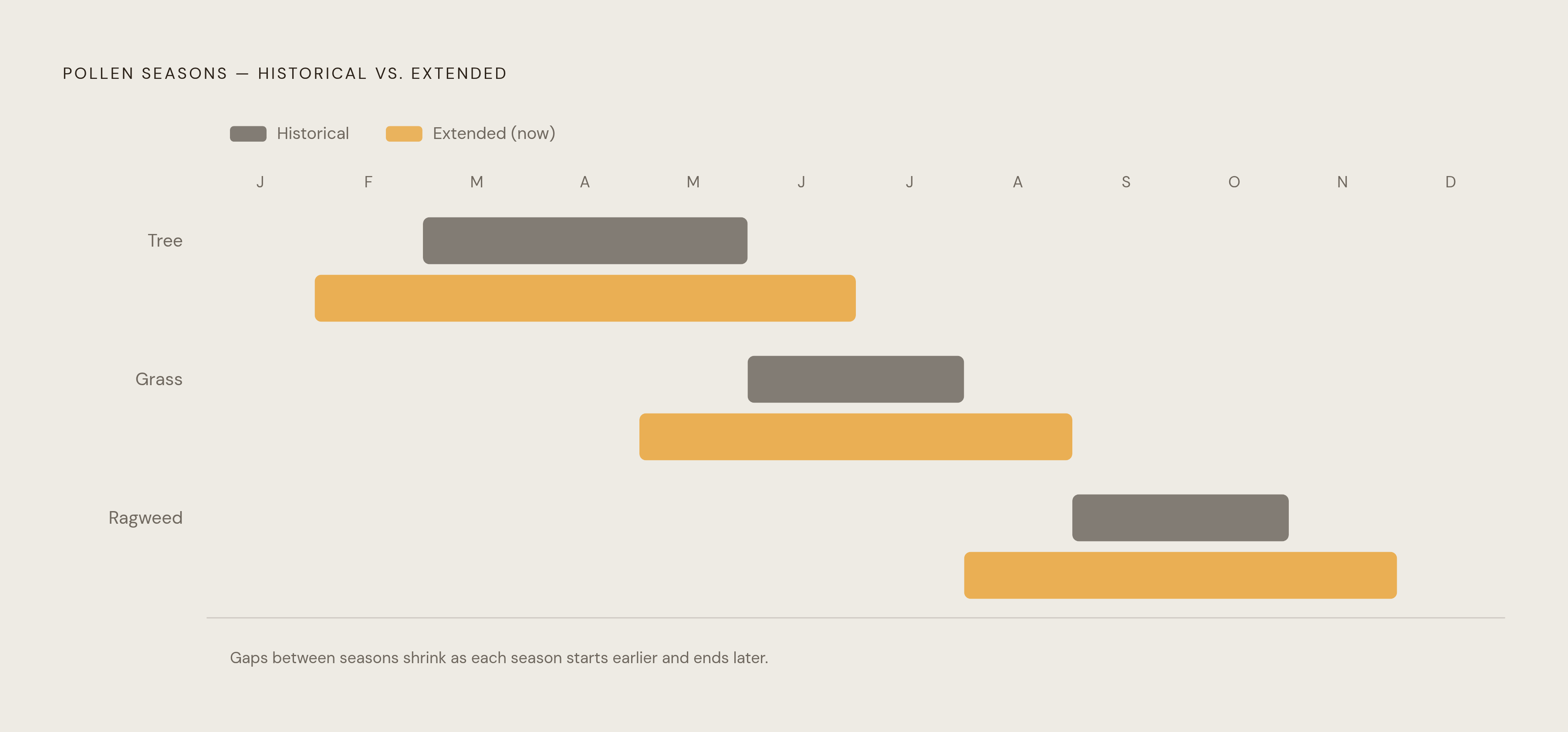
Pollen seasons in the United States are measurably longer than they were decades ago. For the commuter, that means the window of daily in-vehicle allergen exposure is expanding year over year. A problem that used to peak in April now runs deeper into summer and fall.
Higher carbon dioxide levels and warmer temperatures extend the growing season for trees and grasses. Plants are producing more pollen, and that pollen is more potent. Even if your drive route and habits stay the same, the allergen dose per commute is increasing. The same twenty-minute drive delivers more of the particles that trigger symptoms.
The seasonal structure is shifting, too. Tree pollen runs from March through May. Grass pollen follows from June through July. Ragweed arrives in the fall. Historically, these had natural gaps. Now they overlap or run longer than historical norms in many regions. The recovery windows between seasons that symptomatic commuters previously relied on are disappearing. Managing this as a spring problem is no longer accurate. It is becoming a near-year-round reality, and that changes the math on symptom accumulation.
What repeated daily in-vehicle pollen exposure does to how commuters feel, sleep, and think
The physical consequences of repeated allergen exposure during commuting extend well beyond sneezing. They affect sleep quality, cognitive function, and daily productivity in ways that most sufferers do not trace back to their allergy. The morning drive is not an isolated event. It is a daily reinforcement of the inflammatory load that drives these effects.
Allergic rhinitis has been linked with sleep disruption in both children and adults. Nasal inflammation caused by repeated pollen exposure contributes to sleep-disordered breathing. Poor sleep then compounds the cognitive and energy deficits, creating a cycle that runs from the morning commute through the workday and into the night. You wake up tired, drive through allergens, and arrive with a headache you blame on traffic.
Many sufferers do not recognize allergies as the root cause. Fatigue, brain fog, irritability, and difficulty concentrating are downstream effects, and they are typically attributed to other causes: a bad night, a long week, too much coffee or too little. That makes the commute's role invisible and the condition chronically unmanaged. Allergic rhinitis affects tens of millions of Americans annually, and many patients report cognitive fatigue and difficulty concentrating during peak allergy periods. The pattern is familiar to anyone who has spent a spring day squinting through a windshield. Managing the exposure environment matters, and it starts with the cabin itself.
Practical steps that actually reduce pollen exposure inside the vehicle cabin
Reducing in-cabin pollen exposure requires addressing the filter, the ventilation behavior, the parking environment, and the interior surfaces. Doing only one without the others leaves major pathways open. The most useful approach is a layered system, with each layer targeting a different entry or accumulation point.
The cabin air filter comes first. Replace it at the start of pollen season. A clogged filter actively worsens air quality by recirculating allergen-laden air. For allergy sufferers, a HEPA-rated filter is meaningfully better than a standard particle filter because it captures the microscopic airborne allergens that standard filters pass through. Oak, birch, grass. An activated carbon filter also protects against gases that enter alongside pollen, and that matters in urban commuting environments.
Then comes the ventilation behavior. Use recirculation mode on high-pollen days to stop drawing in fresh pollen-loaded outside air. Keep windows and sunroofs closed during the same period. Honda City's spring allergy guide recommends turning on the AC before driving so the filter can begin working before the commute starts. Pollen counts are typically highest between roughly 10 AM and 4 PM. Commuters who drive outside those hours may be able to open windows briefly without the same risk.
Parking and exterior management address the load before you even get in. Garage or covered parking is the most effective single behavioral change for reducing the pollen load a car carries into each morning commute. Parking away from trees and grass patches meaningfully reduces the rate at which exterior pollen accumulates overnight. If you wash the car at least weekly during peak season, you remove the exterior load before door-opens transfer it inside. Rinse with water rather than dry wiping. Tidal Wave Auto Spa confirms that dry wiping moves residue around rather than removing it, and that a full car wash is more effective than dry wiping.
Interior cleaning targets what has already settled. Vacuuming seats, floor mats, and dashboard surfaces removes settled pollen that becomes re-aerosolized during the drive. Compressed air in vents clears pollen that would otherwise be blown directly into the breathing zone when the HVAC runs. Wiping surfaces with a damp microfiber cloth rather than dry dusting prevents particle redistribution into the cabin air. None of these steps alone solves the problem, but together they cut the dose significantly.
Why managing the car environment treats the exposure but not the underlying immune response
Every practical cabin-management step reduces the amount of pollen a commuter inhales. That is genuinely useful. But none of them changes how the immune system responds when pollen is encountered. Symptoms continue as long as the sensitization does, regardless of filter upgrades. You can sit in a spotless cabin with a fresh HEPA filter and still react to the pollen that finds its way in.
Antihistamines and nasal sprays address the downstream symptoms of that immune response: histamine release, nasal inflammation. They work only while the medication is active. They create no durable change after stopping, and they do nothing to reduce the immune system's reactivity to the next exposure. First-generation antihistamines carry a particular problem for commuters. Drowsiness is a documented effect, creating a direct safety concern for people who take them before a morning drive and then sit in an enclosed space with elevated allergen levels that will keep triggering the response anyway.
Allergen-specific immunotherapy works differently. It administers increasing amounts of the specific allergen to gradually achieve desensitization. The goal is reducing the immune system's overreaction to natural pollen exposure rather than suppressing its response after the fact. In sublingual immunotherapy, known as SLIT, the allergen is captured by antigen-presenting cells within the oral mucosa, which has fewer mast cells than subcutaneous tissue. Because the dose per administration is lower, systemic allergic reactions are rare. That is why it is approved for at-home use in many countries, where the first dose is typically administered under medical supervision.
The evidence behind SLIT is substantial. Clinical trials show meaningful reductions in symptoms and rescue medication use with grass and house dust mite SLIT tablets. Sustained benefits hold up to one to two years after completing a three-year treatment course. Real-world cohort data also reports a lower risk of new asthma onset and lower long-term medication use following SLIT. This is where the conversation shifts from exposure management to immune retraining.
How at-home sublingual immunotherapy fits the reality of a commuter's life better than weekly clinic visits
The core barrier to immunotherapy for working commuters has historically been schedule, not conviction. Allergy shots, known formally as subcutaneous immunotherapy or SCIT, require in-office administration under medical supervision. That means clinic visits that recur during working hours over a multi-year course. For someone whose day is already structured around a commute, that is a difficult commitment to sustain.
SLIT eliminates the clinic-visit requirement. Drops or tablets are taken at home. The treatment integrates into a morning routine rather than competing with one. That is a meaningful adherence advantage for people whose daily schedule is already stretched. Because patients are more likely to complete a multi-year immunotherapy course when it does not require regular travel to a clinic, the convenience difference translates directly into treatment completion rates. And a completed course is what produces the sustained, post-treatment benefit that clinical trials document.
FDA-approved SLIT tablets are available in the United States for certain grasses, ragweed, and dust mites. Multi-allergen custom SLIT drops are used off-label with guideline support and are often accessible through telehealth-based allergy care plans. The commuter who can manage a morning routine and a video call can access root-cause treatment without rearranging their life around clinic hours. The car, the filter, the parking spot: these reduce the dose. Retraining the immune response is what ends the cycle.